


Quick Answer: What Is a Shanmen?
A shanmen (山门, shānmén), literally a mountain gate, is the entrance to a Chinese Buddhist temple or monastery. It may be a roofed gatehouse that leads into the first courtyard. Its place at the edge of the compound gives it that role.[1][2][3]
- Position: Look for the gateway between the approach and the temple grounds.[1][3]
- Structure: A roofed gate can contain a passage and side spaces.[1][2]
- Setting: A courtyard or another gateway may come before the main worship hall.[2][3]
The entrance can carry a Buddhist meaning as well as directing movement through the compound.[1][4]
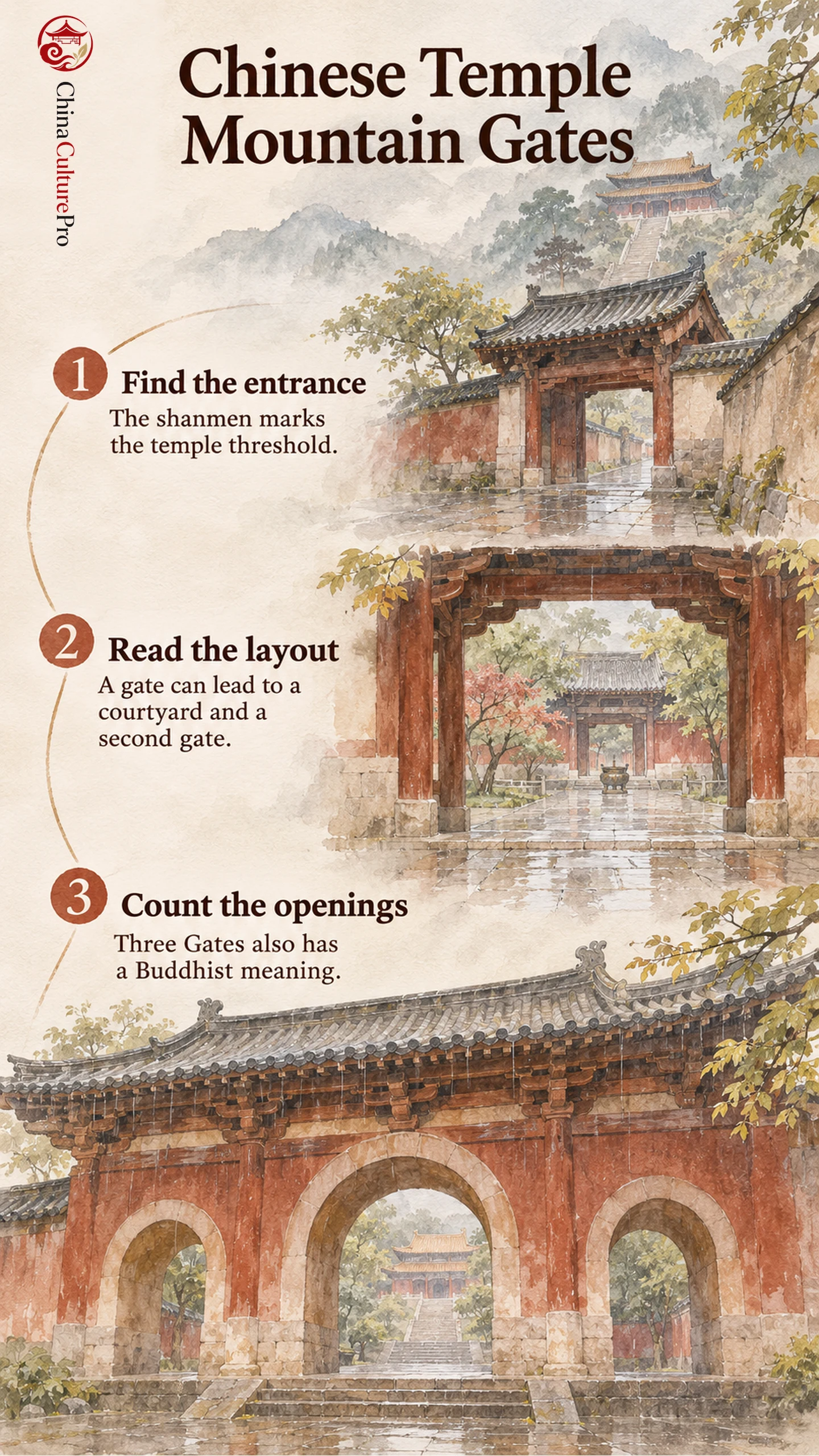
Read the first gate with the buildings behind it. The sequence tells you which opening marks entry and which leads farther into the temple.[2][3]
What a Buddhist Mountain Gate Does
A gate marks the transition from the approach into the precinct. A timber gatehouse can place its passage in a central bay while the roof extends over the side bays. A bay is an interval in the structural grid. The number of bays describes the framing and can differ from the number of open doorways.[1][2]
Some gate buildings also house guardian figures. Tianjin’s description of Dule Temple lists the paired guardians among its Liao sculptures. The entrance brings the figures into view at the threshold, while the temple’s major devotional image stands farther inside, in the Guanyin Pavilion.[2]
Why It Is Also Called the Three Gates
A Buddhist name for a temple entrance is Three Gates (三门, sānmén). A Song-period Buddhist compendium, the Shishi Yaolan, associates the name with three approaches to liberation: emptiness, signlessness and wishlessness. The compendium explicitly recognizes temples with one physical entrance under the same name.[4]
Three visible openings can give the name an architectural expression. The text also preserves its meaning when the physical plan has just one opening. Count the actual entrances when describing a building, and use the religious meaning when interpreting the name.[1][4]
Two Temple Entrances and What Lies Beyond Them
Dule Temple in Tianjin was rebuilt in 984 during the Liao dynasty. Its gatehouse has a hipped roof and stands before the Guanyin Pavilion, the taller building housing the temple’s famous sculpture. The gate marks the threshold before the larger pavilion comes into view.[1][2]
At Zhihua Temple in Beijing, the heritage survey places the outer mountain gate at the south end of the central axis. Inside the first court, bell and drum towers face one another across the axis. Beyond those towers, the separate Zhihua Gate leads toward the main halls. This example shows how Chinese architecture can use successive gateways to organize a temple precinct.[3]
FAQs About Chinese Temple Mountain Gates
Does a mountain gate have to be on a mountain?
The name is used for temple entrances in urban settings too. Zhihua Temple’s mountain gate is part of a courtyard layout in Beijing.[3]
Does every shanmen have guardian figures?
Guardian figures occur at some temple gateways. Identify the sculpture at the individual building from its record, as at Dule Temple.[1][2]
Is the outer gate also the main worship hall?
At Dule and Zhihua, the outer entrance and the principal hall stand at different points in the compound.[2][3]
Sumber
[1] Buddhist Studies Network. Chinese Buddhist Architecture from the Tenth to the Thirteenth Century
[2] Tianjin Municipal Bureau of Culture and Tourism. Dule Temple and Its Gate
[3] Beijing Municipal Cultural Heritage Bureau. Architectural Structure and Style of Zhihua Temple
[4] Shishi Yaolan, volume 1. Temple Gateways, CBETA Text