
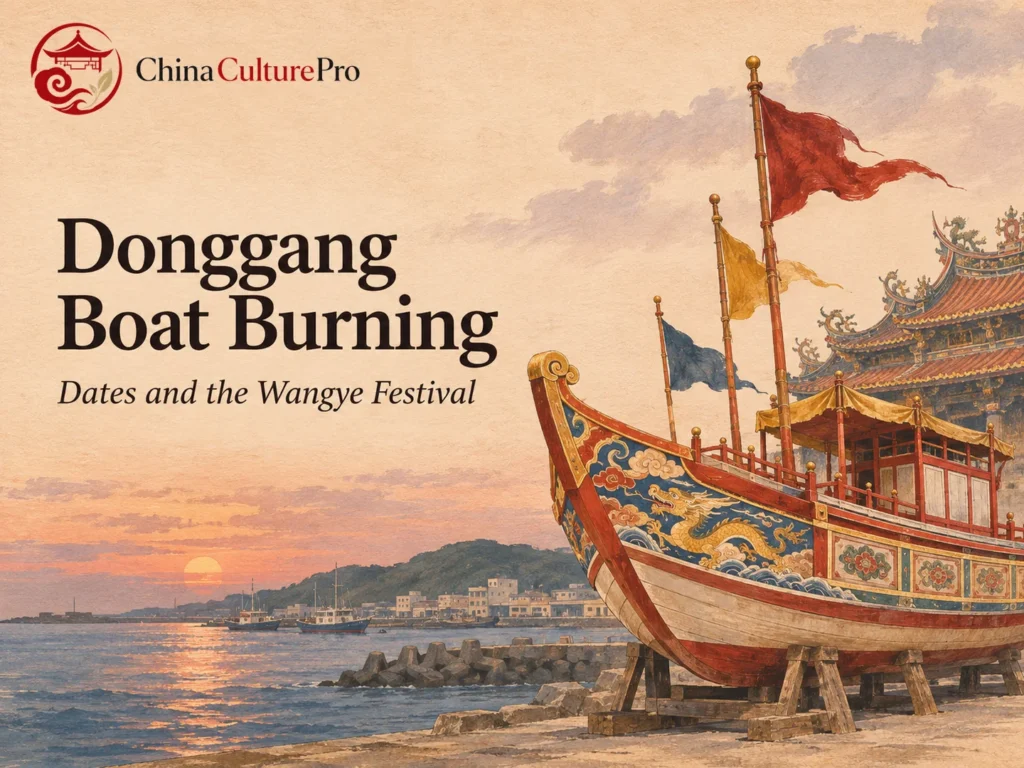

Quick Answer: When Is the Donggang Boat Burning?
The Donggang Wangye Festival (東港迎王平安祭典, Dōnggǎng Yíngwáng Píng’ān Jìdiǎn) takes place every three years in Pingtung, Taiwan. Donglong Temple (東隆宮, Dōnglóng Gōng) determines the dates by divination. The burning of the King Boat (王船, wángchuán) is the final send-off in a festival of eight days and seven nights. [1][2]
- Timing: In 2024 the festival ran from September 28 to October 5, crossing from the eighth lunar month into the ninth. [3][4]
- Local meaning: The send-off symbolizes carrying away misfortune and seeking peace for the town. [1][2]
- Annual calendar: The temple announces the dates for each edition. Look for its schedule of the eight days. [1][3]
Look for the temple’s entry for the send-off. In the 2024 schedule, the boat went through town on October 4 and the farewell was listed for the early hours of October 5. [3]

At the opening of the festival, a delegation goes to the shore to welcome the Wangye deities (王爺, Wángyé). At the end, the ceremonial boat goes to the shore for their departure. Between those two events, the ritual moves through the streets and neighborhoods of Donggang. [1][3][5]
How Donglong Temple Sets the Festival Dates
The usual season is around the ninth lunar month. The temple consults the deities using divination blocks to determine the actual dates. In 2024 the opening fell on lunar month eight, day 26, while the closing fell on lunar month nine, day three. The next edition in the three-year cycle would be in 2027. Its specific dates depend on the temple’s announcement. [1][3][4]
The 2024 schedule separated the boat’s procession through town on October 4 from the send-off in the early hours of October 5. Organizers canceled two other neighborhood processions because of a typhoon, while carrying out the planned temple rites. The typhoon affected the scheduled neighborhood rounds. The temple kept the send-off on the October 5 program. [3][6]
What the Boat Carries Away
In Donggang tradition the Wangye travel as divine emissaries. Their visit is associated with protection from epidemics and other misfortunes. Temple descriptions say that people place provisions aboard for the deities’ symbolic voyage. Offering supplies is a way of treating the visitors as guests. [1][2]
At the closing rite, the boat is burned in a ceremonial farewell. In local accounts it carries away the dangers that the visiting deities have gathered. The festival name emphasizes peace and well-being for the community. [1][2][3]
How the Town Welcomes the Wangye
The welcome at the shore opens the public observance. The Wangye are received and installed at a temporary ritual seat. Processions then visit parts of Donggang, where households and associations help receive the deities. In 2024 the temple scheduled separate rounds for the north, south, center and farming districts. [1][3][5]
Donggang’s neighborhood associations and the temple’s palanquin group share duties. The Ministry of the Interior describes a gathering after one festival in which responsibilities for the next are assigned. Making the boat and preparing performance troupes bring local craft and religious practice together well before the send-off. [1]
FAQs About Donggang’s Boat-Burning Festival
Is Donggang’s boat burning an annual event?
Donglong Temple’s major welcoming festival follows a three-year cycle. Other communities can hold similar rites on their own schedules. [1][2]
Does the UNESCO Wangchuan listing cover Donggang?
The UNESCO entry for Ong Chun, Wangchuan and Wangkang covers coastal communities in southern Fujian and Chinese communities in Melaka. Donggang’s festival is recorded in Taiwan’s own heritage system. [1][7]
Sources
[1] Taiwan Ministry of the Interior. Welcoming Donggang Wangye Deities Ceremony
[2] Taiwan Tourism Administration. Donglong Temple
[3] Donglong Temple. 2024 Donggang Wangye Festival Dates
[4] Gongxing Hall. 2024 Donggang Wangye Schedule
[5] Central News Agency. Donggang Welcomes the Wangye Deities
[6] Central News Agency. Two Donggang Processions Canceled in 2024
[7] UNESCO. Ong Chun/Wangchuan/Wangkang Ceremony