
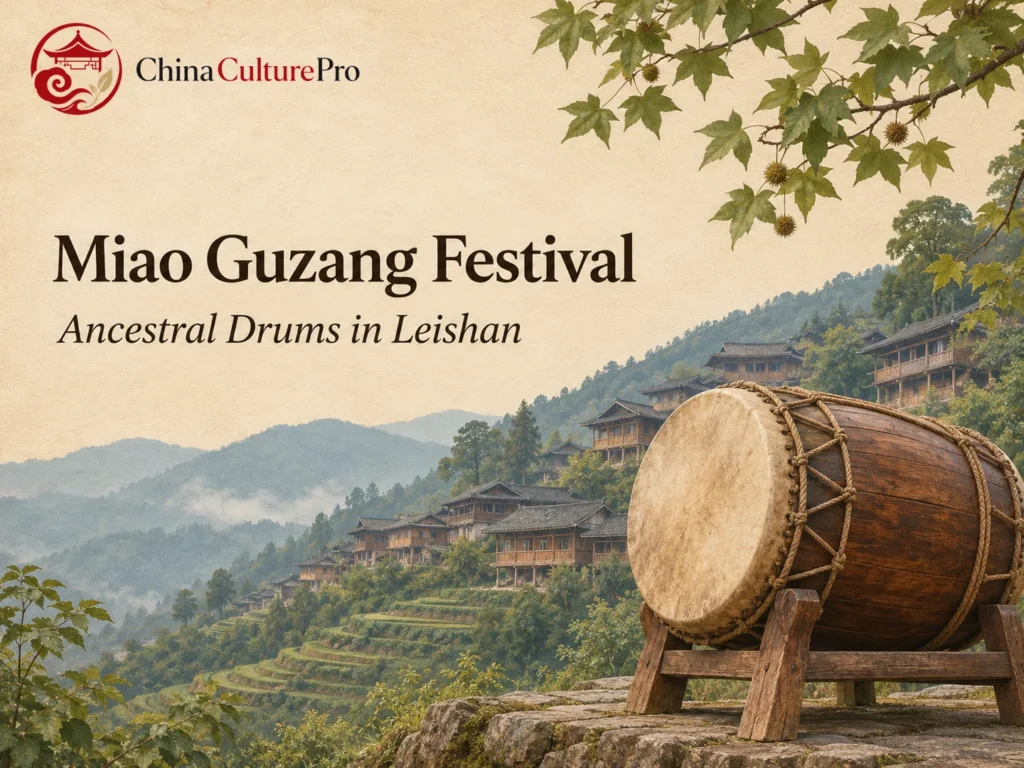

Quick Answer: What Is the Miao Guzang Festival?
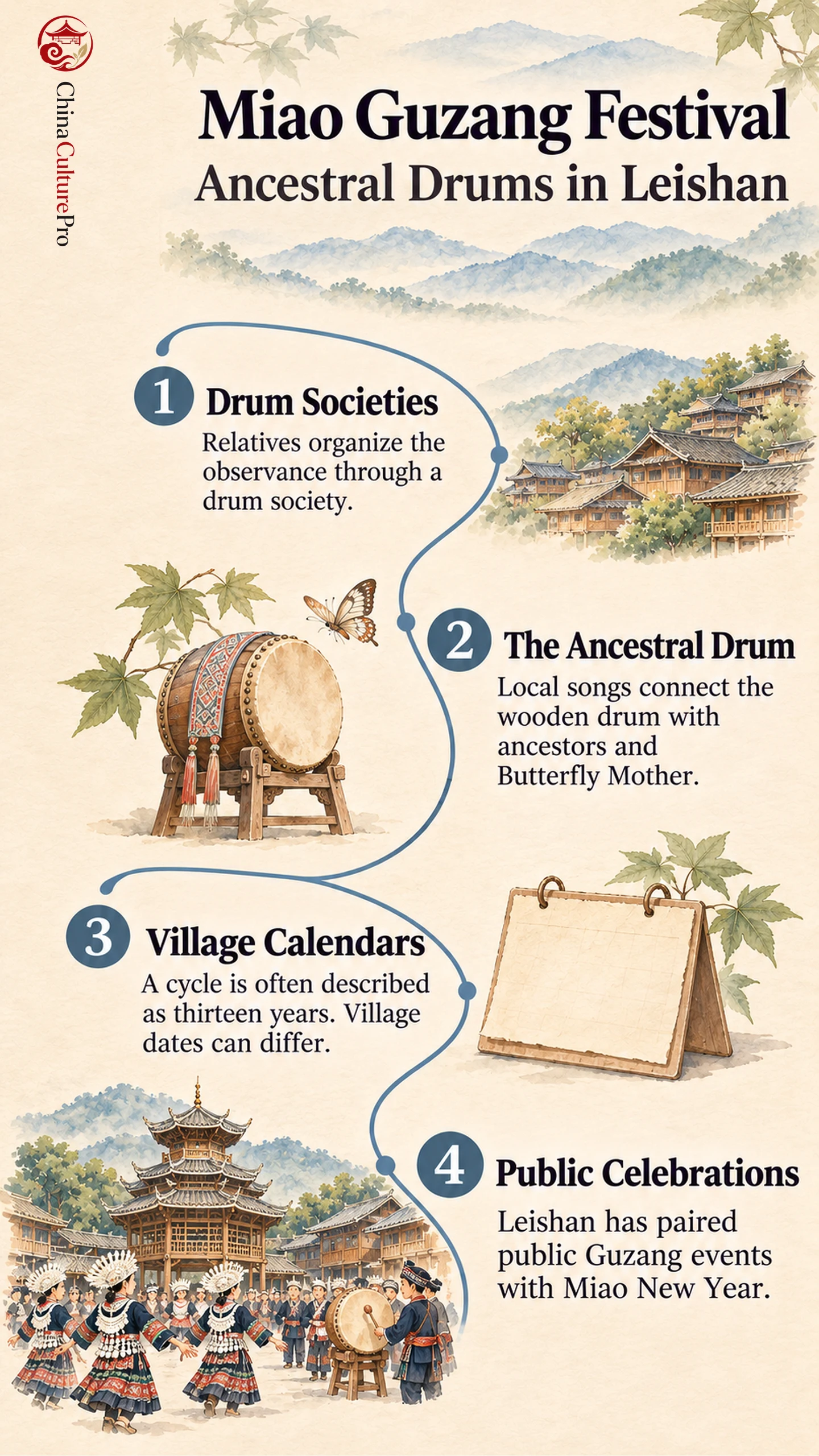
The Guzang Festival (鼓藏节, gǔzàng jié) in Leishan County, Guizhou, is a Miao ancestral observance organized through kinship-based drum societies (鼓社, gǔshè). The society’s ancestral wooden drum is the focus of the rites. China’s national heritage inventory listed the Leishan tradition in 2006. [1][2]
- Who organizes it: A drum society has a locally chosen festival head (鼓藏头, gǔzàngtóu).
- Why the drum matters: The heritage account connects the wooden drum with ancestors and a Miao origin story.
- When it happens: The major local cycle is often described as 13 years. Villages schedule their own observances. [1][2][3]
Leishan has held public events combining Guzang programming with Miao New Year celebrations. A shared programme can bring people together while village and lineage observances follow their own calendars. [2][3]
In November 2023, Leishan County held a public celebration with parades, heritage displays and a shared banquet. That month, residents of Huangli village in Xijiang Town also held a 13-day Guzang observance. The dates put a countywide programme alongside a longer village gathering. [2][3]
The Drum Society and Its Responsibilities
The national heritage record describes the drum society as an organization formed around descent and place. A drum represents ancestral ties shared by participants. Members choose a festival head to organize the observance. In Huangli, a village festival head interviewed in 2023 emphasized relatives visiting each other and the chance for families to get to know one another. [1][2]
A gathering can bring relatives who do not see each other often back to the same village. Host families make room for visits and meals as part of the observance. For the wider languages, clothing and regional diversity of these communities, see the Miao culture overview. [1][2]
Why the Ancestral Drum Is Central
The heritage inventory recounts a story from the Miao Ancient Songs (苗族古歌, miáozú gǔgē). In that account Jiangyang (姜央, jiāngyāng), an ancestral figure, holds the festival to honor Butterfly Mother (蝴蝶妈妈, húdié māma). The story traces Butterfly Mother to a sweetgum tree. The wood of such a tree is associated with the drum as a resting place for ancestors. [1][2]
The song explains why the drum can embody a family’s relationship to its ancestors. Labels such as waking the drum and welcoming the drum identify ritual occasions in the official record. The names mark stages in the society’s observance and concern the ancestral drum itself. [1][2]
What a Twelve- or Thirteen-Year Cycle Means in Leishan
The heritage inventory describes a 12-year recurrence and records observances that unfolded over several years. A regional oral-history account describes a 13th year by inclusive reckoning, with stages such as waking, receiving and storing the drum in successive years. A Guizhou Daily report quotes local sources describing a 13-year cycle for many present-day observances. The descriptions also distinguish the longer ritual sequence from the duration of a public or village celebration. [1][2][4]
In 2023, some Leishan villages started in mid-November and the latest observance extended into December. Huangli’s festivities concluded on 30 November. A news report on the county’s public opening gives 16 November. Treat each date as a record of the particular village or county event. The heritage inventory records a separate Guzang tradition for the Duliu River area, with Rongjiang as a representative place. [2][3][5]
How Guzang Relates to Miao New Year and Lusheng Festivities
Leishan’s 2023 public event shared a programme with Miao New Year. It included heritage and music demonstrations, yet the ancestral drum and the kinship group give Guzang its own purpose. A lusheng (芦笙, lúshēng), a reed-pipe instrument, may accompany community celebrations. The Miao Lusheng Festival guide explains gatherings in which that instrument and its music are foregrounded. [1][2][3]
The Guizhou culture guide places Leishan and other festivals within the province’s broader regional traditions. In Leishan, first identify whether a description concerns a drum society’s observance, a village celebration or a county event. These can overlap on the calendar and bring together different participants. [1][2][3]
FAQs About the Miao Guzang Festival
Does every village in Leishan celebrate Guzang at the same time?
No. Reporting from 2023 gives different start and end dates by village. Drum societies work with their own customary calendars. [2]
Is Guzang the same festival as Miao New Year?
They have separate traditions. Leishan presented them in a combined public programme in 2023, while Guzang’s ancestral rites continued on village schedules. [1][2][3]
Why is there more than one English spelling?
Guzang and Gǔzàng are the same Mandarin name written without and with tone marks. The Chinese heritage listing for Leishan uses 鼓藏节. Other local and published accounts also write 牯藏节. [1][4]
Sources
[1] China Intangible Cultural Heritage Protection Center. Miao Guzang Festival, Leishan County
[2] Guizhou Daily. Leishan Guzang Festival: A Miao Cultural Gathering
[3] Xinhua. Leishan Celebrates Miao New Year and Guzang
[4] Intangible Cultural Heritage Net. Miao Guzang Festival in Leishan County, Guizhou
[5] China Intangible Cultural Heritage Protection Center. Miao Guzang Festival, Rongjiang County