


Quick Answer: What Is the Difference Between Mandopop and Cantopop?
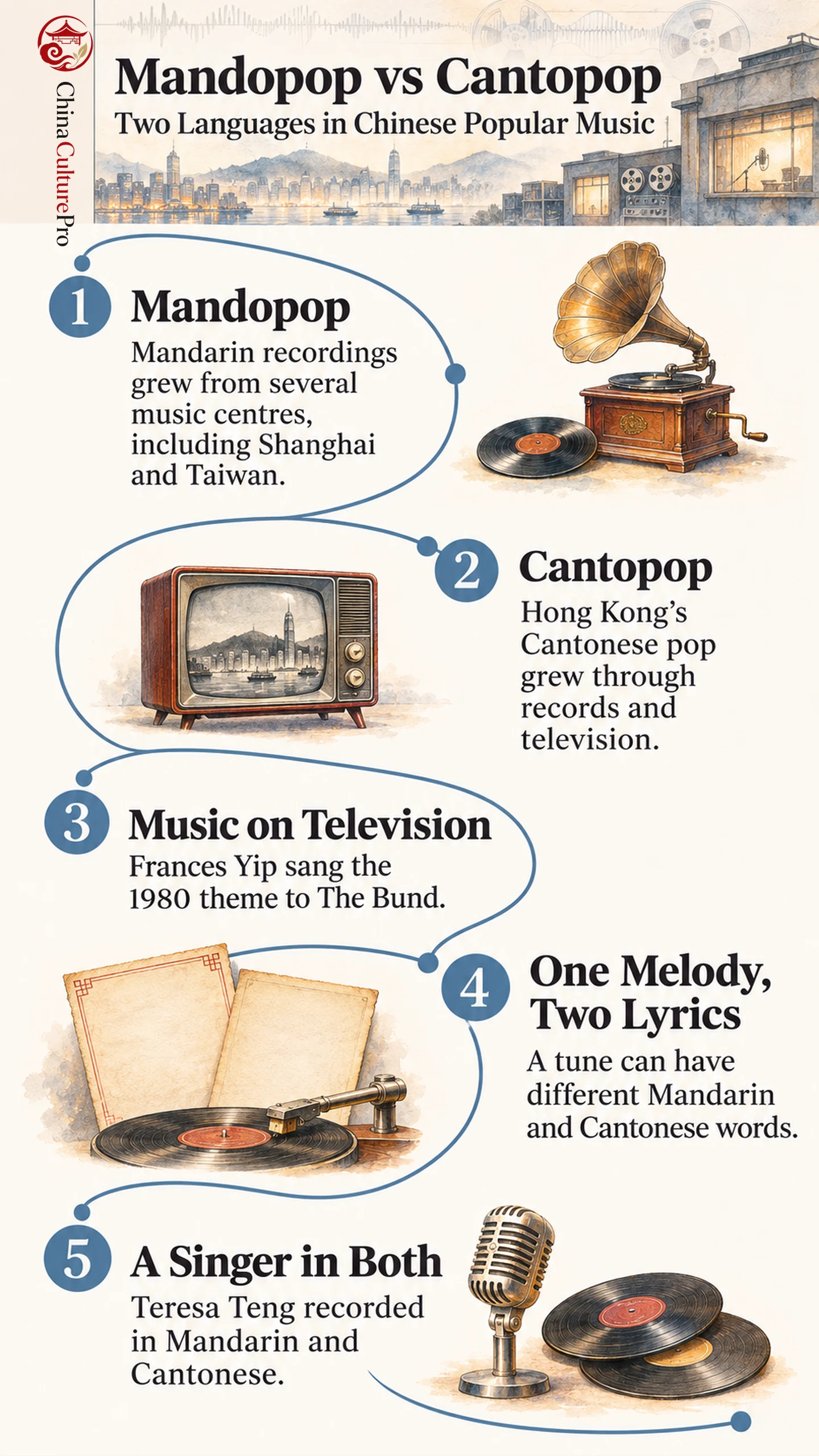
Mandopop (华语流行音乐, huáyǔ liúxíng yīnyuè) refers here to popular music sung in Mandarin. Cantopop (粤语流行音乐, yuèyǔ liúxíng yīnyuè) refers to popular music sung in Cantonese. Mandarin and Cantonese recordings can circulate in the same markets and come from the same performers.[1][3][5]
- Mandarin-language popular music has roots in Shanghai’s early recording scene. Taiwan later became a major centre for Mandopop.[1]
- Hong Kong’s local television and recording businesses helped shape Cantopop in the 1970s.[2][3]
- Some artists have recorded songs in both languages, and some melodies have separate Mandarin and Cantonese lyrics.[5][8]
For a particular recording, start with the language you hear. The performer’s career tells a wider story.
Two tracks on a Teresa Teng compilation can sound familiar to the same listener while belonging to different language traditions. That overlap helps explain why comparing these labels involves both the language of a recording and the history of the industry that brought it to listeners.
How Their Recording Histories Took Shape
Mandarin popular song has antecedents in the urban music culture of 1920s Shanghai. Taiwan later became an important centre for making and circulating Mandarin-language pop. Taiwan’s music industry also influenced producers and listeners in mainland China.[1] That history runs across several places, and the language is what ties those productions together as Mandopop.
Hong Kong’s early local market included Cantonese opera and English-language pop. In the early 1970s, Sam Hui brought contemporary local subjects into Cantonese songs with a rock influence. Leslie Cheung and Anita Mui became prominent in the following years.[2] Pop in both languages forms part of Chinese popular culture. Each label includes artists with differing sounds, from quieter ballads to more rhythm-driven songs.
Why Television Mattered to Cantopop
Competition among Hong Kong television channels gave local Cantonese drama theme songs an audience. A tune could become familiar through repeated episodes, giving the performers and the record business a connection to the drama’s viewers.[3]
Frances Yip sang the theme to The Bund, a 1980 Hong Kong series. Its composer Joseph Koo and lyricist James Wong worked with Yip on Cantonese songs, and the theme remained associated with her career.[6] Television was also a training ground for filmmakers in the Hong Kong New Wave. In both cases, the medium gave artists a way to reach local audiences regularly. For another example of television carrying popular music to a large audience, see the Spring Festival Gala.
What the Language Changes in a Song
Pitch can help distinguish words in both Mandarin and Cantonese. Research on Cantonese songwriting finds that successive tone targets and musical notes often move in a similar direction.[7] That tendency gives a writer a reason to pay attention to how a line sounds as well as what it says.
Some Cantonese and Mandarin versions share a melody and use different words. The second lyric can have its own subject and point of view.[8] To compare versions, listen for the melodic phrase they keep and the way the words land on it in each recording.
Two Recordings by One Singer
Teresa Teng is widely associated with Mandarin recordings such as The Moon Represents My Heart. Its use as the title of a New York museum exhibition shows the music’s place in the lives and memories of overseas listeners.[4] Those listening histories are one part of Chinese diaspora culture.
Her compilation also lists Forget Him as a Cantonese recording.[5] These two titles give a comparison within one singer’s repertoire. Her voice remains the point of comparison while the sung language changes.
FAQs About Mandopop and Cantopop
Can one singer be associated with both genres?
Yes. Teresa Teng is known for Mandarin songs and also recorded in Cantonese.[4][5]
Is The Bund theme Mandopop because it is about Shanghai?
The original Hong Kong television theme sung by Frances Yip is Cantopop. The setting of a drama does not determine the language of its theme song.[6]
Can a song have both versions?
Yes. Recordings can share a melody and have distinct Mandarin and Cantonese lyrics.[8]
Sources
[1] Marc L. Moskowitz. Cries of Joy, Songs of Sorrow
[2] Hong Kong Heritage Museum. Rediscover Heritage 101: HKPOP Music
[3] Yat-wai Joseph Wong. Television as the Arena of Shaping a Music Genre
[4] Museum of Chinese in America. Teresa Teng Tian Mi Mi
[5] Universal Music Taiwan. Teresa Teng Greatest Hits Vol. 3
[6] Tai Kwun. Frances Yip in Conversation with Robert Chua
[7] Wing-see Ho, University of Hong Kong. A Phonological Study of the Tone-Melody Correspondence in Cantonese Pop Music
[8] Johnson Leow. Alter-Centring Cantopop: One Melody, Two Lyrics