


Quick Answer: How Do You Look Up Someone in CBDB?
Start with the China Biographical Database’s access page. Search a known Chinese name, spelling or alias, compare the results, then save the selected person’s ID and the source of the claim you are researching. The documentation also describes a standalone database for more detailed work.[1][2][3]
- Identity: Compare written names, aliases and dynasty before selecting a record.[3]
- Dates: Read the index year together with its type. The value was designed to place a person in time for analysis.[2][3]
- Evidence: Check what source underlies a fact such as a name, office or relationship.[3]
The illustrated example below follows the project’s CBDB Browser guide. The online query tools offer another route to the records, and their screens and access options differ.[1][3]
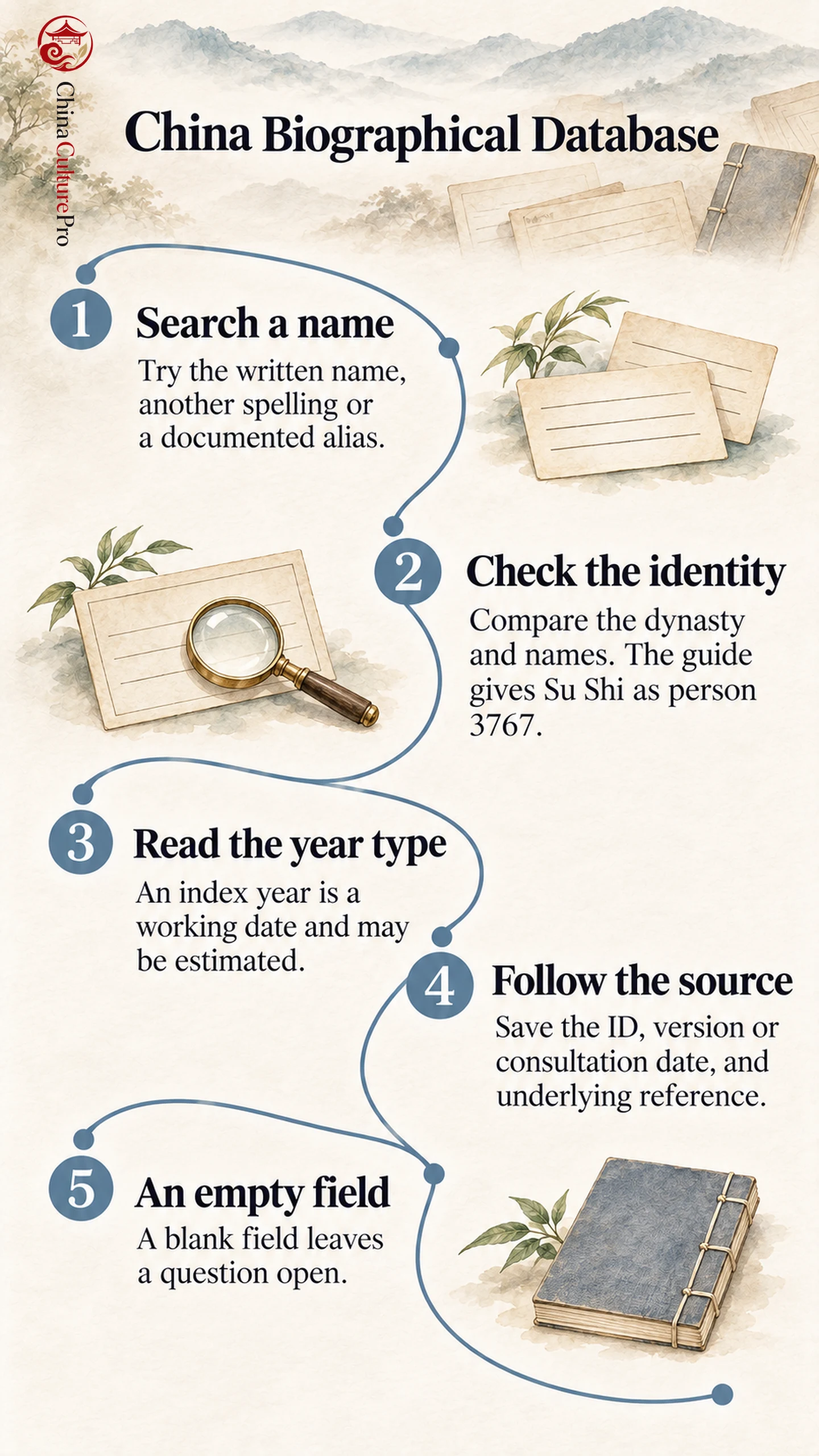
A historical figure can appear under a family name, a courtesy name and a literary name. Matching a string is only the first part of finding the right person. The China Biographical Database helps you match those names to a record, then check the dates and sources behind what it says.
How to Find and Verify a Person in CBDB
1. Search a name and a documented alias
Enter the Chinese name or romanisation in the relevant search field. If the first search misses, try a traditional or simplified spelling and any known alternate name. For example, Su Shi (蘇軾, Sū Shì) also appears as Su Dongpo (蘇東坡, Sū Dōngpō). The desktop guide shows a search for 東坡 returning multiple records.[3][4]
2. Compare the entries and keep the person ID
Open results that share the name and compare the written form, alternate names and dynasty. In the guide’s example, the Su Dongpo result opens the written name 蘇軾 and Person ID 3767. A recorded alias and that ID give you a way to return to the same person when another query gives a similar-looking result.[3]
3. Read the year type and follow the source
Read the index-year value with the field that describes how it was derived. Then look through the linked or listed sources for the specific claim you need. Record the person ID, database version or date consulted, and the source reference. Follow that reference if you need evidence for a publication.[2][3]
Why the Index Year Needs Context
The supporting documents define the index year as a birth year or the project’s best estimate for analysis. The Browser example displays 1036 for the Su Shi entry and labels its type as based on birth year. The Library of Congress catalogue for a collection of his works gives his lifespan as 1037–1101. Preserve the values with their sources and check the chronology or date convention before citing a birth year.[2][3][4]
The database connects people with other recorded entities, including places, offices and social relationships. Its coverage reflects available sources and the scope of data entry, so a blank field leaves a question open. Use the profile to locate evidence, then return to the relevant record, text or catalogue for the question you are asking. It is one tool for studying Chinese culture and checking information about Chinese historical figures.[3][5]
FAQs About the China Biographical Database
What if several people share the same name?
Compare aliases, the period and other documented details such as office or place. Record the ID only after you have matched enough details to identify the person you mean.[3]
Is the CBDB index year always a confirmed birth year?
No. It is a working year for analysis and can be estimated. Check the index-year type and the underlying source before treating it as biographical evidence.[2][3]
Sources
[1] Harvard University and CBDB Project. Accessing CBDB Online
[2] China Biographical Database Project. Supporting Documents and Index-Year Rules
[3] China Biographical Database Project. CBDB User’s Guide, 2026
[4] Library of Congress. Collection of Su Dongpo, Volume 1
[5] Harvard University Digital Humanities. China Biographical Database Project