

Quick Answer: What Is Chingay?
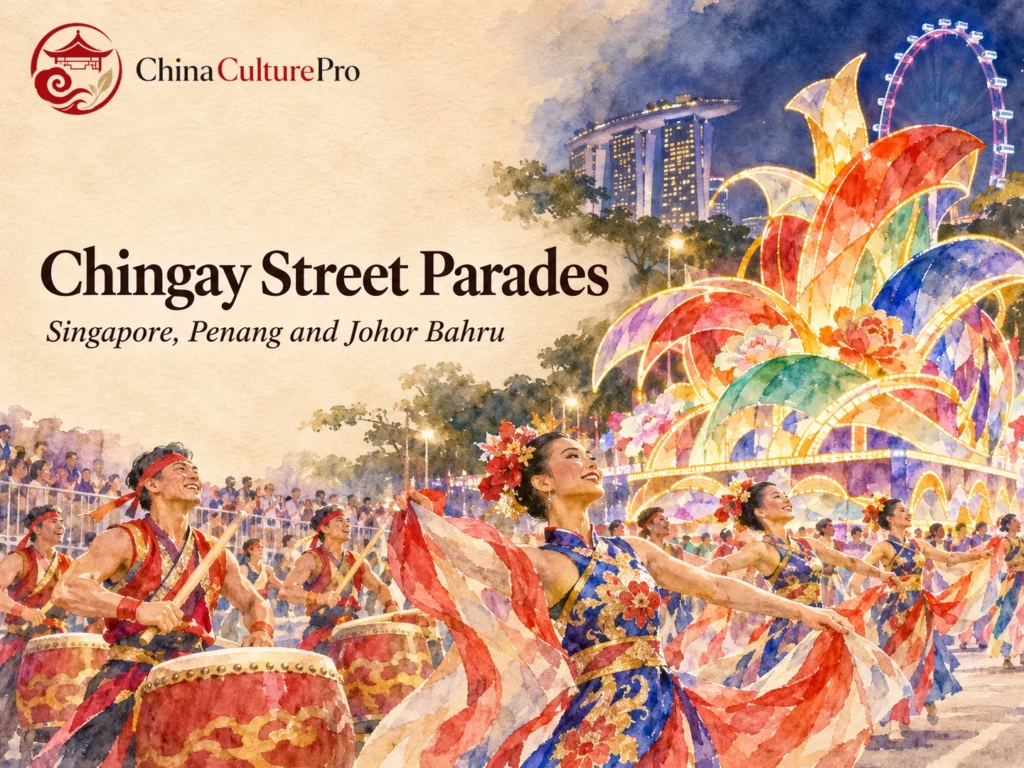
Chingay (妆艺, zhuāngyì) is a street parade tradition with distinct forms in Singapore and Malaysia. Singapore’s annual parade grew from Chinese New Year festivities into a multicultural event. Penang is known for balancing giant flags, and Johor Bahru’s procession centers on its Old Chinese Temple. [1][2][3][4]
- Singapore: Costumed groups and floats take part around Chinese New Year. [1][2]
- Penang: Acrobatic flag performances feature in a civic parade in George Town. [3][4]
- Johor Bahru: The night procession brings five Chinese communities together to honor the temple’s deities. [3][4][5]
Each city sets its own schedule. Johor Bahru follows a traditional lunar date, while organizers announce the other parades’ dates.
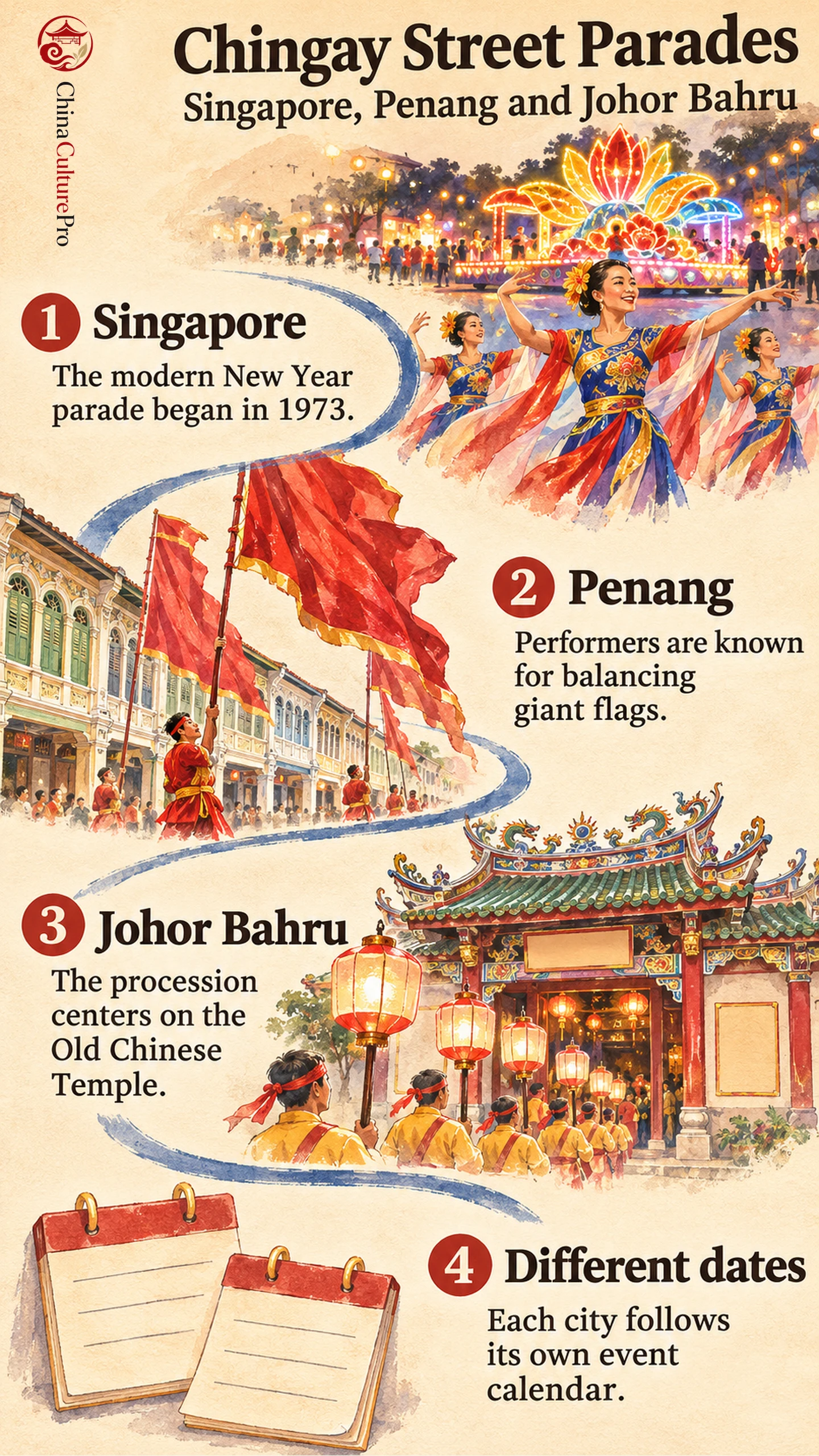
In George Town, tall flags rise above the shophouses. In Singapore, lights pick out floats and dancers. The name Chingay fits both scenes and also belongs to a procession that carries temple deities through Johor Bahru. [1][3][4][5]
How Singapore’s Chingay Parade Began
Singapore’s first modern Chingay parade took place on February 4, 1973. After the 1972 firecracker ban, the People’s Association and Singapore National Pugilistic Federation organized a new street event to bring sound and movement back to the holiday. The program included street opera in local Chinese languages, martial arts and lion and dragon dances. [1][2]
By 1976, performers from other ethnic communities had joined. Singapore moved the parade to Orchard Road in 1985 and held its first night parade in 1990. Elaborate costumes and large floats remained a visible part of the event as its participation and program broadened. The parade is now one part of the wider New Year season in Singapore and Malaysia. [1][2][6]
How Penang and Johor Bahru Celebrate
Penang’s parade tradition has roots in temple and public processions. A history published by Singapore’s National Library Board identifies the December 1862 reopening of Kong Hock Keong temple as a likely early example. Newspaper reports describe costumed figures on platforms among the banners and musicians. Today’s George Town civic parade is known for performers who balance large flagpoles, alongside other groups on the route. Malaysia’s heritage overview places that civic parade in December. [3][4][5]
Johor Bahru’s night procession belongs to a cycle of ceremonies at the Old Chinese Temple. Hokkien, Teochew, Cantonese, Hakka and Hainanese communities take part. Malaysia’s heritage overview links the procession to the temple’s five deities. The National Library Board describes the festival cycle as days 20 through 22 of the first lunar month. The joint heritage nomination identifies day 21 as the annual procession date. [3][4][5]
When to Look for Each Parade
In Singapore, the annual parade usually takes place on a weekend during the New Year season. Its dates are announced for each edition. The event’s moves from Orchard Road to other venues are another reason to look up the year and location together. [1][6]
| Lieu | Timing to look for | Distinctive feature |
|---|---|---|
| Singapore | A scheduled weekend around Chinese New Year | Large floats and performances from multiple communities. [1][2] |
| George Town, Penang | A civic parade typically listed in December | Giant flag balancing. [4][5] |
| Johor Bahru | Day 21 of lunar month one within a longer festival cycle | Old Chinese Temple deity procession. [3][4][5] |
Check the named city and organizer when reading a Chingay event notice. A Penang listing may refer to the civic flag parade or to a temple procession with its own occasion. In Johor Bahru, the Old Chinese Temple program distinguishes the night procession from the ceremonies around it. [3][4][5]
FAQs About Chingay
What does Chingay mean?
Singapore’s organizer explains it as a Hokkien term associated with the art of costume and masquerade. Historical descriptions also apply the word to costumed figures displayed on moving platforms. [1][3]
Is every Chingay a Chinese New Year parade?
Singapore’s modern event began as a Chinese New Year parade. Malaysia’s heritage descriptions include temple-centered observances and a Penang civic parade commonly listed in December. [1][3][4][5]
Sources
[1] Singapore People’s Association. The Chingay Story
[2] Singapore National Heritage Board. Chingay
[3] Singapore National Library Board, BiblioAsia. Chingay in the 19th and 20th Centuries
[4] Malaysia National Heritage Department. Chingay
[5] Singapore People’s Association. Joint Nomination for UNESCO
[6] Singapore People’s Association. The Chingay Timeline