


Quick Answer: How Has Television Review Changed in China?
In mainland China, content review has shaped how television drama (电视剧, diànshìjù) reaches viewers. Rules issued in 2010 and revised in 2016 set out review and licensing for television drama. A 2022 notice set out distribution licensing and review arrangements for categories of domestic online drama (网络剧, wǎngluòjù) and related productions.[2][3]
- Broadcast: Television rules address production, distribution and airing.[2]
- Streaming: Online releases also have forms of pre-release review.[3]
- Versions: A licensing record identifies a decision about distribution.[2][4]
The relevant record depends on the date and medium of the release.
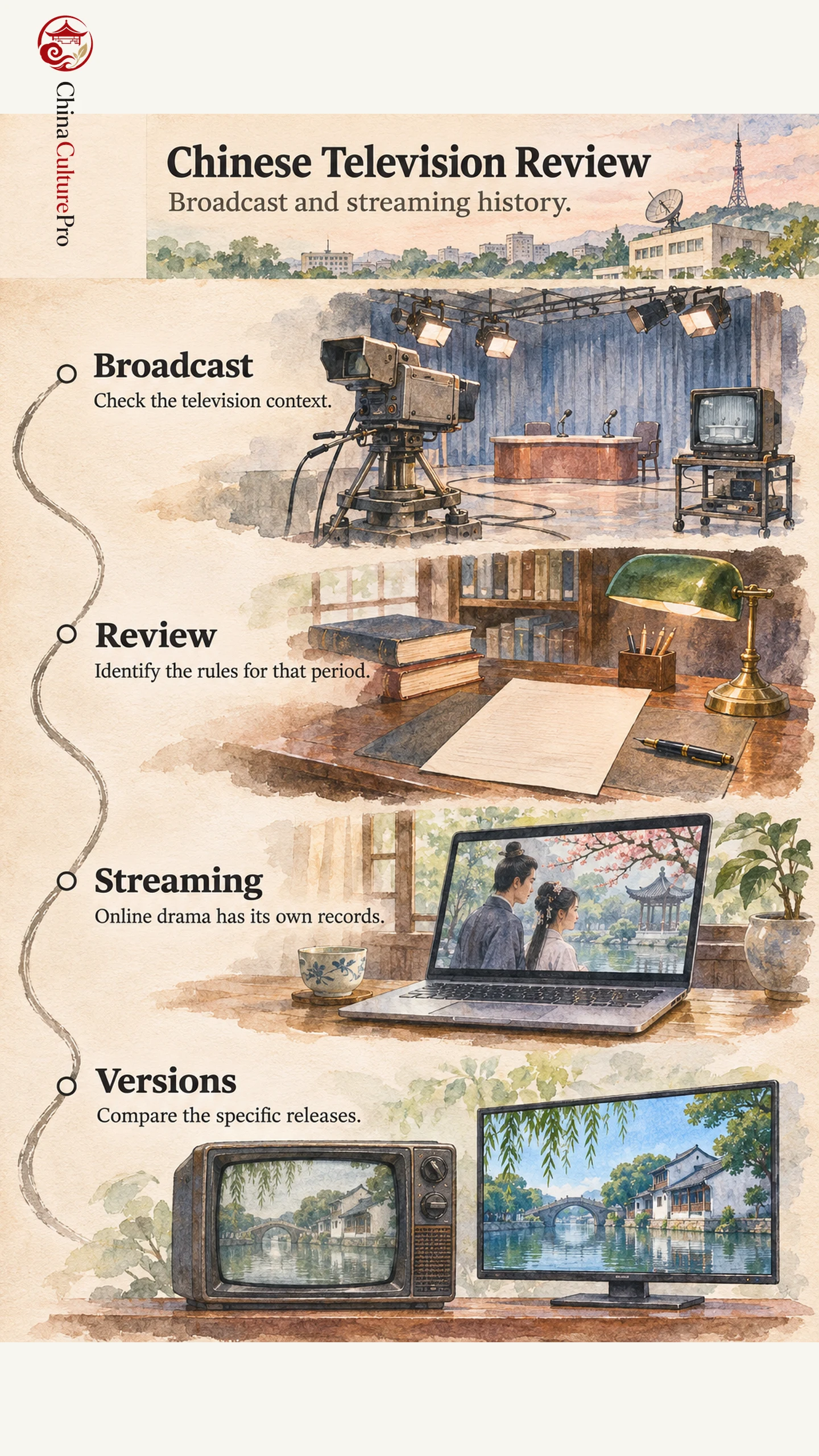
A television drama can appear first on a broadcaster, on an online platform or in another territory. A viewer trying to explain a difference between versions needs to know which release is at issue and which rules applied to it.[2][3]
The Television Industry Before Streaming
Chinese television drama developed in an institutional setting that changed considerably after the start of regular television production. Industry histories distinguish early production organized largely through public institutions from a period of stronger commercial competition beginning in the 1990s. Commercial competition shaped programming alongside formal oversight of distribution and broadcast.[1][2]
These changes also shaped Chinese reality television, although the rules discussed here concern drama. A talent contest and a scripted serial are different programme categories.
What the Television Drama Rules Cover
The 2010 content management provisions, amended in 2016, distinguish domestic, co-produced and imported dramas in their defined scope. The rules describe review before distribution and requirements for broadcasters. A distribution license (发行许可证, fāxíng xǔkězhèng) identifies authorization for distribution under the applicable framework.[2]
The provisions also address changes to approved details such as title, main plot or length. Authorization and a broadcaster’s actual scheduling decision can therefore answer different questions about the history of a series.[2]
How Online Drama Review Developed
The 2022 notice describes licensing for designated key domestic online productions and platform review for other productions within its scope. It covers categories beyond series, including online films and animations. A notice issued in October 2026 lists distribution licensing for domestic television and online dramas in that year’s third quarter. That is a dated example of the regulator publishing records.[3][4]
What an Edited Version Can Establish
A difference in runtime or dialogue establishes that two releases differ. Other evidence is needed to attribute that change to a particular review decision. A title in a licensing list supplies one piece of evidence. For a story discrepancy, compare the source work and production credits as well. The guide to Chinese palace dramas and history explains how to check a different kind of claim about a scene.[2][3][4]
FAQs About Chinese Television Censorship
Are Streaming Dramas Reviewed Too?
Yes. The 2022 notice distinguishes official licensing for key domestic online productions from pre-release review by services in other cases it covers.[3]
Does a Distribution License Guarantee Broadcast?
A license authorizes distribution in the relevant framework. A broadcaster or platform also makes decisions about scheduling and release.[2][3]
Does Every Missing Scene Reflect Censorship?
A missing scene shows a difference between editions. Establishing its cause requires evidence about the production, distributor or review decision.
Sources
[1] Michael Keane. Television Drama in China: Remaking the Market
[2] National Radio and Television Administration. Provisions on television drama content management
[3] National Radio and Television Administration. Notice on domestic online drama and film distribution licensing
[4] National Radio and Television Administration. Third-quarter domestic television and online drama licensing notice