


Quick Answer: What Did Chinese Astronomers Record?
Chinese astronomers recorded unfamiliar lights that appeared among known stars. A guest star (客星, kèxīng) was a historical description. Modern astronomers have connected some of these accounts with the remains of stellar explosions. The best-known example is the 1054 event that produced the Crab Nebula.[1][4][5]
- 185 CE: A brief Chinese account is often linked to the remnant RCW 86.[1][2]
- 1054 CE: The records describe a bright object that was visible in daylight. It is linked to the Crab Nebula.[4][5]
- 1181 CE: Chinese and Japanese accounts help place the event near the remnant now known as Pa 30.[6]
An old report records what was seen. Identifying the physical event requires comparison with evidence available today.[1][4][6]
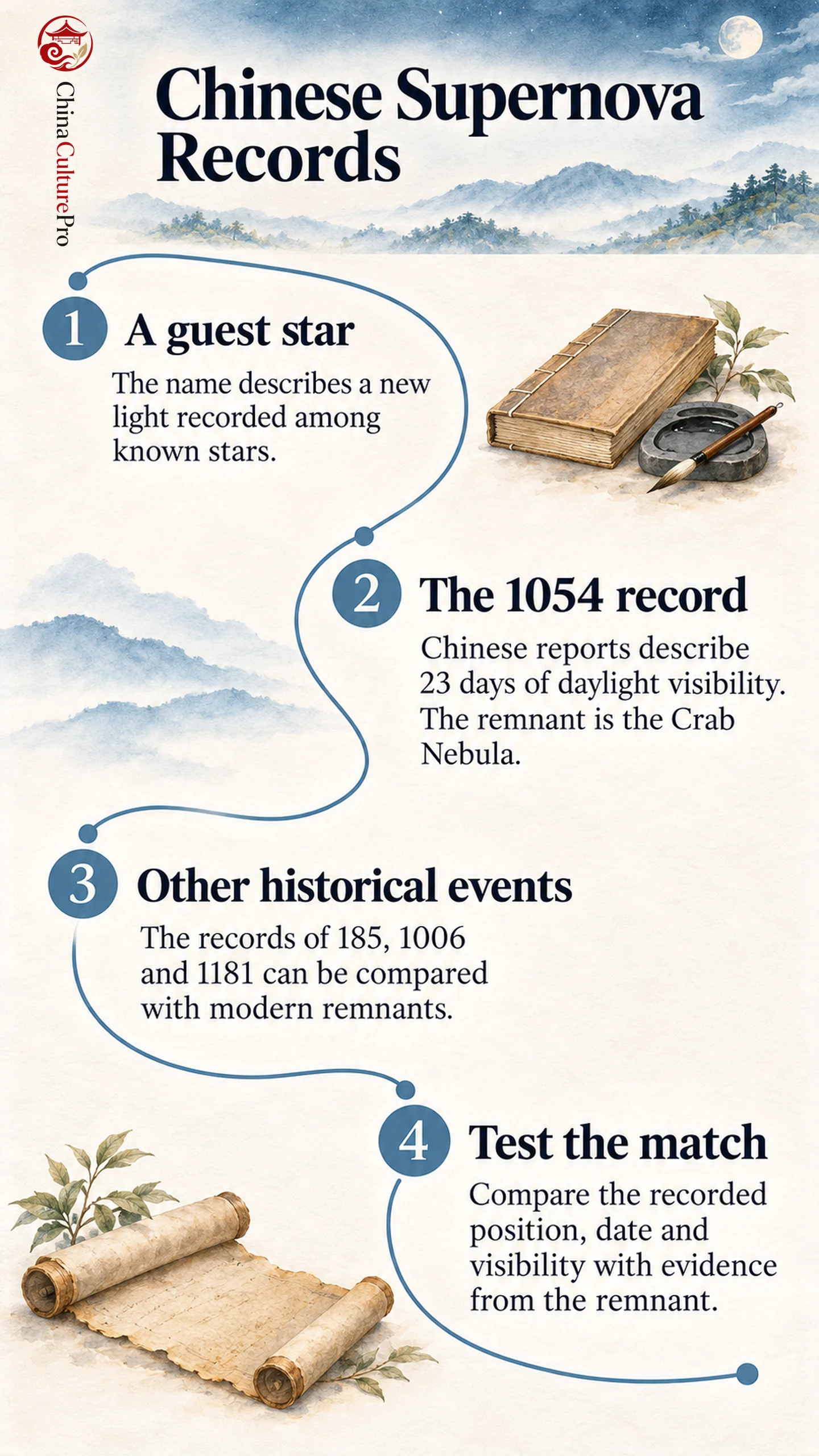
A Chinese chronicle can describe a new point of light without explaining what caused it. Modern astronomers can observe material still expanding in the reported region. A persuasive match brings the written date, the historical position and the physics of the remnant together.[1][4][5][6]
What “Guest Star” Meant in Chinese Records
A guest star was a visitor to a sky whose familiar star groups already had names. The term describes the appearance of something new. Duration, reported movement and position give researchers further clues to its nature. Some reports are brief enough that several interpretations remain possible.[1][3]
The position was often described in relation to a known grouping. To convert that description into a modern search area, researchers first need to identify the historical reference stars and account for possible differences among surviving versions of the record. The system is easier to follow with the guides to Chinese star maps and the twenty-eight lunar mansions.[1][4][6]
How the 1054 Record Connects to the Crab Nebula
Chinese records place a guest star in a region near the modern star Zeta Tauri. A scholarly reconstruction reports that the new light was visible in daylight for 23 days and continued to be reported until 1056. The daylight figure describes the exceptionally bright early part of the event.[4]
The Crab Nebula is the expanding material left by the explosion. The historical position and the time implied by the remnant’s expansion helped establish the connection. Small differences among the recorded directions are part of the history of the identification. They do not need to be smoothed into one perfectly exact ancient coordinate.[4][5]
The case shows why a sustained record matters. The dates distinguish the beginning of the appearance, the interval of daylight visibility and the later disappearance. Each tells researchers something different about how the object brightened or faded.[4][5]
What the Records of 185, 1006 and 1181 Add
In 185 CE, an early Chinese record describes a new star in Nanmen (南门, Nánmén), an asterism whose name means Southern Gate. Astronomers commonly associate it with RCW 86. The historical notice is short. Its date and reported region can support a proposed match without supplying the detail found in the 1054 sources.[1][2][4]
The 1006 event was exceptionally bright. Accounts survive from several parts of the world, giving researchers independent descriptions of the same appearance. A comparison of these records helps constrain when it appeared and how bright it looked. Modern observations identify the remains as the shell catalogued as SN 1006.[3][7]
For 1181, reports from China and Japan have helped narrow the part of the sky to investigate. Recent studies associate the event with Pa 30. The identification illustrates how returning to the historical wording can sharpen the comparison with a modern object.[6]
How Astronomers Match Old Reports to Remnants
The first question is where the observers placed the object. The next is whether a modern remnant in that region has a physical age consistent with the written record. Researchers also compare how long the light lasted and how bright it was said to be. A candidate can agree with one clue and disagree with others.[1][3][4][6]
Chronicles also have their own history. An event may survive in a compilation written later, and an English translation may need to convert the original calendar and identify an old star name. This is where the tools of Chinese historical source reading overlap with those of Chinese astronomy.[1][4][6]
FAQs About Chinese Supernova Records
Was every Chinese guest star a supernova?
A guest star was a new light described in the records. Classifying a particular appearance requires more evidence, such as its position, duration, movement or association with a remnant.[1][3][6]
How long was the 1054 guest star visible?
The Chinese evidence is commonly read as 23 days of daylight visibility. Later reports place its final disappearance in 1056.[4]
Is Pa 30 the same remnant as 3C 58?
They are separate objects. Earlier work proposed 3C 58 for the 1181 event. More recent studies combining the historical directions with observations of Pa 30 favor the latter identification.[6]
Sources
[1] Richard Stephenson and David A. Green. Sources of Historical Records of Galactic Supernovae
[2] NASA Astronomy Picture of the Day. RCW 86: Historical Supernova Remnant
[3] F. Richard Stephenson. SN 1006 and Other Historical Supernovae
[4] Vistas in Astronomy. A Re-evaluation of the Eastern and Western Records of the Supernova of 1054
[5] NASA Science. Crab Nebula
[6] Monthly Notices of the Royal Astronomical Society. From the 1181 Observations to the Pa 30 Identification
[7] Chandra X-ray Observatory. SN 1006: A Thousand-Year-Old Supernova Remnant