

Quick Answer: Which Chinese Kitchen Utensils Do What?
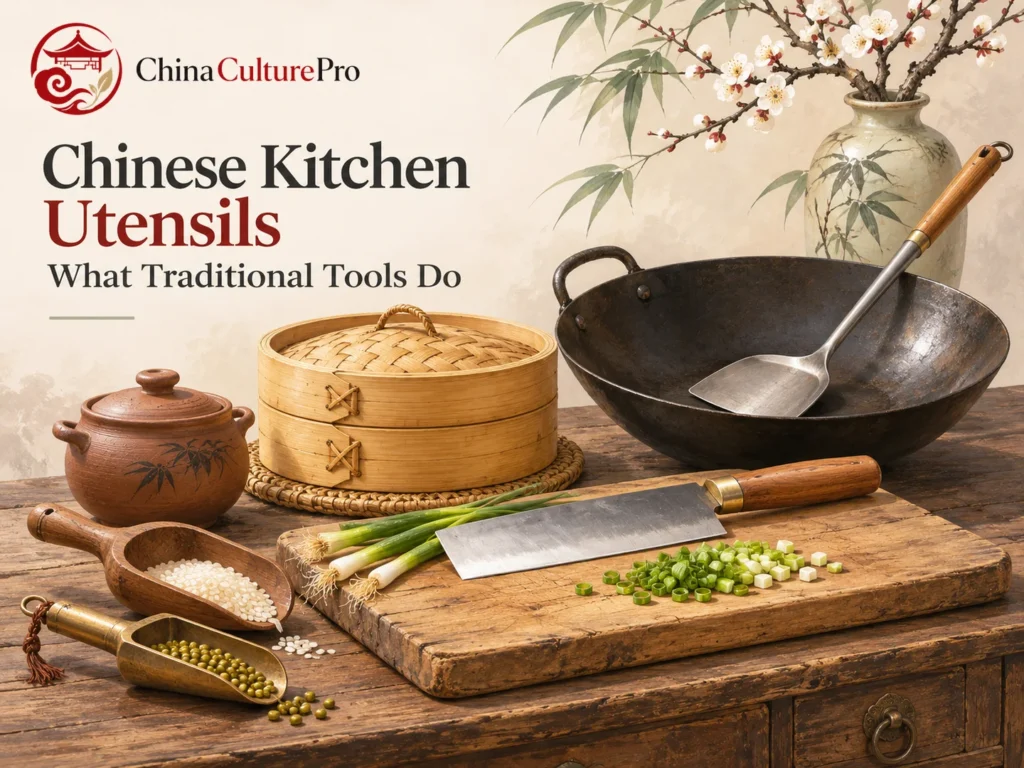
Traditional Chinese kitchen utensils are easiest to recognize by the jobs they do. A rectangular cai dao (菜刀, càidāo) slices and scoops ingredients off a board. A spatula turns food in the wok. A bamboo steamer (蒸笼, zhēnglóng) holds food over boiling water. [1][2][3]
- Prep: Choose a thin Chinese slicer for vegetables and boneless meat, and a stable board with space to collect the cut pieces. [1][2]
- Cook: Use a wok and spatula to toss, a lidded steamer to cook over rising vapor, or a covered clay pot for dishes cooked slowly. [1][3]
- Transfer: A ladle carries liquid. A perforated or woven scoop lifts noodles or dumplings while the water drains away. [1][4]
The most useful tool depends on how the food needs to move, drain or retain heat.

A wide blade can carry a pile of chopped scallions, and two scoops beside the stove can have opposite jobs. Read the width and shape of each tool before assuming that a familiar English name explains it.
Chinese Kitchen Utensils by Task
| Outil | À observer | Common job |
|---|---|---|
| Rectangular slicer and cutting board | A wide blade face, with a thinner edge on a slicer. [1][2] | Slice, chop or mince vegetables and boneless meat, then lift the prepared ingredients. [1][2] |
| Wok and wok spatula | Curved pan and a broad turning tool. [1][2] | Bring pieces against the pan and turn them over during wok cooking. [1] |
| Bamboo steamer | A vented rack below a fitted lid. [3] | Keep buns, dumplings or fish above the water so vapor reaches them. [1][3] |
| Ladle | A solid curved bowl. [1] | Carry broth, sauce or soup. [1] |
| Woven or wire scoop | An open mesh with a long handle. [4] | Lift noodles or dumplings from hot liquid and let that liquid drain. [4] |
| Covered clay pot | A broad body and a lid. [1] | Simmer a stew or cook a covered rice dish that can be brought to the table. [1] |
Why Blade Shape and Thickness Both Matter
A thin, broad vegetable slicer and a heavier bone cleaver can look similar at first glance, but their thickness and intended work differ. A vegetable knife gives good surface area for moving a pile of ingredients. A cutter should still be selected for its actual edge and heft, especially if the recipe involves bones. [1][2]
Part of a dish’s character comes from how its pieces were cut. Thin pieces cook quickly in a stir-fry. A cook can slice and lift them with the same knife, then transfer them into a bowl while other ingredients are prepared. These jobs help connect cutting to the larger family of Chinese cooking methods. [1][2]
When to Use a Steamer, Scoop or Ladle
A steamer’s floor has spaces where vapor can rise, and a lid keeps the vapor around the contents. In a stack of baskets, steam rises around food held above the water. The cooking vessel below needs to support the basket securely. Setting the food into the water would give it a different kind of heat and contact with liquid. [1][3]
Look at the scoop’s base when removing food. A ladle can lift a dumpling with its broth. A mesh scoop can leave that broth behind. The Smithsonian’s woven strainer, associated with Chinese immigrant cooking, is a historical example of this separation of jobs. [1][4]
Tools also appear in food storytelling. When watching A Bite of China, notice what the camera shows a tool doing: turning a piece, draining it or transferring it. The movement can identify the utensil before a label does.
FAQs About Chinese Kitchen Utensils
Is every Chinese cleaver a bone cleaver?
A rectangular profile can also belong to a thin vegetable or meat slicer. Choose a blade expressly made for cutting bone if that is the job. [1][2]
Does a bamboo steamer need a wok?
A wok can hold the water and support the steamer. A stable compatible pot can also supply steam. Keep the food above the water. [1][3]
What is the difference between a ladle and a spider strainer?
A ladle’s solid bowl carries liquid. A spider-style mesh scoop lifts solids and lets the liquid drain through. [1][4]
Sources
[1] Lee Kum Kee Hong Kong. Chinese Cooking Tools
[2] Joyce Chen Foods. Utensils for Chinese Cooking Recommended by Joyce Chen
[3] Smithsonian National Museum of American History. Bamboo Steamer Strainer
[4] Smithsonian National Museum of American History. Woven Bamboo Strainer