


Quick Answer: What Are Chinese Double-Hours?
A Chinese double-hour (时辰, shíchén) is one of twelve named periods of the day. Each corresponds to two hours on a modern clock. The zi hour (子时, zǐ shí) spans 23:00 to 01:00. The wu hour (午时, wǔ shí) spans 11:00 to 13:00. [1][2]
- Names: The periods follow the order of the twelve Earthly Branches (地支, dìzhī). [1]
- Midpoints: Midnight lies in the middle of zi hour, and noon lies in the middle of wu hour. [1][2]
- Reading: A historical text may use a branch name or a descriptive name such as cockcrow. [3]
Use the range for the named hour. Read the scene for a more precise time if the text gives one.
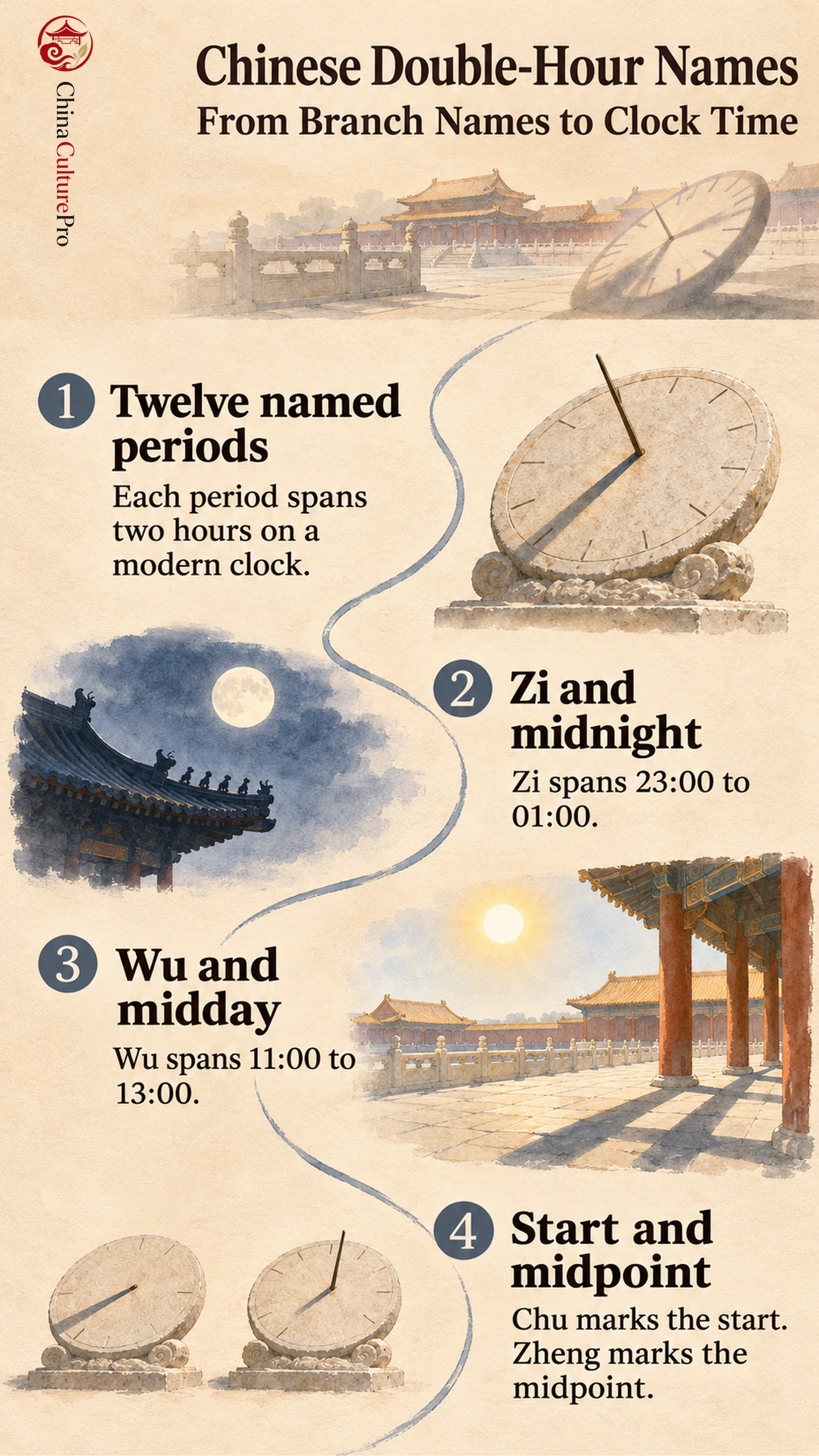
In a historical text, wu hour gives a period centered on midday. The first clue is the branch name. A second word may tell you whether the time is at the start or the midpoint of that period. [1][2][4]
The Twelve Double-Hours at a Glance
The branch names come from the twelve Earthly Branches. The chart uses the Hong Kong Observatory and Hong Kong Space Museum’s clock equivalents. The third column gives a set of traditional descriptive names. [1][2][3]
| Branch hour | Modern clock equivalent | Traditional descriptive name |
|---|---|---|
| Zǐ shí (子时) | 23:00–01:00 | Midnight (夜半, yèbàn) |
| Chǒu shí (丑时) | 01:00–03:00 | Cockcrow (鸡鸣, jīmíng) |
| Yín shí (寅时) | 03:00–05:00 | Early dawn (平旦, píngdàn) |
| Mǎo shí (卯时) | 05:00–07:00 | Sunrise (日出, rìchū) |
| Chén shí (辰时) | 07:00–09:00 | Meal time (食时, shíshí) |
| Sì shí (巳时) | 09:00–11:00 | Late morning (隅中, yúzhōng) |
| Wǔ shí (午时) | 11:00–13:00 | Midday (日中, rìzhōng) |
| Wèi shí (未时) | 13:00–15:00 | Sun tilting west (日昳, rìdié) |
| Shēn shí (申时) | 15:00–17:00 | Late afternoon (晡时, būshí) |
| Yǒu shí (酉时) | 17:00–19:00 | Sunset (日入, rìrù) |
| Xū shí (戌时) | 19:00–21:00 | Dusk (黄昏, huánghūn) |
| Hài shí (亥时) | 21:00–23:00 | Settling for the night (人定, réndìng) |
How to Read the Start and Midpoint
In the system described by the Hong Kong Space Museum, each double-hour has two halves. The initial part called chu (初, chū) starts the first half. The midpoint called zheng (正, zhèng) starts the second. Zi chu corresponds to 23:00. Zi zheng corresponds to midnight, and chou hour starts at 01:00. You can use the same pattern at noon. Wu chu corresponds to 11:00 and wu zheng to 12:00. [1][2][4]
Why an Old Time Name Can Be Approximate
Read a word such as dusk or sunrise in context. A list of traditional time names can use sunrise as a name for a period. A poem or diary may simply mean the moment when the sun appeared. The shadow on a sundial reflects the Sun’s position at that location, so its reading can differ from civil clock time. Use the chart as a standard correspondence for named periods, and let the place and date guide interpretation when the text describes an observed event. [1][3][5]
The same branch names also appear in the sexagenary cycle. In a record with a full stem and branch pair, check whether the writer is naming a day, a year or an hour before reading it as a time of day. [1]
FAQs About Chinese Double-Hours
Does zi hour cross midnight?
Yes. In the usual clock correspondence it begins at 23:00, passes midnight and ends at 01:00. [1][2]
What does wu zheng mean?
It marks the middle of wu hour, equivalent to noon in the standard clock comparison. [1][2][4]
Sources
[1] Hong Kong Observatory. Heavenly Stems and Earthly Branches
[2] Hong Kong Space Museum. Astropark Exhibit Captions
[3] Central Commission for Discipline Inspection Cultural Section. The Twelve Hours in Tang and Song Poetry
[4] Palace Museum. Qing Emperors and Western Clocks
[5] Palace Museum. Sundial