
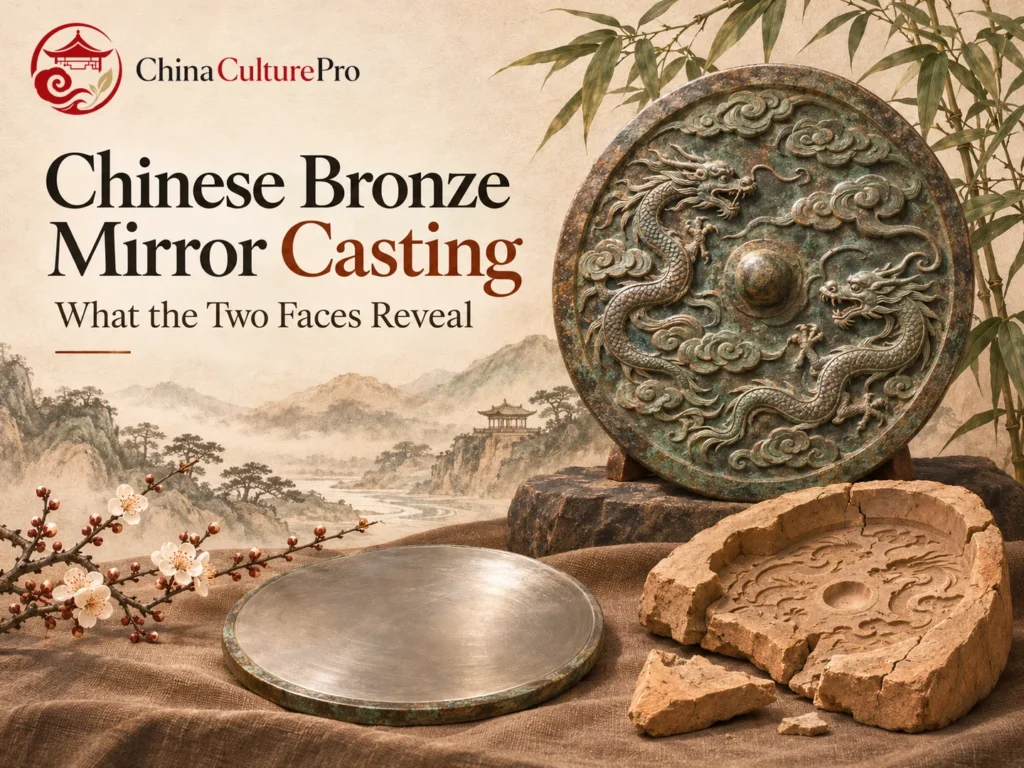

Quick Answer: How Were Chinese Bronze Mirrors Cast?
A Chinese bronze mirror (铜镜, tóngjìng) was cast as a disc. Clay molds could give one face a smooth shape and the other a design in relief. Finishing and polishing made the smooth face reflective. Finds from workshops and surviving mirrors preserve different stages of the work.[1][2][6]
- A mirror mold (镜范, jìngfàn) can carry the reverse impression of a finished design.[1][2]
- The Han workshop at Linzi (临淄, Línzī) provides evidence in the form of molds and metal fragments.[3][6]
- A central knob and raised decoration help identify the back of many examples.[4]
The museum photograph most likely to catch your eye may show the back.

Turn a bronze mirror over and you pass from a surface intended to reflect a face to one made for looking at in its own right. The difference begins in the mold and continues in the finishing.
Why the Two Sides Look Different
The reflecting side needed a relatively even face. The back could have raised figures, inscriptions and a central knob. Bronze mirrors often used an alloy containing copper and tin, and some contained lead. The surfaces of surviving mirrors have changed over time. The history of mirror polishing explains why the appearance of the face today can differ sharply from its appearance when new.[2][4]
What a Clay Mirror Mold Can Show
A mold surface that held the decoration has depressions where the finished metal has raised lines. The other side of the mold shaped the reflecting face. The disc still needed finishing. A mold records the intended shape before that finishing, which makes it evidence for a part of the history invisible on the final object.[1][2]
The same distinction between the shape made by the mold and the work that follows applies to bronze vessels, although the shape and mold arrangements differ. Chinese iron casting offers a comparison in a different metal.
What the Han Workshop at Linzi Reveals
Archaeologists at the former Qi capital in Shandong recovered Han mirror molds and workshop remains. These finds connect the production of mirrors to a particular place even when the finished mirrors found elsewhere have no maker’s name.[6]
Researchers analyzed eight mirror fragments from the site and compared their manufacturing and material evidence with other mirrors. They found similarities to Western Han examples from Chang’an and Japan. Similar techniques and materials raise questions about how metal, finished mirrors and technical knowledge moved. Multiple kinds of evidence are needed to choose among those explanations.[3]
Reading a Finished Mirror
A Western Han mirror in the Metropolitan Museum of Art has two dragons and curling waves on the back. They surround a central boss, a raised part of the disc. That relief shows the maker’s choice to devote the back to figures while preserving the other face for reflection.[4]
The National Museum of China traces bronze mirrors across many periods, so the Linzi finds illustrate one well-documented industry within a much longer history.[5] Compare the work of giving a reflective surface its finish with the separate tradition of finishing objects with lacquer.
FAQs About Chinese Bronze Mirror Casting
Which side of a bronze mirror reflected the viewer?
The smooth and polished face was the reflecting side. Designs in raised relief generally appear on the back.[2]
What makes a mold useful to archaeologists?
A mold can preserve a negative of the design and connect production to a workshop when its findspot is known.[1][6]
Were all mirrors made at Linzi?
Linzi is a documented Han production center in Shandong. Bronze mirrors were made and used across many places and periods.[1][5]
Sources
[1] Academy of Chinese Studies. How artisans cast bronze mirrors
[2] Cotsen Institute of Archaeology Press, UCLA. Ancient Chinese Bronze Mirrors
[3] University of Chinese Academy of Sciences. Scientific archaeology and Han bronze mirrors
[4] The Metropolitan Museum of Art. Mirror with two dragons
[5] National Museum of China. Chinese bronze mirror culture exhibition
[6] People’s Daily. Deciphering traditional bronze mirror manufacture