


Quick Answer: What Was the Tianyuan Method?
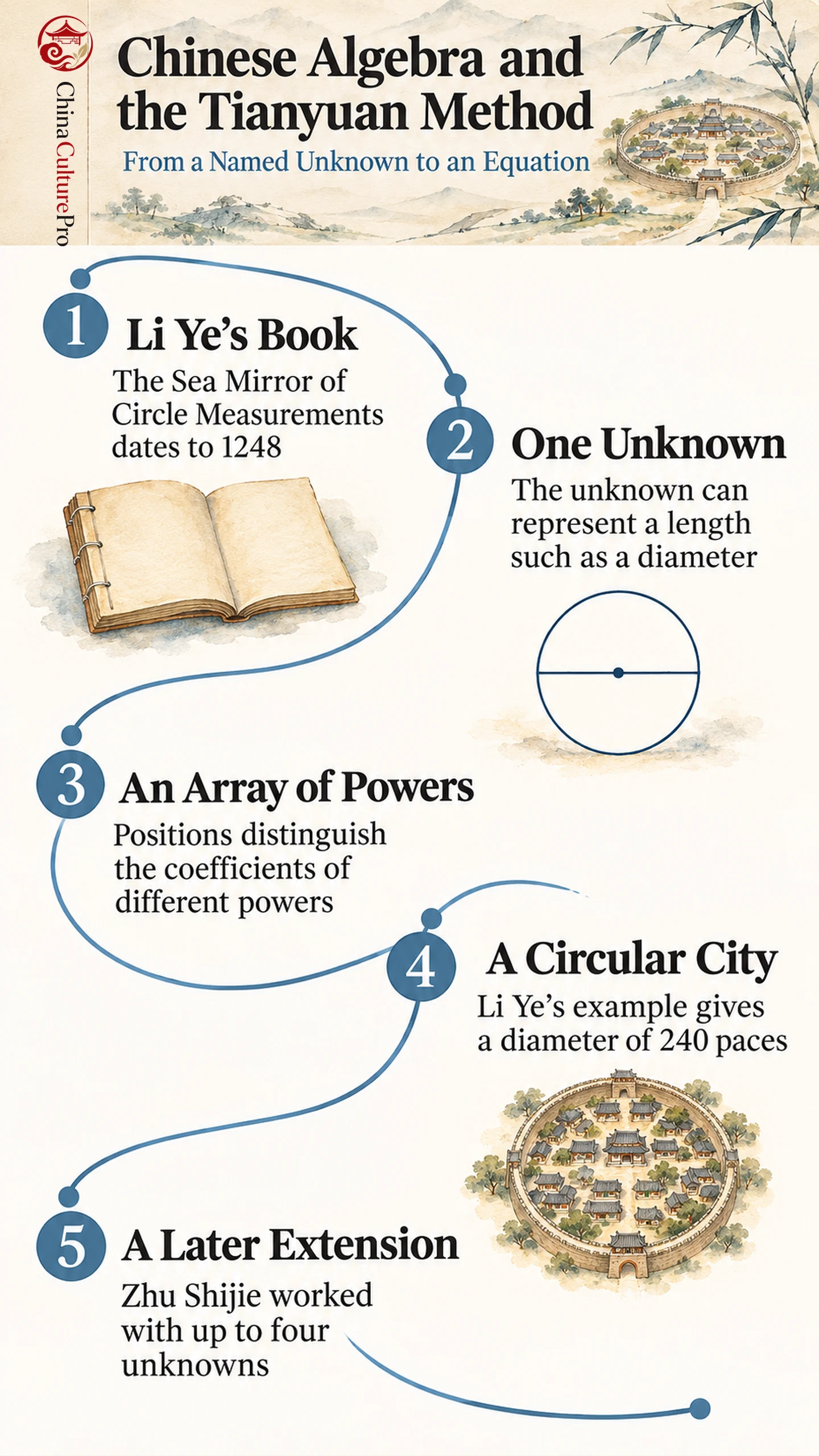
The tianyuan method (天元术, tiānyuánshù) was a Chinese algebraic technique for naming an unknown and constructing an equation in it. The unknown could stand for a geometric quantity such as a city’s diameter. The solver arranged the equation’s coefficients in positions on a counting surface.[1][4]
- Li Ye’s Sea Mirror of Circle Measurements (测圆海镜, Cèyuán Hǎijìng) documents the method in a work dated 1248.[2][3]
- The positions of coefficients represent different powers of the same unknown.[1][4]
- Zhu Shijie’s later work used related techniques with up to four unknowns.[5]
It gives a way to turn a relationship stated in words or shown in a diagram into a form that can be calculated.
Algebra usually starts by giving a name to something you do not know. Li Ye’s book shows how that choice can carry a length from a geometry problem into a column of numbers.
What Li Ye’s Book Documents
In the Sea Mirror, Li Ye systematically used a named unknown in problems about a circular city. In 1259 he completed another work with more elementary problems that also used algebra.[2][3] The earlier book is important evidence for the method, and historical research discusses writers and works that came before Li Ye.[6]
How the Coefficient Array Worked
A column can hold the coefficients of several powers of one quantity. The place of a coefficient in the column indicates whether it belongs to the constant term, the unknown, its square or another power. The number in each place can itself be written using decimal place-value counting rods.[4]
Consider a modern example, x² − 5x + 6 = 0. The coefficients for the square term, the linear term and the constant are 1, −5 and 6. The positions carry the information that the written powers convey in the modern expression. The use of negative numbers in historical calculations is a related part of that story.
A Circle Problem in the Sea Mirror
One problem provides distances associated with routes around a circular city and asks for its diameter. Li Ye assigns the unknown to the diameter and uses geometric relations to express other lengths. These expressions lead to a cubic equation. The solution given for the diameter is 240 paces.[1]
The interesting step happens before the final answer. Once the diameter is named, several quantities that initially seem unknown can be expressed using that same variable. Geometry establishes the relationship, and the algebra gives that relationship a form that can be calculated.
From One Unknown to Several
Zhu Shijie’s Precious Mirror of the Four Elements (四元玉鉴, Sìyuán Yùjiàn), dated 1303, applies related ideas to problems with more than one unknown.[5] This is a later development in Chinese mathematical history. For earlier work on equations and geometric problems, see The Nine Chapters.
FAQs About the Tianyuan Method
Was the unknown written as x?
No. Modern accounts may translate it as x. The traditional notation assigned an array position to the unknown and its powers.[1][4]
Was the method used only for simple equations?
No. A circle problem in the Sea Mirror involves a cubic equation.[1]
Did Li Ye invent every part of the method?
His work documents and systematizes the technique. Historians have traced lines of study before his 1248 book.[6]
Sources
[1] Donald B. Wagner. The development of the classical Chinese algebra of polynomials
[2] MacTutor, University of St Andrews. Chinese mathematics overview
[3] Li Ye. Sea Mirror of Circle Measurements
[4] Karine Chemla and contributors. The History of Mathematical Proof in Ancient Traditions
[5] MacTutor, University of St Andrews. Zhu Shijie and the Precious Mirror
[6] Inner Mongolia Normal University. Forty years of research on Song and Yuan mathematics