
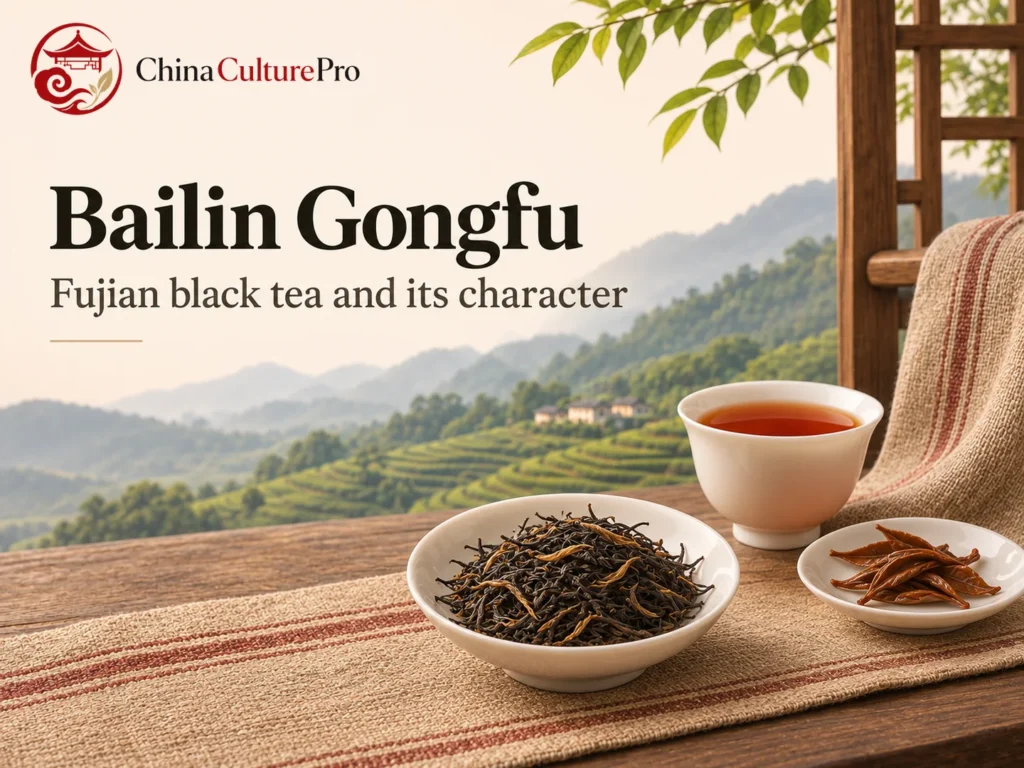

Quick Answer: What Is Bailin Gongfu Tea?
Bailin Gongfu(白琳工夫,Báilín gōngfu)is a black tea associated with Bailin in Fuding, northeastern Fujian. It is traditionally grouped with two other regional Fujian gongfu black teas, rather than classified as a white tea. [3]
- Origin: Bailin is a place name within Fuding’s tea-producing region. [3]
- Material: Local large-budded tea varieties supply important raw material. [1]
- Appearance: Fine, curved dark strands may show golden bud hairs.
- Cup: Traditional descriptions emphasise a bright reddish infusion and mellow, sweet character. [2]
“Gongfu” in the product name concerns a black-tea making tradition. It does not require every drinker to use a formal tea service, and the name does not identify a single plant cultivar.
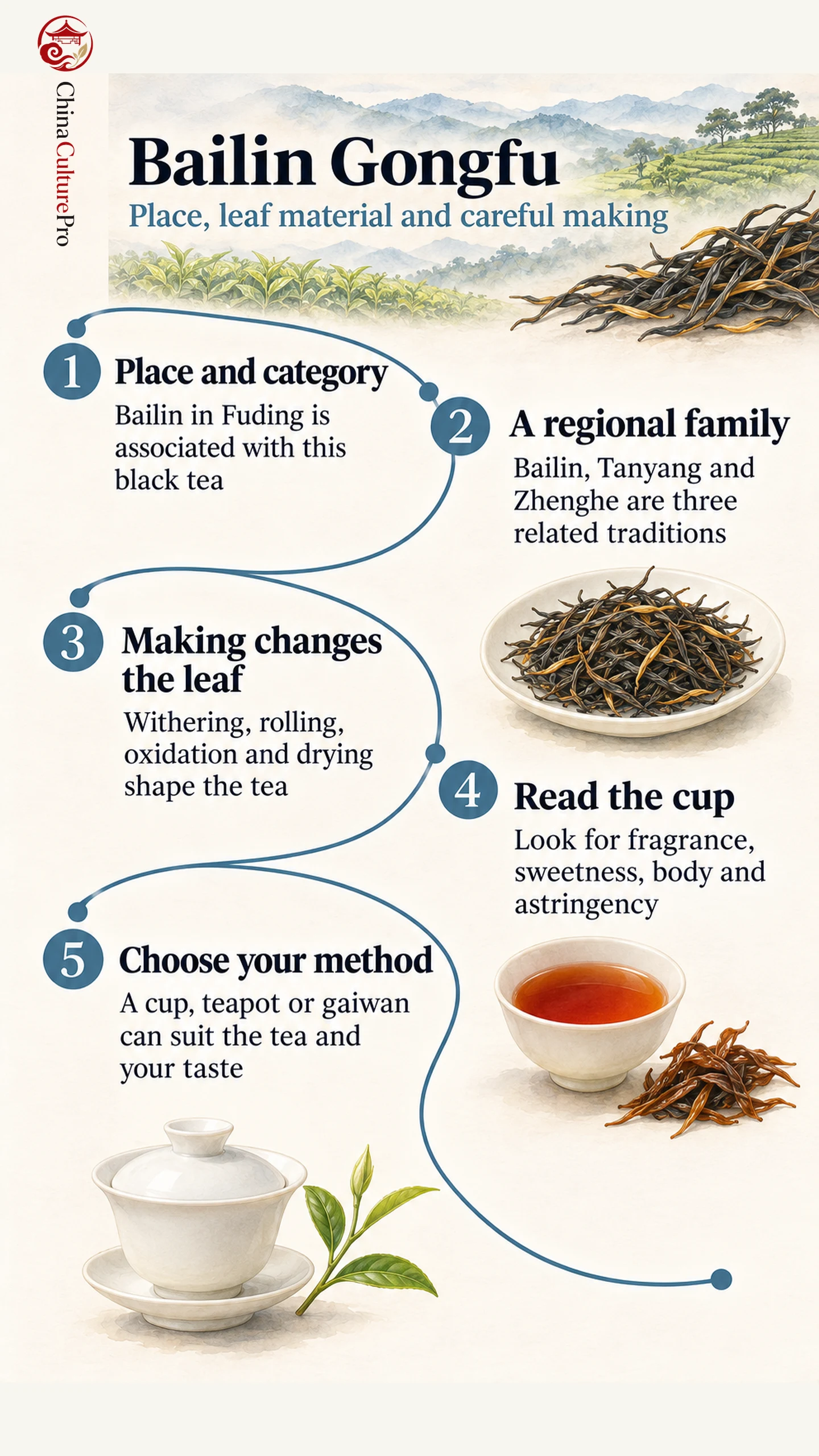
Dark leaf strands and golden tips give Bailin Gongfu a different appearance from the pale white teas many readers associate with Fuding. The distinction begins in manufacture. Understanding its place, leaf material and processing makes this regional thé noir chinois easier to recognise and enjoy.
A Black Tea from Bailin, Not a White Tea
Bailin is a tea-trade locality attached to this black-tea name. Modern reports describe black and white tea sharing its commercial and cultural setting. [7]
Gongfu black tea(工夫红茶,gōngfu hóngchá)names a manufacturing tradition. Regional descriptions emphasise the care involved in making and refining the leaf; it is not a synonym for a particular small teapot. [1][2]
The overlap with Fuding white tea is geographical and can involve related plant material. Sharing a tea-growing area does not erase the different processing categories. Read the product’s stated tea type before assuming that “Fuding” means white tea.
Bailin among Fujian’s Three Gongfu Black Teas
Minhong(闽红,Mǐnhóng)is the familiar grouping for these Fujian black-tea traditions:
| Thé | Association régionale |
|---|---|
| Bailin Gongfu | Bailin and the Fuding area. |
| Tanyang Gongfu(坦洋工夫,Tǎnyáng gōngfu) | Tanyang and the Fu’an area. |
| Zhenghe Gongfu(政和工夫,Zhènghé gōngfu) | Zhenghe in Fujian. |
These related regional teas differ in origin, material and character. They are not three grades of one product. [2]
For a comparison, begin with the actual tea and its processing description. The word “Fujian” provides regional context, but it is too broad to predict every cup’s aroma or strength.
Tea Shoots, Bud Hairs and Product Differences
Fuding Dabai(福鼎大白茶,Fúdǐng dàbáichá)is identified as an important raw material in the regional gazetteer. An industry account also mentions Fuding Dahao(福鼎大毫茶,Fúdǐng dàháochá)among the tea varieties used. These are plant-material names, while Bailin Gongfu identifies the made tea and its regional tradition. [1][3]
Golden hairs are one descriptive feature to consider alongside leaf shape and the brewed result. [2]
Different picking and processing descriptions deserve separate attention. A bud-heavy example and one containing more opened leaf need not look identical. Read the producer’s specification instead of converting a photograph of a single sample into a universal rule.
Withering, Rolling, Oxidation and Drying
Weidiao(萎凋,wěidiāo), or withering, begins the regional manufacturing sequence. Rolling, the stage traditionally called fermentation, and drying follow. The gazetteer records both older hand methods and later mechanised production. [1]
In black-tea manufacture, that fermentation stage centrally involves enzyme-driven oxidation of tea polyphenols. Research examining the reaction shows the importance of oxygen and leaf compounds. This is a general explanation of black-tea processing, not a laboratory analysis of every Bailin Gongfu product. [4]
The distinction helps explain why a tea variety used in a pale tea can also supply a dark, reddish-cupping black tea. The plant material matters, but the decisions made after picking matter too.
Contemporary work continues to examine those decisions. A college reported a November 2025 meeting on developing a Bailin Gongfu processing specification, linking teaching, research and production. That report documents a drafting process; it does not establish that the proposed specification was already in force. [6]
What Bailin Gongfu Looks and Tastes Like
Traditional descriptions include fine curved leaves, golden down, reddish liquor and mellow sweetness, sometimes compared to liquorice. That comparison describes flavour, not an added ingredient. [2]
Broader black-tea research shows that manufacture changes compounds involved in colour, aroma and taste. The cup is the result of interacting materials and reactions, rather than one visible feature such as a golden tip. [4]
Use a tea-tasting approach that separates aroma, sweetness, body and drying astringency. A fragrant cup can still feel too concentrated for your preference. Comparing these dimensions gives you a clearer reason to adjust the next infusion.
Brewing and Comparing the Cup
A published preparation guide uses water around 90°C and suggests a 2–3 minute teapot infusion for its tea. It also describes glass and covered-vessel approaches. These provide examples, not a fixed temperature and time required for every Bailin Gongfu. [5]
A gaiwan(盖碗,gàiwǎn)or teapot can both be practical. Our vessel comparison explains their handling differences. Follow your packet’s quantities and consider the vessel’s volume before borrowing somebody else’s infusion time.
For a useful first comparison, taste the infusion without additions. Then change one brewing factor at a time, such as leaf quantity or contact time, and note whether the result becomes lighter, fuller or more drying. Pouring the liquor away from the leaves gives you control over that contact.
The word “gongfu” does not prevent a straightforward cup or pot. Gongfu cha is a brewing approach you may choose, rather than an obligation imposed by the product name.
Tea Trade, Local Life and Modern Craft
The regional gazetteer records tea firms in both Fu’an’s Tanyang and Fuding’s Bailin processing and exporting gongfu black tea during the late Qing and early Republican period. It also describes the arrival of manufacturing machinery at a Fu’an experimental tea station in 1936. That is regional industrial history, not evidence that one Bailin shop invented all black tea. [1]
A March 2026 report describes Bailin’s old street as a place where black-tea and white-tea histories meet contemporary tea spaces. The report connects historical tea commerce with present-day social uses. [7]
This is part of Fujian’s regional culture. The production name, trade network and present-day ways of serving tea provide different kinds of context for the same cup.
FAQs About Bailin Gongfu Tea
Is Bailin Gongfu the Same as Fuding White Tea?
No. Bailin Gongfu is black tea. A shared region or related raw material does not make it the same product as a white tea. [1]
Does Gongfu Mean It Needs a Tea Ceremony?
No. The product belongs to a gongfu black-tea tradition, but published brewing directions include an ordinary teapot method. Choose the service that suits you. [5]
Are Honey or Fruit Always Added?
No. Sweet or fruity language can describe the tea’s own character. It is not, by itself, an ingredient list; check any blended or flavoured product. [2][4]
Does Bailin Gongfu Contain Caffeine?
Yes. As a traditional tea-leaf drink, it contains caffeine. Its mellow taste does not establish a caffeine-free product. [8]
Sources
[1] Fujian provincial gazetteer office. Ningde regional gazetteer: traditional black-tea manufacture
[2] CPPCC public cultural feature. The taste of black tea
[3] Fuding White Tea industry exhibition introduction, republished by Fujian Tea. Fuding’s Bailin Gongfu exhibition presentation
[4] Food Chemistry:X original research. Structural insight into polyphenol oxidation during black tea fermentation
[5] TeaVivre. How to brew Bailin Gongfu black tea
[6] Fujian Agriculture Vocational Technical College. Bailin Gongfu processing-standard development meeting
[7] Fujian provincial portal. New tea-consumption settings in Ningde
[8] Harvard Nutrition Source. Thé