


Quick Answer: What Is Bai Rui Xiang Oolong?
Bai Rui Xiang(白瑞香,Bái Ruì Xiāng)is a named tea cultivar associated with Wuyi rock tea(武夷岩茶,Wǔyí yánchá), the oolong tradition of Wuyishan in Fujian. The regional category combines suitable tea plants, local growing conditions and a distinctive manufacturing process.[1][2]
- Identity: A cultivar name, rather than a complete description of one finished batch.
- Processing: Leaf handling, partial oxidation and roasting contribute different qualities.
- Flavor: Evaluate the liquor, fragrance, texture and finish separately.
Similar names need checking against their Chinese characters. Neither the English translation nor a floral tasting note establishes the plant material, added ingredients or roast history of a packet.
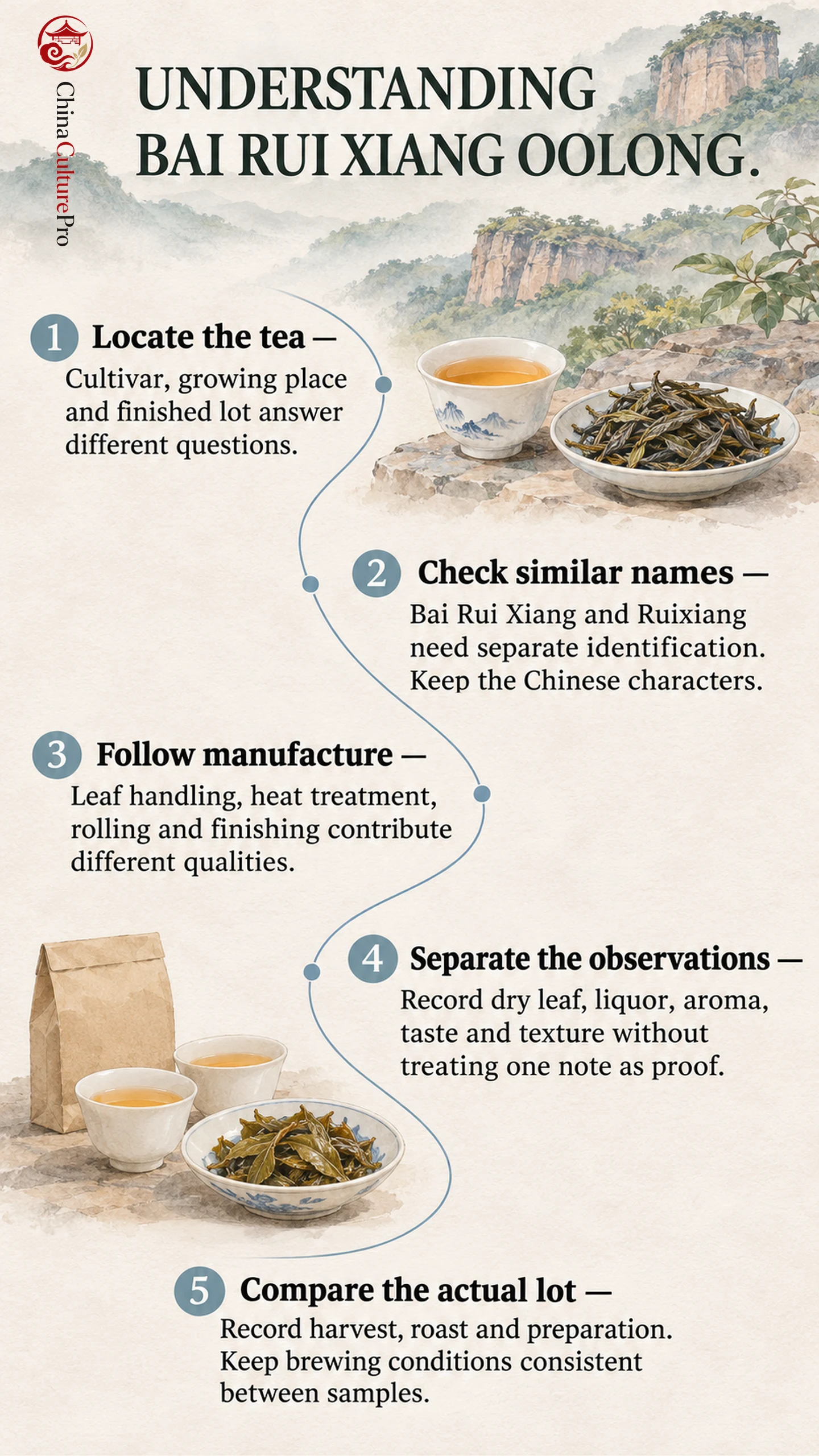
An orange-yellow cup beside dark, twisted leaves can introduce Bai Rui Xiang oolong. The fragrance may be striking, but the useful questions reach beyond its name: where was the leaf grown, how was it processed, and what distinguishes this lot? Those details explain the tea beyond a list of promised aromas.
Bai Rui Xiang’s Place in Wuyi Tea
Wuyi rock tea names a regional tea family, while Bai Rui Xiang identifies particular plant material within that discussion. A cultivar name, a garden location and a finished product therefore answer different questions. A label can provide one without supplying the others.
Research on Wuyi tea resources reinforces the value of precise identification. A 2023 genetic study examined cultivars and strains using DNA markers; its groupings reflected genetic relationships rather than simply tree habit or leaf shape.[3] This was research on a defined sample collection. It does not make a photograph or a tasting impression a laboratory identification of a purchased tea.
A published germplasm-reference entry, reproduced online with botanical images, associates Bai Rui Xiang’s collection with the rock wall at Huiyuan Keng in the Wuyi area.[1] That is a provenance account for the plant material. It does not establish that every contemporary packet bearing the name came from that collection location.
When origin matters, ask for the producer and growing location of the actual harvest. Keep that information alongside the cultivar rather than replacing it with an evocative mountain photograph.
Bai Rui Xiang and Ruixiang Are Different Labels
Ruixiang(瑞香,Ruìxiāng)has its own entry in the International Camellia Register. The entry identifies a tea cultivar selected by the Fujian Academy of Agricultural Sciences’ Tea Research Institute from natural hybrid progeny of Huangdan.[4] That pedigree should not be transferred to Bai Rui Xiang merely because the English names share two syllables.
| Label to check | What the record establishes | What to ask about the packet |
|---|---|---|
| Bai Rui Xiang, 白瑞香 | A named Wuyi tea with a documented collection account | Confirm the Chinese name, producer and growing location |
| Ruixiang, 瑞香 | A separately recorded cultivar with a breeding pedigree | Confirm that this is the plant material intended |
If another character spelling appears, retain that spelling when asking the producer what it means. English spacing and a poetic translation cannot settle cultivar equivalence. Ask about shortened names before silently adding or deleting a character.
From Withered Leaf to Roasted Rock Tea
Bai Rui Xiang made as Wuyi oolong belongs to a multi-stage manufacturing tradition. The national heritage account emphasizes complex withering, attentive leaf handling, repeated pan-firing and rolling, and prolonged roasting.[5] These operations have different roles; “roasted tea” is too broad to explain the entire transformation.
Zuoqing(做青,zuòqīng)is the leaf-working stage associated with developing the oolong character before fixation(杀青,shāqīng), the subsequent heated treatment. Rolling shapes the leaf, while drying and later finishing belong to further stages of manufacture. The regional description also distinguishes making the initial tea from refining the finished product.[2]
A useful process account therefore includes both the earlier leaf work and the finishing roast. Ask how the particular lot was finished rather than assigning every Bai Rui Xiang one roast level from the cultivar name alone.
Our guide to tea oxidation versus fermentation explains the terminology behind “partially oxidized oolong.” Individual makers adjust this sequence to the leaf and intended finish.
What to Expect from the Flavor
The germplasm-reference description gives a useful starting point: greenish-brown dry tea, an orange-yellow infusion, pronounced aroma and a mellow, sweet taste.[1] It offers a reference profile rather than a compulsory flavor checklist for every harvest.
Separate what you observe:
- Dry leaf: Note its shape and color before drawing conclusions about the cup.
- Liquor: Describe clarity and color without treating darkness as a quality score.
- Aroma: Record the fragrance in the warmed vessel and above the infusion.
- Taste and texture: Distinguish sweetness, bitterness, drying sensations and the finish.
Taiwan’s Tea and Beverage Research Station similarly treats appearance, liquor, aroma, taste and infused leaves as separate dimensions in sensory assessment.[6] A tea may smell floral yet feel brisk or drying; those observations need not collapse into one adjective.
Use Chinese tea aroma vocabulary to describe an impression clearly. A flower comparison does not establish that flowers were added. Check the ingredient declaration if added scenting or flavoring matters to you.
Brewing and Comparing a Particular Lot
Begin with the product’s preparation guidance and a vessel you can drain completely. A gaiwan ou théière allows you to separate the infusion from the leaves and change the next steep deliberately.
Record the leaf amount, water and infusion conditions. Keep those conditions consistent when comparing two lots. Formal sensory evaluation also uses controlled preparation, although an assessment method is not a compulsory everyday brewing recipe.[6]
Write down the harvest and roast information beside your notes. If one cup seems stronger, changing the preparation can help you explore that particular tea before attributing everything to its cultivar. Comparing successive infusions is useful, but no fixed number of good steeps follows from the name alone.
FAQs About Bai Rui Xiang Oolong
Is Bai Rui Xiang the same as Ruixiang?
Do not assume so. 白瑞香 and 瑞香 are different labels; the latter has a separate registered cultivar entry.
Is Bai Rui Xiang a scented flower tea?
The cultivar name does not establish flower scenting. Check the actual product’s ingredients and processing information.
Is Bai Rui Xiang always lightly roasted?
The name alone does not specify a roast level. Ask about the finishing of the particular lot.
Can taste alone establish the cultivar?
No. Sensory notes describe the cup; they do not independently establish the identity of its plant material.
Sources
[1] Liu Jianfu, Wang Wenjian and Huang Kun. Illustration of Chinese Oolong Tea Germplasm Resources, Bai Rui Xiang entry, reproduced with botanical images
[2] China National Intellectual Property Administration. Wuyi Rock Essence Tea
[3] Li Li et al. Genetic Analysis and Marker Development for Wuyi Tea Based on GBS-SNP
[4] International Camellia Register. Ruixiang
[5] China Intangible Cultural Heritage Network (Réseau chinois du patrimoine culturel immatériel). Wuyi Rock Tea Making Techniques
[6] Tea and Beverage Research Station. 茶葉感官品評