
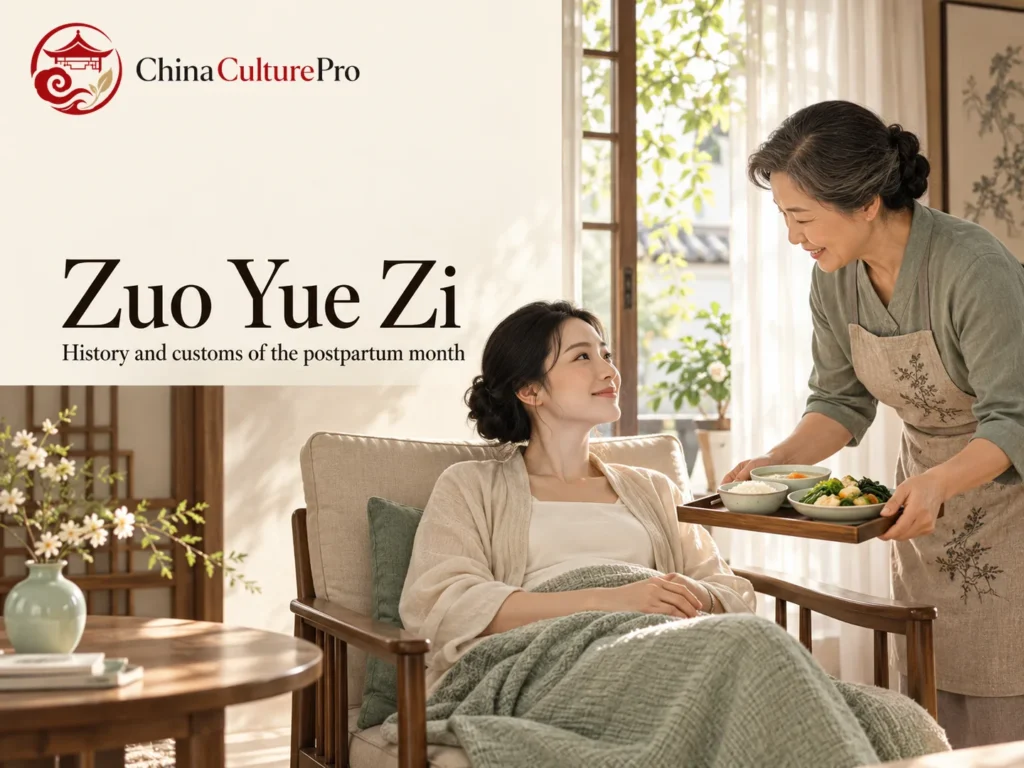

Quick Answer: What Is Zuo Yue Zi?
Zuo Yue Zi (坐月子, zuò yuè zi), often translated as “doing the month” or “sitting the month,” is a Chinese postpartum tradition centered on a period of rest and care after childbirth. Food, warmth, household help and restrictions on activity can form part of it, with substantial variation.
- Purpose: Give the mother a recognized period of care while the household adjusts to a new baby.
- Customs: Families may emphasize warm meals, reduced chores, fewer visitors and particular beliefs about food or washing.
- Family support: Relatives, a paid carer or a confinement center may help, depending on resources and preference.
- Modern care: Cultural observances should be adapted around current clinical guidance and the mother’s needs.
A traditional month is not a medical recovery deadline. Describing a restriction does not establish its health benefit, and family custom should not delay needed care.

For some families, the postpartum month means an older relative cooking familiar food and taking over household work. For others, it includes a hired carer, a stay away from home or disagreement about rules handed down through generations.
The English word “confinement” catches the restrictions but can miss the care. Understanding both helps explain why the tradition persists, why mothers experience it differently and why a modern family may preserve its support while changing its rules. It belongs to the wider world of Chinese baby traditions, while placing the mother’s experience at the center.
What the Postpartum Month Means
Zuo Yue Zi describes a socially recognized interval after childbirth, commonly associated with roughly a month. It is neither a month of literal uninterrupted sitting nor a single nationally standardized program.
The household may reorganize meals, chores, visiting and infant care around the new mother. That practical work can coexist with beliefs that childbirth leaves the body especially vulnerable and requires restoration. Families differ in which ideas they accept and how strictly they apply them.
A 2007 qualitative study in Fujian interviewed thirty-six family members and eight health workers in one rural and one urban county. Participants described the practice through diet, activity, hygiene and infant-feeding customs. The study offers a specific view of family practice at that time; it does not measure how every Chinese mother observes the month today.[2]
Useful starting questions are “Who will help?” and “Which customs does this family mean?” A familiar name can cover very different arrangements, including a supportive period of rest or a demanding set of expectations.
Historical Ideas Behind Rest, Warmth and Food
Historical explanations often connect postpartum care with restoring bodily balance and avoiding harmful exposure. In that framework, warmth and food classifications carried meanings beyond the temperature of a room or meal.
Barbara Pillsbury’s 1978 anthropological study examined the practice through folk medical explanations, Chinese medical reasoning and Western medical evaluation. Its interview material came from Taiwan and mainland Chinese respondents. The research shows why it is misleading to treat every household rule as if it came from one uniform medical doctrine.[1]
It also helps distinguish cultural history from clinical evidence. A belief that contact with wind could affect later health explains why a family restricted drafts. It does not prove that a fan causes future illness. Similarly, a food called “warming” within a traditional system is not automatically a treatment for a diagnosed condition.
Many popular accounts assign the custom a precise ancient starting date. A named passage and its context would be needed to support that claim. It is more accurate here to describe a longstanding, changing tradition documented in historical scholarship than to name an inventor or assert an unchanged regimen lasting millennia.
Customs Described in Family and Regional Research
The Fujian interviews recorded avoiding cold foods, eating more or emphasizing protein-rich dishes, staying indoors, limiting visitors and reducing housework. They also recorded restrictions on bathing and dental hygiene. These reported practices should be read as evidence of what participants did, not recommendations to reproduce the whole set.[2]
| Area of family life | A reported cultural emphasis | What should remain a separate question |
|---|---|---|
| Rest and chores | Other people take over demanding work | Appropriate activity during an individual recovery |
| Alimento | Special meals and ideas about warming or cooling foods | Adequate nutrition and any clinical dietary needs |
| Washing and temperature | Avoiding cold, drafts or some forms of washing | Hygiene, comfort and specific wound-care advice |
| Visitors | A quieter household and fewer demands | The mother’s wishes and access to necessary support |
A single account cannot stand for all regions, incomes or generations. A family may retain warm soups while dropping bathing restrictions, or welcome close relatives while asking other visitors to wait.
Celebratory foods are another distinction. Red eggs and ginger shared with guests announce and welcome a baby; they do not establish a prescribed postpartum diet. An ingredient’s role at a party and its role in a family’s recovery beliefs may overlap without being identical.
Relatives, Paid Carers and Confinement Centers
Who provides care shapes the experience. A mother or mother-in-law may contribute skills, food and affection, while a partner manages chores or visitors. A paid carer changes the arrangement again: expectations about infant care, meals and privacy need to be understood rather than assumed.
Research among Malaysian Chinese mothers documents both home care and private confinement centers. In that cohort, mothers reported concerns about hand hygiene and facilities in some centers; the study did not establish a difference in reported infection-related health problems between the groups. It illustrates the importance of actual care practices, rather than proving one setting is always better.[3]
A confinement center should not be assumed to provide the services of a hospital merely because it serves postpartum families. Ask what staff do, what qualifications they hold and how clinical concerns reach a healthcare professional. A cultural service and medical treatment have different responsibilities.
Family help also benefits from clear expectations. Knowing who cooks, who handles laundry and when the mother wants company makes support more concrete than a promise to “follow tradition.”
Where Cultural Practice Meets Modern Healthcare
Some inherited restrictions conflict with current public-health guidance. Singapore’s Health Promotion Board explicitly encourages warm bathing for hygiene and comfort and says fans or air-conditioning can be used to keep mother and baby comfortable. It also rejects the idea that every dish must include sesame oil, herbs and ginger.[4]
Hong Kong’s Family Health Service advises a balanced diet after delivery and emphasizes hygiene and appropriate wound care. These points do not require abandoning a familiar cuisine; they require separating a preferred traditional dish from an exclusive regimen that crowds out other needs.[5]
The same distinction applies to claims that particular soups guarantee milk supply or that alcohol is needed for warmth. Singapore’s guidance does not support those claims and advises avoiding alcohol during confinement and breastfeeding. Questions about medicines, herbs or feeding difficulties belong with qualified clinicians, rather than a ritual checklist.[4]
Recovery differs after different births and complications. Follow the maternity team’s advice about washing, movement, wounds and follow-up appointments. A family observance should make obtaining help easier; it should not require waiting for the month to finish before raising a health concern.
Supporting the Mother and Respecting Her Choices
The Fujian study found that elders’ own experiences influenced their advice. Concern for a daughter’s future health could motivate both strict rules and more flexible interpretations. Recognizing that concern can help a conversation, while leaving the mother room to make decisions about her own care.[2]
Useful support can be specific: take over a chore, prepare a meal she wants, coordinate visitors or help her attend an appointment. Ask before arranging an expensive service or announcing a family gathering. Privacy and reassurance may matter as much as the food.
A respectful discussion can separate three questions: which customs carry emotional meaning, which arrangements reduce work and which decisions require medical advice. They do not all have to be settled by the same person or justified in the same way.
The full-month celebration may recognize a baby’s milestone, but it does not certify that the mother has finished recovering. As with other Chinese family traditions, continuity can lie in care and relationships while the way people express them changes.
FAQs About Zuo Yue Zi
Does Zuo Yue Zi always last exactly thirty days?
No. Roughly a month is the familiar framework, but families and care arrangements vary. The traditional duration is not an individual medical recovery deadline.
Does the tradition mean a mother cannot bathe?
Some accounts record restrictions on washing, but these are not a universal medical rule. Current public-health guidance supports hygiene; follow the maternity team’s advice for individual wound care.
Are special confinement foods medically necessary?
A family may value familiar dishes, but no single traditional menu is necessary for everyone. Balanced nutrition and individual clinical needs should guide dietary decisions.
Is a full-month baby party the end of postpartum recovery?
No. A baby celebration marks a cultural milestone. The mother’s recovery and need for support can continue beyond that date.
Fuentes
[1] Barbara L. K. Pillsbury. Doing the month: Confinement and convalescence of Chinese women after childbirth
[2] Joanna H. Raven and colleagues. Traditional beliefs and practices in the postpartum period in Fujian Province, China: a qualitative study
[3] Siew Cheng Foong and colleagues. Mothers’ hygiene experiences in confinement centres: A cohort study
[4] Singapore Health Promotion Board. First days of our lives with baby: confinement
[5] Hong Kong Family Health Service. Postnatal Care and Family Planning