


Quick Answer: Who Was Zhu Yuanzhang?
Zhu Yuanzhang (朱元璋, Zhū Yuánzhāng) founded the Ming dynasty in 1368 and ruled until 1398. He rose from a poor family to command rebel forces during the decline of the Yuan. Hongwu (洪武, Hóngwǔ) was his reign name.[1][2][3]
- Rise: He joined the rebellion against Yuan rule and built a base at Nanjing.
- Founding: He proclaimed the Ming in 1368, the same year his armies took the former Yuan capital.
- Government: He strengthened direct imperial supervision and ordered detailed records for taxation and administration.
- Legacy: His government, portraits and mausoleum gave later rulers different precedents to follow.[1][2][3][4][5][7][9]
His personal name, reign name and title as dynastic founder all refer to the same ruler.
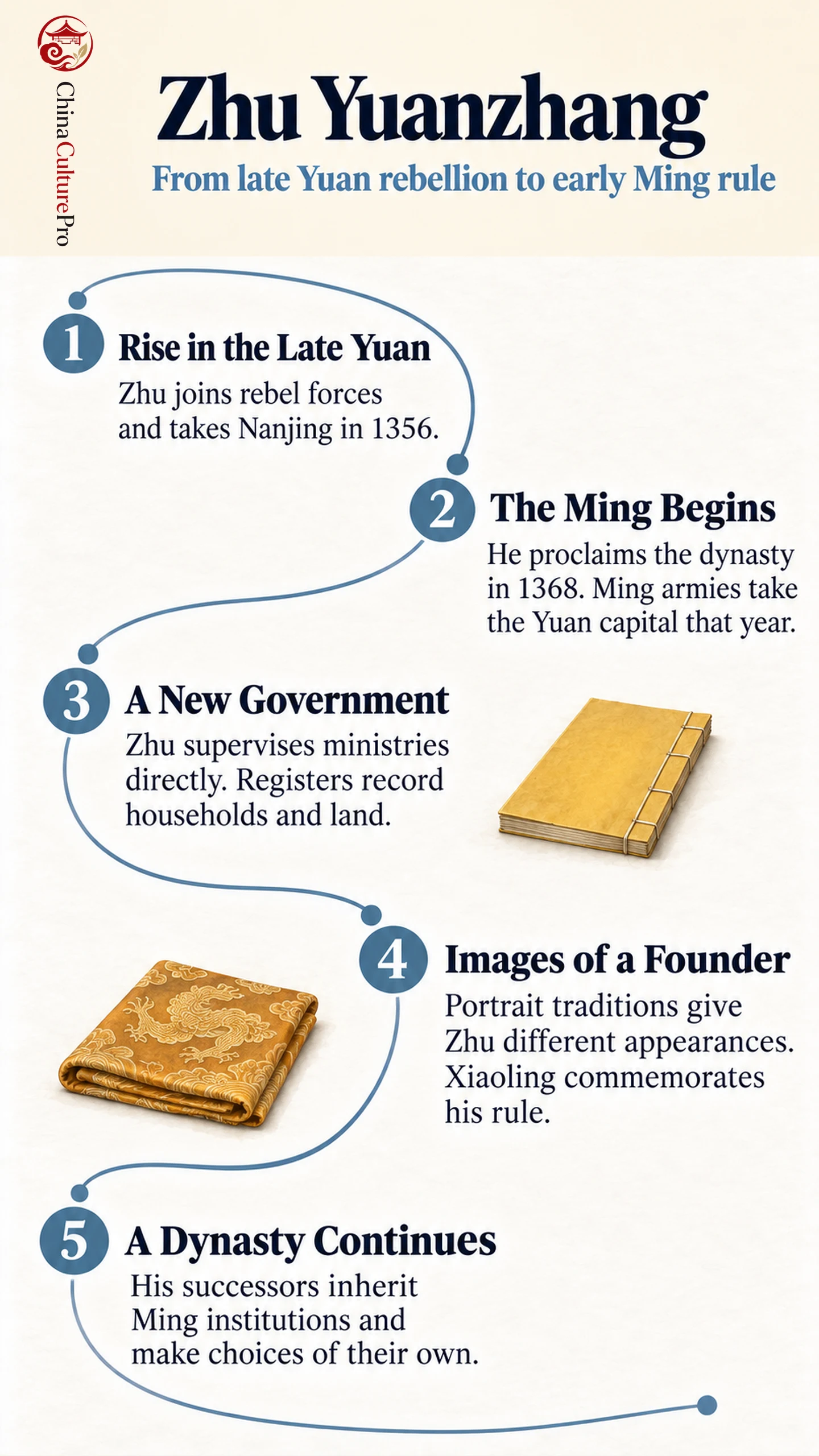
When Zhu Yuanzhang took the throne, the proclamation described a ritual offering to Heaven and Earth before his accession near Nanjing. That was a public account of a new ruler’s legitimacy. Household and property registers produced under his court show the less ceremonial work of turning conquest into government.[2][5]
From Poverty to the Red Turban Rebellion
Born in 1328, Zhu came from a poor family in what is now Anhui. He became a monk for a time before entering military life. In 1352 he joined forces connected with the Red Turban Rebellion (红巾军起义, Hóngjīnjūn Qǐyì), a wider movement that challenged the Yuan dynasty.[1][3]
Zhu’s rise depended on building a force with its own resources. Capturing Nanjing in 1356 gave him a major base in the lower Yangzi region. He fought other rebel leaders as well as Yuan forces. His victory at Lake Poyang in 1363 removed a major rival and improved his position in the Yangzi valley.[1][2][3]
How Zhu Founded the Ming in Nanjing
In 1368 Zhu established the Ming dynasty with his court based in Nanjing. The founding proclamation presents his accession as a response to petitions and as an act carried out through imperial ritual. The document connects a new ruler’s claim to familiar rituals. Its account of petitions shows how the court wanted its accession understood.[1][2][3]
Later that year Ming armies captured the Yuan capital in what is now Beijing. The former Yuan court withdrew northward. The dynasty’s founding at Nanjing and the military occupation of the northern capital were related events. They answer different questions when reading a timeline of Chinese dynasties.[1][2][3]
Direct Rule, Households and the Law
In 1380 Zhu abolished the position of chief minister. The Six Ministries (六部, Liùbù) came under more direct imperial supervision. The reorganization reduced the authority of an office that had stood between the emperor and senior administrators. More decisions could reach the emperor without passing through a chief minister, which increased the demands on the ruler and his immediate staff.[1][4]
The Yellow Registers (黄册, Huángcè) compiled information on households and property. Land records sometimes called fish-scale registers organized parcels spatially, so officials could locate land as well as associate obligations with households. Together they illustrate different kinds of information used to assess taxes and labor obligations.[5]
The court issued a formal law code, and Zhu also used edicts to address official conduct. One surviving edict condemns abuses by local officials and warns of severe punishments. Read it as evidence of what the ruler wanted to regulate and the means he considered acceptable. The edict’s existence gives no direct measure of how consistently officials followed its demands.[1][6]
Portraits and the Xiaoling Tomb
A formal portrait of the Ming founder shows him seated in imperial dress. The robe, posture and placement present a ruler with recognized status. Details of dress can be read alongside the conventions of imperial colors and rank. An unofficial portrait tradition gave him exaggerated facial features, which a museum exhibition relates to beliefs about the extraordinary appearance of someone destined to rule.[7][8]
Zhu was buried at Xiaoling (孝陵, Xiàolíng) in Nanjing. The tomb’s layout established a precedent for later imperial tombs. The layout set out a way to honor the founder in a place designed for ritual. The portraits used different visual conventions to give the same ruler a recognizable public identity.[7][8][9]
The Founder’s Legacy
Zhu died in 1398 and was succeeded by his grandson, the Jianwen emperor (建文, Jiànwén). Later rulers inherited the dynasty and many of its institutions while making choices of their own. The court that eventually sent Zheng He overseas belonged to the next phase of Ming history.[1][3]
Among Chinese historical figures, Zhu is especially useful for studying how a dynasty emerged from civil war. The proclamation dates the new court’s claim to authority. The ministries and registers show how it tried to administer people, property and officials.[2][4][5]
FAQs About Zhu Yuanzhang
When did Zhu Yuanzhang found the Ming dynasty?
He proclaimed the Ming in 1368 at Nanjing. Ming armies captured the former Yuan capital later that year.[1][2][3]
Are Zhu Yuanzhang and the Hongwu emperor the same person?
Yes. Zhu Yuanzhang was his personal name, and Hongwu was the reign name used from the founding of the Ming until his death in 1398.[1][7]
Why do portraits of Zhu Yuanzhang look different?
Formal images emphasize imperial status. Other paintings use exaggerated features associated with a belief that extraordinary rulers had distinctive appearances. These images reflect conventions of portraiture and do not settle his exact appearance.[7][8]
Fuentes
[1] The Palace Museum. The Hongwu Emperor
[2] China Heritage. Founding a Dynasty in Nanking
[3] Smithsonian National Museum of Asian Art. Ming Dynasty
[4] The Palace Museum. The Six Ministries
[5] University of Washington Press. Boundaries, Taxes, and Property Rights
[6] Columbia University Asia for Educators. Excerpts from an Imperial Edict Restraining Officials from Evil
[7] National Palace Museum. Following and Improving: Imperial Portraits of the Ming Dynasty
[8] National Museum of China. Formal Portrait of the Ming Founder
[9] UNESCO World Heritage Centre. Imperial Tombs of the Ming and Qing Dynasties