

Quick Answer: Who Was Emperor Taizong of Tang?
Emperor Taizong (唐太宗, Táng Tàizōng), born Li Shimin (李世民, Lǐ Shìmín), was the second Tang emperor. He took the throne in 626 and ruled until 649. His reign became a model for later discussions of government, even though he gained power through a violent succession struggle.[1][2][6][7]
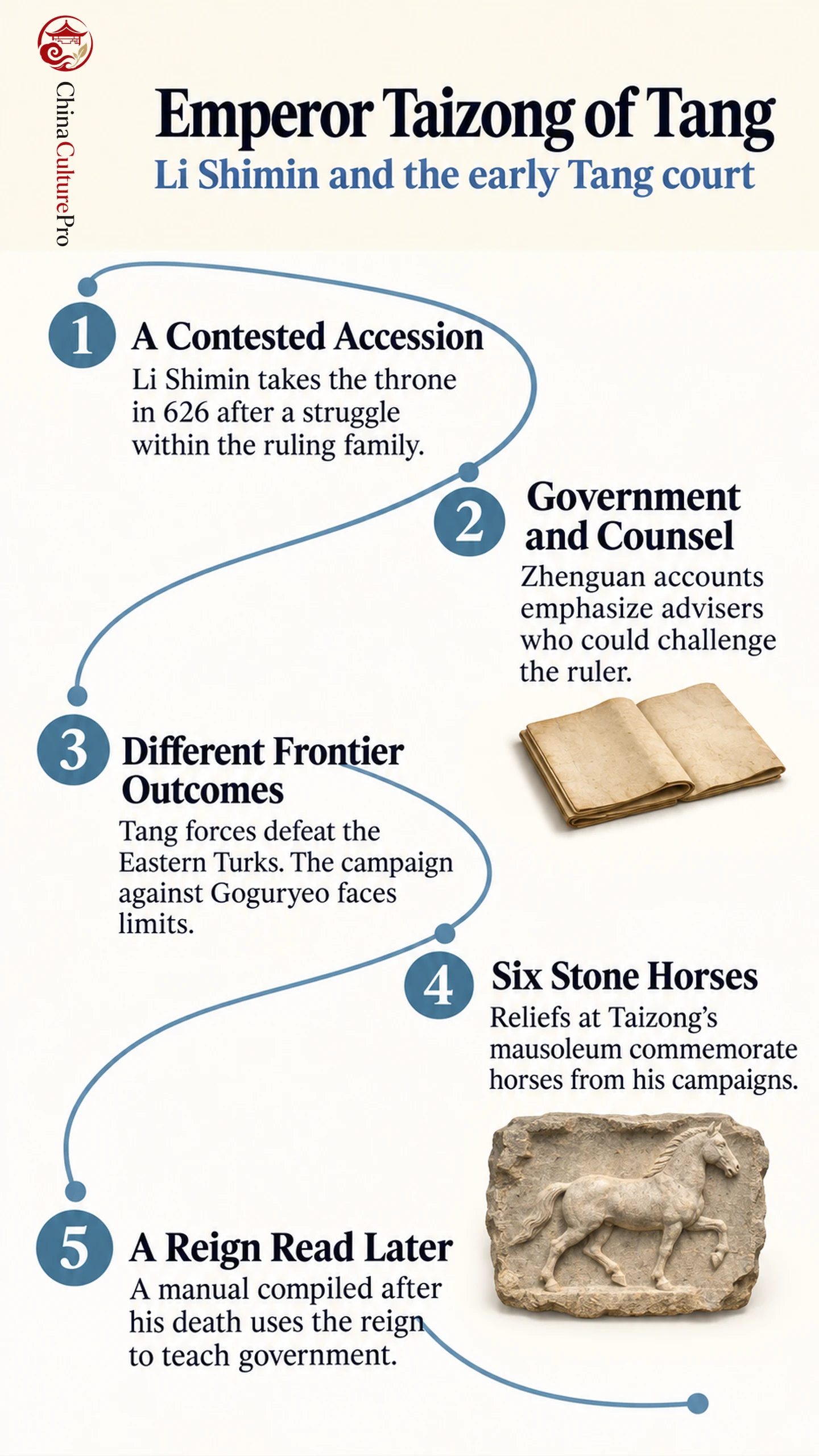
- Accession: He helped his father establish the Tang and then took the throne after defeating his brothers.
- Government: His court became associated with capable officials and advice that could challenge the ruler.
- Frontiers: His armies defeated the Eastern Turks, while his campaign against Goguryeo failed to secure a decisive victory.
- Memory: Court writings and carved warhorses preserve different accounts of what his reign was meant to represent.[1][2][3][4][5][6][7]
The dates of his accession and the first year of his reign era differ by one year.
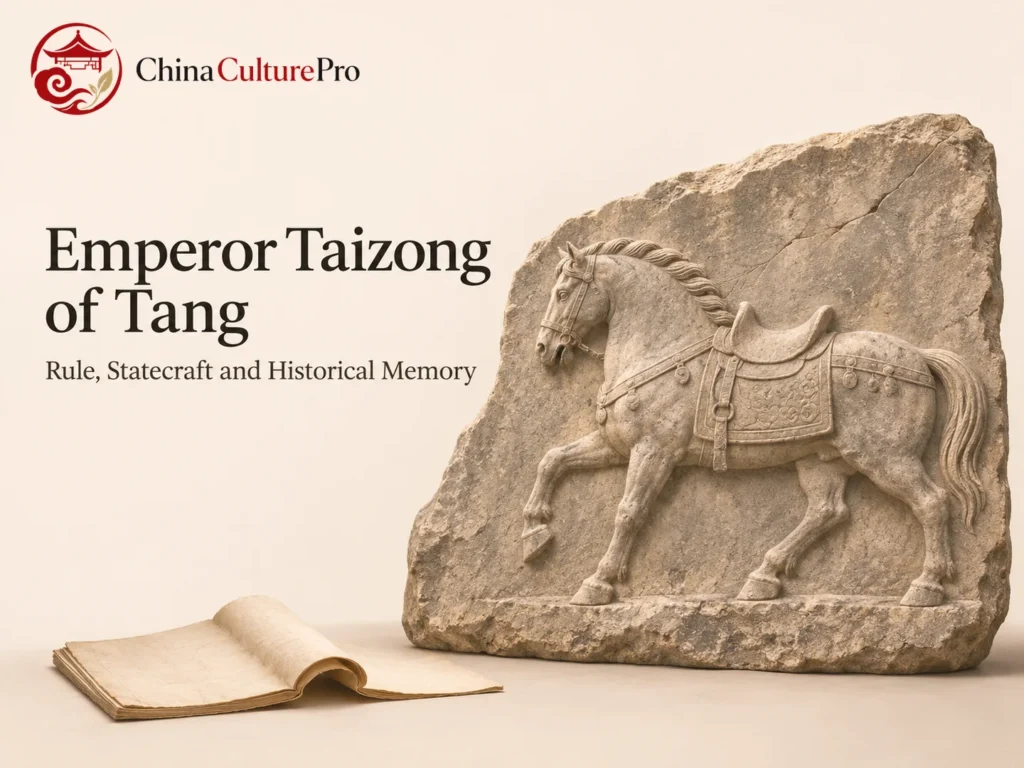
One of Taizong’s tomb reliefs shows a man pulling an arrow from a horse’s chest. The horse was one of six commemorated for carrying the emperor in battle. The relief presents the military past through a moment of vulnerability and service. Later texts gave another kind of shape to the reign, using the ruler’s exchanges with advisers as lessons in government.[6][7]
Li Shimin and the Struggle for the Throne
Li Shimin fought in the campaigns that brought his father, Li Yuan (李渊, Lǐ Yuān), to power as the Sui dynasty collapsed. Li Yuan founded the Tang dynasty in 618 and became its first emperor. Li Shimin’s early victories gave him considerable authority as a commander. His older brother nevertheless held the position of crown prince.[1][2][6]
In 626 Li Shimin and his allies ambushed two of his brothers at a palace gate. The episode is known as the Xuanwu Gate Incident (玄武门之变, Xuánwǔmén Zhī Biàn). Both brothers were killed. Li Yuan soon abdicated, and Li Shimin became emperor. The succession explains why later accounts of his government must also be read with attention to how he came to power.[1][2][6]
Government in the Zhenguan Era
The Zhenguan (贞观, Zhēnguān) era began in 627. Later accounts of the reign emphasize the place of remonstrance, the practice of giving frank counsel to a ruler. The official Wei Zheng (魏徵, Wèi Zhēng) became closely associated with this practice. The stories about his relationship with Taizong gave later readers a way to ask how a sovereign ought to respond when ministers challenged a decision.[2][5][7]
A text attributed to Taizong and presented as advice to his heirs offers a different view of government. It argues that a ruler cannot direct a large territory alone and proposes entrusting some outlying places to members of the imperial family. The passage puts delegated authority at the center of the problem. As advice, it tells readers what the writer thought would make government work. To see what the court put into practice, historians also need records of appointments and administration.[3]
War, Diplomacy and the Tang Frontiers
Tang armies defeated the Eastern Turkic khaganate in 630. The result increased the court’s influence along its northern frontier. Military power and diplomacy both shaped relationships with neighbors and peoples moving along the routes of the Silk Road. The choices available to the Tang differed from one frontier to another.[2][4][5]
In 645 Taizong led a campaign against Goguryeo. The Tang won engagements but failed to take the fortified position at Ansi and withdrew. The contrast with the victory of 630 shows how geography and resistance could limit the reach of the same court.[4][5][9]
The Six Horses and Imperial Memory
Six stone reliefs of Taizong’s warhorses stood at his mausoleum, Zhaoling (昭陵, Zhāolíng). They show different animals walking, galloping or standing. Several bear arrows, and one scene shows a man pulling an arrow from a horse. These details distinguish individual animals associated with the emperor’s campaigns. The reliefs make the experience of war visible through the horses that carried him.[6]
The sculptures were commissioned for the ruler’s tomb. Their size and arrangement made military service part of how visitors encountered his memory. An image of an injured horse can show what a court chose to remember without settling every detail of the battle in which the horse was wounded.[6]
How Later Readers Used Taizong’s Reign
The Essentials of Government in the Zhenguan Era (贞观政要, Zhēnguān Zhèngyào) was compiled after Taizong’s death. It presents episodes and exchanges as material for thinking about rule. It circulated beyond China and was translated into languages including Japanese and Mongolian. Later readers encountered a selection shaped for instruction. Its stories can tell us which examples of government editors and translators considered worth passing on.[7][8]
Taizong’s successor ruled the court in which Wu Zetian later gained authority. Among Chinese historical figures, Taizong is a case where the way a reign was written about became part of its legacy. Comparing historical records and later stories helps explain why some episodes survived as models of statecraft. The military reliefs, political advice and later manual can be read together by asking what each source was made to preserve.[5][6][7][8]
FAQs About Emperor Taizong of Tang
Was Taizong the first Tang emperor?
Li Yuan founded the Tang in 618. Taizong helped him establish the dynasty and became its second emperor in 626.[1][2][6]
What was the Zhenguan era?
It was the reign era associated with Taizong, from 627 to 649. The first era year followed his accession in 626.[1][2]
Why are the Six Horses of Zhaoling important?
They show horses associated with Taizong’s campaigns in distinct poses and conditions. Commissioned for his tomb, they provide material evidence of how he chose to commemorate military service.[6]
Fuentes
[1] The Palace Museum. Li Shimin
[2] Academy of Chinese Studies. Emperor Taizong of the Tang
[3] Columbia University Asia for Educators. Excerpts from Emperor Taizong on Effective Government
[4] Asia Major. Tang Diplomacy and Foreign Policy
[5] University of California Press. China: Dictionaries of Civilization
[6] University of Chicago Center for the Art of East Asia. The Six Stone Horses of Zhaoling
[7] Korea Journal. A Tang-Dynasty Manual of Governance and the East Asian Vernaculars
[8] The Oxford History of Historical Writing. The Growth of Historical Method in Tang China
[9] East Asian History. Tang Taizong in Korea: The Siege of Ansi