


Quick Answer: Who Was Zhang Heng?
Zhang Heng (张衡, Zhāng Héng, 78–139 CE) was an Eastern Han (东汉, Dōng Hàn) court official, astronomer and writer. He studied how the heavens moved, built instruments and wrote on subjects ranging from the structure of the sky to the excesses of imperial capitals.[1][2]
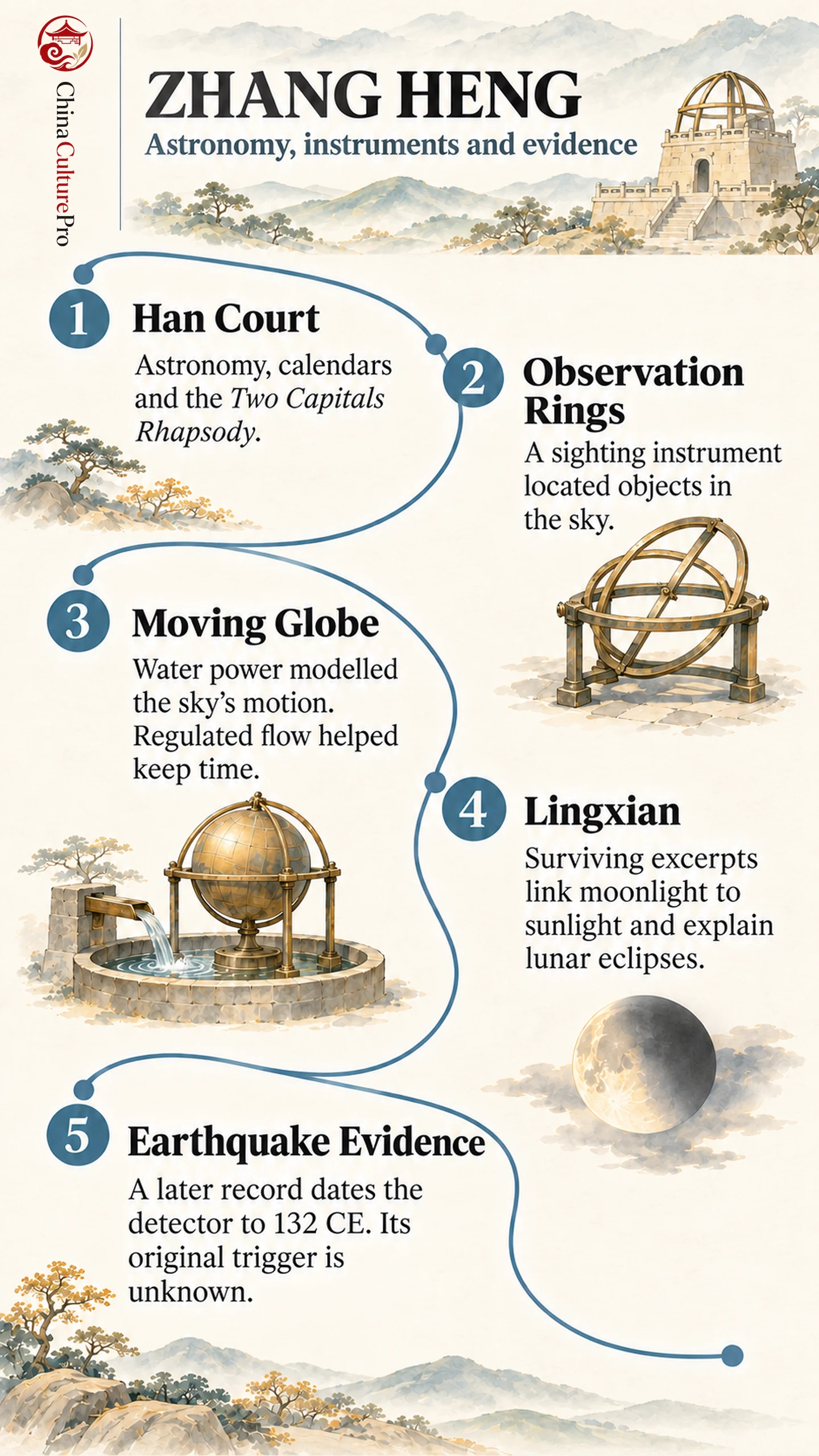
- Astronomy: His armillary sphere (浑天仪, húntiānyí) supported observation, while a celestial globe represented movements in the sky.[2]
- Cosmology: The Lingxian (灵宪, Língxiàn) discusses the Moon’s light and eclipses as part of a wider account of the cosmos.[3]
- Earthquakes: His seismoscope (候风地动仪, hòufēng dìdòng yí) was described as signalling the direction associated with shaking.[1]
The instruments are known through historical descriptions. A modern model can illustrate a possible design, while the original mechanism remains unresolved.[2][4]
A dragon dropping a bronze ball is an arresting image, but the famous vessel represents only one part of Zhang Heng’s career. His writing, court appointments and astronomical instruments show how several kinds of knowledge met in the capital. Reading his life alongside other Chinese historical figures also reveals a recurring problem: the object people remember most clearly may be the object historians can reconstruct least securely.
An Astronomer at the Eastern Han Court
Zhang came from Nanyang in present-day Henan. He studied in Luoyang, the Eastern Han capital, and held the office of Taishiling (太史令, tàishǐlìng), which involved official astronomy and calendrical work. His service included appointments under Emperor An and Emperor Shun. Late in life he administered the kingdom of Hejian before returning to a court post.[1][2]
At the Han court, determining dates was a public responsibility. Calendrical calculations connected recurring movements of the Sun and Moon with a timetable that the state could use. A person holding Zhang’s office also worked in a setting where reports of unusual celestial events or disasters could become part of a discussion about government. That combination helps explain why close observation and political argument appear together in his biography.[1][2]
His literary work had its own political purpose. The Two Capitals Rhapsody (二京赋, Èrjīng fù) drew on the imperial cities of Chang’an and Luoyang. Its descriptions of courtly scale and luxury gave Zhang a way to criticize extravagance through a literary form that could dwell on the very spectacle it questioned.[1] The rhapsody and his technical work reached different audiences, but both belonged to the career of a man who wrote for and about the court.
His work also touched Chinese mathematics. A treatise on circles inscribed in and drawn around a square is associated with his use of the square root of ten as an approximation for π. The example shows how a geometric argument could yield a value even when the result was less accurate than some other approximations.[5]
How the Armillary Sphere and Globe Differed
An armillary sphere is a system of rings that represents reference circles on the sky. A sighting arrangement lets an observer align the instrument with a celestial object and describe its position relative to those circles. Zhang worked within an existing Chinese instrument tradition. Earlier Han observers and makers had already used ring instruments, so his contribution belongs to a succession of improvements.[2]
The globe served a different purpose. A model of the celestial sphere could display relationships among positions and help with graphical calculations. Later records describe a globe that turned under water power to model the apparent daily motion of the heavens. The distinction is easiest to see in use: an observer points the ring instrument at the sky, whereas the globe brings a model of that motion into the room.[2]
A water supply also poses a practical timing problem. As a reservoir empties, the falling water level can alter the rate of flow. A second reservoir that keeps the lower supply nearer a steady level reduces that change. Fragments associated with Zhang describe this kind of regulation, though they do not supply a complete construction drawing.[2] His work therefore connects Chinese astronomy with an engineering question about how to make a model move consistently.
What the Lingxian Says About the Sky
Zhang developed the huntian (浑天, húntiān) account of a spherical heaven surrounding a central Earth. The familiar comparison to an egg comes from the instrument commentary associated with him: the outer shell conveys the surrounding heavens and the yolk conveys the central position of Earth. Taking the shape of the yolk as decisive proof that Zhang described a spherical Earth asks the analogy to settle a question the evidence leaves open.[2]
The Lingxian gives a more specific example of his reasoning. It connects the bright part of the Moon to illumination from the Sun and relates lunar eclipses to a dark region opposite the Sun. Those passages show how Zhang used the positions of celestial bodies to account for visible changes in light.[3] They sit within a Han cosmology with its own assumptions and vocabulary.
The transmission matters as much as the translation. Zhang’s astronomical writings survive through later quotation and collection. A printed excerpt can preserve a passage without preserving every step of the argument or an accompanying instrument drawing.[2] This is one reason the history of his astronomy and the history of his instruments have different kinds of gaps.
The Earthquake Instrument and Its Evidence
The Book of the Later Han (后汉书, Hòu Hàn shū), compiled centuries after Zhang’s lifetime, places the bronze instrument in 132 CE. Its biography describes eight external dragon heads holding balls above open-mouthed toads. One ball could drop and make an audible signal. In the famous anecdote, a release at the capital puzzled observers who had felt no shaking, and a later report identified an earthquake in Longxi.[1]
The account gives useful constraints for reconstructing the seismoscope: a directional release, an audible indication and a concealed linkage. It leaves room for incompatible designs. For example, a suspended pendulum and an upright mechanism that tips under motion could both be explored as ways to trigger a release. No original mechanism survives to test which model matches the written account.[1][4]
Read the anecdote as evidence of what the historical account credited the vessel with doing. It supplies no calibrated measurement of distance, magnitude or sensitivity. A working modern model can answer whether one arrangement is feasible under its test conditions. Recovering Zhang’s particular arrangement would require a different kind of evidence. The same distinction is useful when reading other examples of history and legend in China.
FAQs About Zhang Heng
Is Zhang Heng the same person as Chang Heng?
Yes. Chang Heng is an older romanization of the same name. Zhang Heng is the modern pinyin spelling.
Did Zhang Heng predict earthquakes?
His instrument reportedly responded to shaking after it reached the vessel. An indication from a distant event was still a detection, even if people in the capital did not feel it.
Why do museum models of the seismoscope differ?
The written description constrains some visible features while leaving the trigger open to interpretation. Exhibits can show different workable solutions to that missing part of the design.
Fuentes
[1] Fan Ye. Book of the Later Han, Volume 59: Biography of Zhang Heng
[2] Biographical Encyclopedia of Astronomers. Zhang Heng
[3] Zhang Heng. Lingxian Excerpt in the Imperial Encyclopedia, Astronomy Volume 36
[4] Kuo-Hung Hsiao and Hong-Sen Yan. The Review of Reconstruction Designs of Zhang Heng’s Seismoscope
[5] University of St Andrews, MacTutor. Zhang Heng