


Quick Answer: Who Was Xu Wei?
Xu Wei (徐渭, Xú Wèi; 1521–1593) was a Ming-dynasty painter, calligrapher, poet and playwright from Shanyin, now Shaoxing in Zhejiang. His flower paintings turn vigorous brushwork into personal expression. [1][7]
- Approach: Freehand painting (写意, xiě yì) emphasizes expressive brush and ink.
- Connection: Painted forms, handwriting and poems work together.
- Range: His surviving flower works vary in scale, format and degree of boldness.
Freedom of execution includes choices about outlines, tonal density and the placement of each mark.
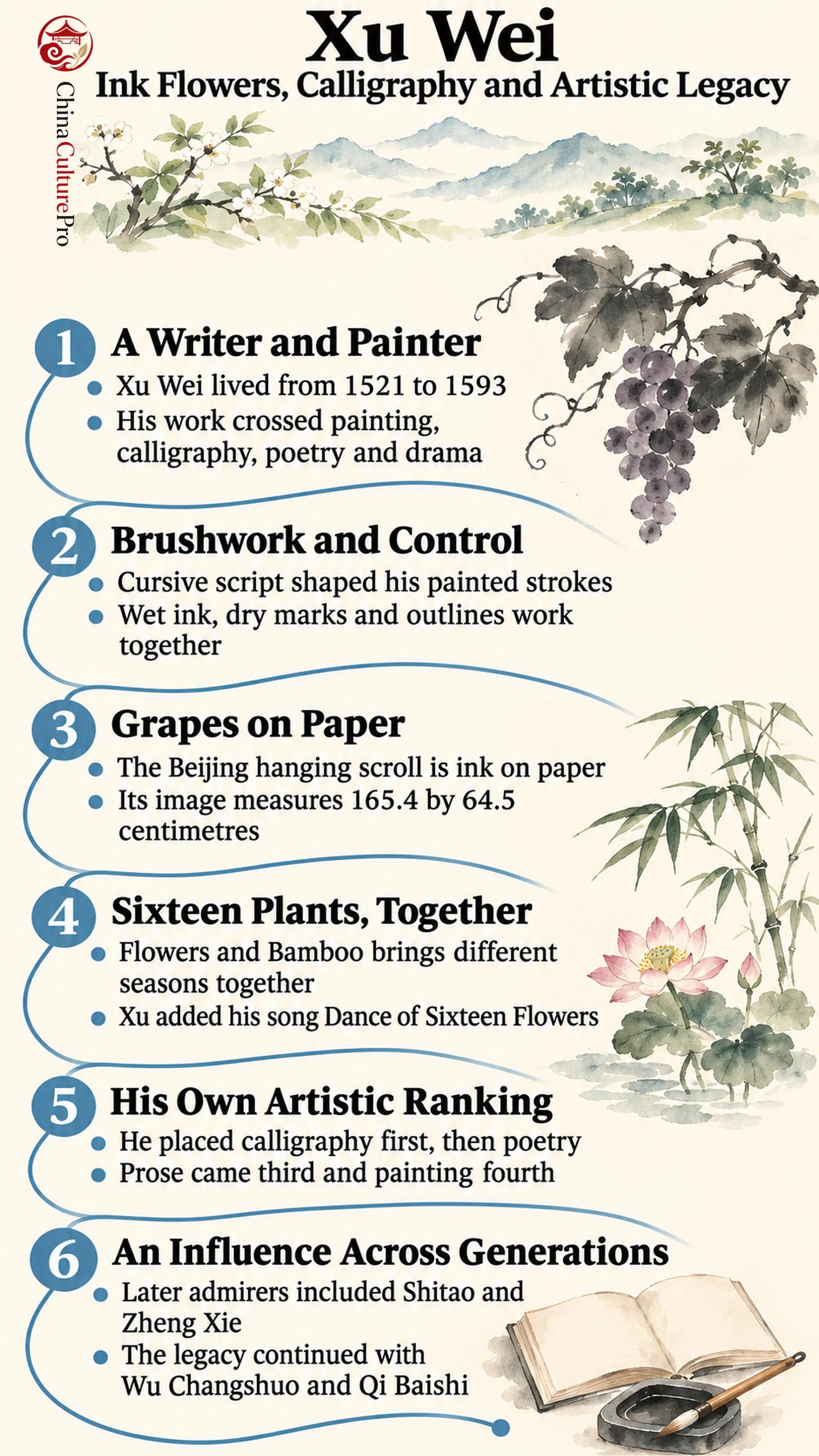
A broad ink leaf and a quick written line can share a rhythm. Xu’s paintings make that relationship visible, while their poems give familiar plants a particular voice.
A Literary Life Beyond Painting
Xu lived during the Ming dynasty. He repeatedly failed the provincial examinations, worked in Hu Zongxian’s secretariat and later returned home in poverty. [5]
His dramatic writing included Four Cries of a Gibbon, a group of four plays. Its stories include Mulan taking her father’s place in the army and a woman entering the examinations in male disguise. [7]
This literary range matters when reading an inscribed painting: the poetic speaker contributes to the work’s character alongside its visual forms.
Brushwork: Freedom with Structure
Cursive script (草书, cǎo shū) supplies a model for the moving brush. Shanghai’s Flowers connects written strokes with painted forms and pairs each section with a poem. [1]
In Grapes, twisting vines and spreading leaves combine with clusters of fruit. The Palace Museum describes pale ink mixed with glue and alum, producing diffused effects. Its inscription voices frustration at unrecognized talent, while the handwriting recalls Mi Fu. [2]
Nine Sections of Ink Flowers combines splashed ink (泼墨, pō mò), dry ink and outlines. Each section has its own seven-character quatrain. [3]
These are different technical choices. Compare a wet mass with a sharp edge, then follow the branch linking them. Its direction holds the composition together even where individual forms are abbreviated. The broader distinction between detailed and freehand painting becomes clearer when applied to an actual mark.
Four Museum Works to Compare
All four works below are ink on paper. Their dimensions help distinguish a long, gradually viewed handscroll from a vertically displayed hanging scroll.
| Work | Collection | Format and image size |
|---|---|---|
| Grapes | Palace Museum, Beijing | Hanging scroll; 165.4 × 64.5 cm. [2] |
| Nine Sections of Ink Flowers | Palace Museum, Beijing | Handscroll; 46.6 × 625 cm. [3] |
| Flores | Shanghai Museum | Handscroll; 33.5 × 522.8 cm. [1] |
| Flowers and Bamboo | National Palace Museum, Taipei | Hanging scroll; 337.6 × 103.5 cm. [4] |
Flowers, Seasons and Written Voices
Flowers and Bamboo combines sixteen kinds of plants from different seasons, including plum, lotus, chrysanthemum and narcissus. It mixes outlines with directly washed forms; Xu added his song Dance of Sixteen Flowers at the left. [4]
The gathering is an artistic arrangement rather than a record of plants blooming together. A viewer can move between distinct flower shapes, differences in ink weight and the written passage. Ask how the spacing of the inscription balances the denser painted areas.
In Shanghai’s handscroll, the repeated pairing of a plant image with a poem creates successive encounters. Its calligraphic forms invite comparisons with Chinese scripts. [1]
Interpretación painting inscriptions therefore adds more than a name or date: a poem can change how a plant’s visual character is understood.
An Influence Beyond the Ming Dynasty
Xu drew on flower-painting traditions associated with Liang Kai, Lin Liang and Shen Zhou; his calligraphy also engaged with Su Shi and Mi Fu. Alongside Chen Chun, he advanced expressive ink flower painting. [6]
His legacy extends through Bada Shanren, Shitao and Zheng Xie to Wu Changshuo and Qi Baishi. These are connections across generations, rather than a chain of personal apprenticeships. [8]
Compare how each later painter transforms the earlier vocabulary: the weight of a stem, the handling of a leaf, or the balance between ink and empty paper.
FAQs About Xu Wei
Was Xu Wei mainly a painter or a calligrapher?
His talents crossed several arts. He ranked his own calligraphy first, then poetry, prose and painting; this was his own assessment of his talents. [5]
Are all his flower paintings equally wild?
No. The National Palace Museum describes the eleven-plant Sketches from Life as less boldly unrestrained than some of his other flower scrolls, while retaining force and fluency. [5]
Do the flowers represent one actual season?
Not always. Flowers and Bamboo deliberately gathers plants from different times of year into one composition. [4]
Fuentes
[1] Shanghai Museum. Flores
[2] Palace Museum. Grapes
[3] Palace Museum. Nine Sections of Ink Flowers
[4] National Palace Museum, Taipei. Flowers and Bamboo
[5] National Palace Museum, Taipei. Sketches from Life
[6] Palace Museum. Xu Wei
[7] National Museum of Taiwan Literature. Wang Jiacheng’s Biography of Xu Wei: Four Cries of a Gibbon
[8] Shaoxing Museum, via Chinese Museums Association. Qi Baishi and Xu Wei’s Legacy