

Quick Answer: What Is Wuyuan Mingmei Tea?
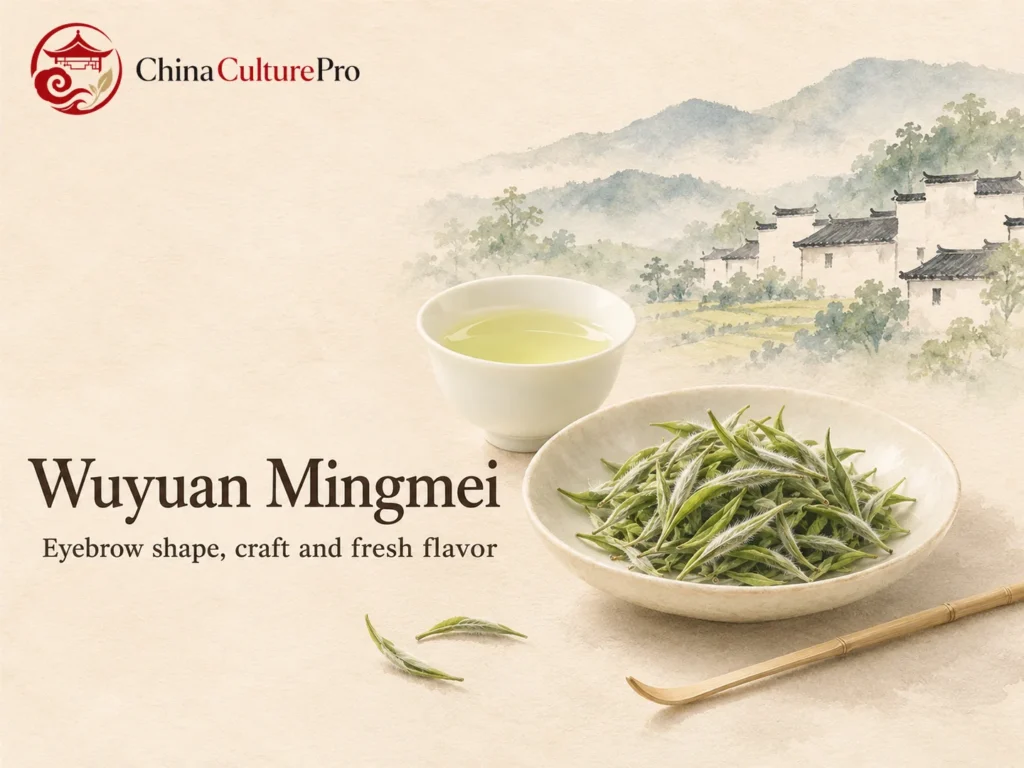
Wuyuan Mingmei(婺源茗眉,Wùyuán Míngméi)is an eyebrow-shaped green tea from Wuyuan in Jiangxi.[1]
- Leaves: fine, tightly formed green shoots curve slightly like eyebrows.[2]
- Craft: its traditional processing combines pan work with baking stages.[2]
- Flavor: local descriptions emphasize lasting fragrance and a fresh, mellow cup.[2]
- Identity: it is a named product within the wider Wuyuan green-tea family.[1]
The name refers to the tea and its shape; it does not mean plum-flavored tea.
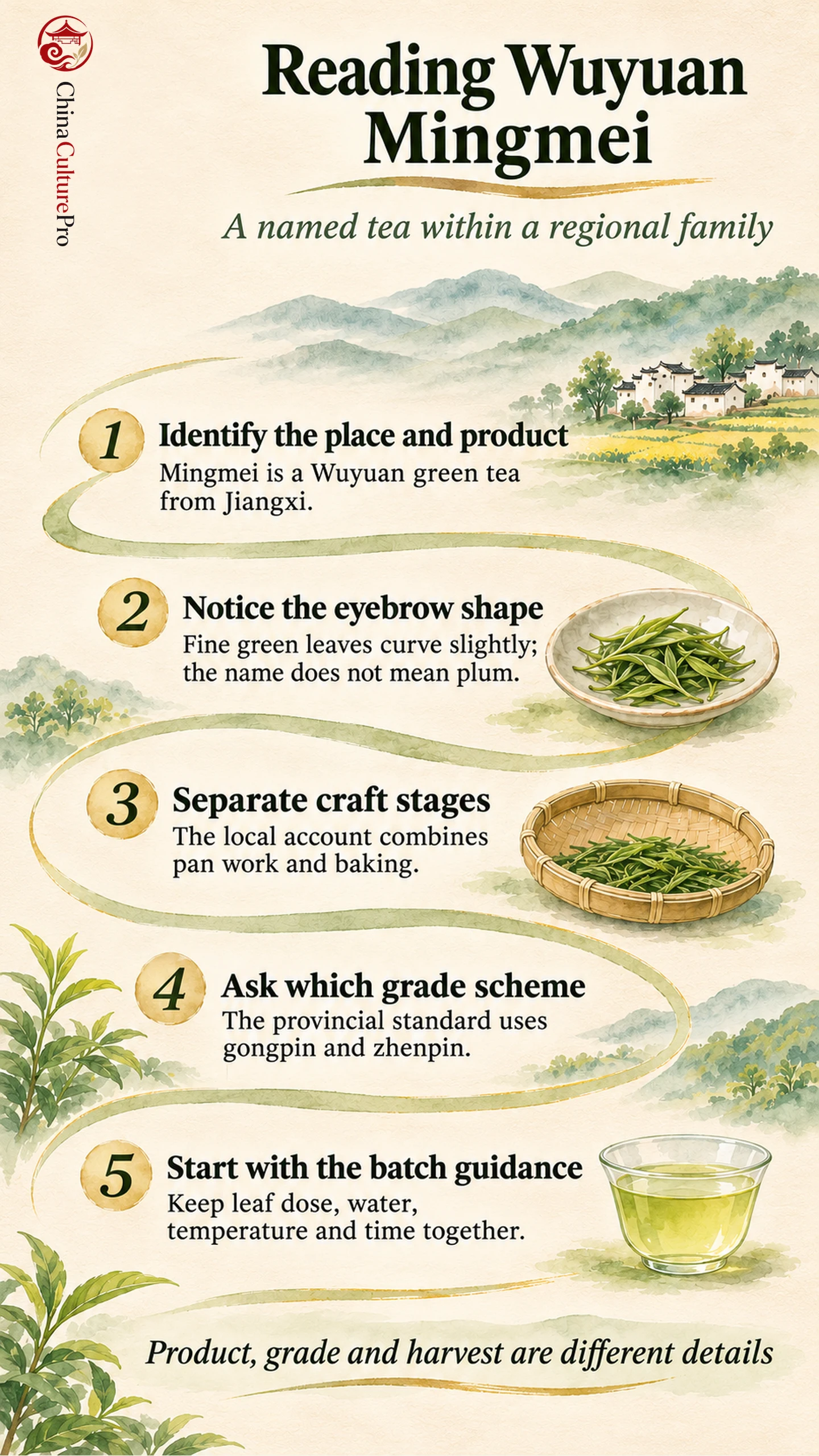
Understanding Mingmei means separating the named product, its regional background and the grade or harvest of the particular packet.
Wuyuan Mingmei, Wulu and Chunmee
Wulu(婺绿,Wùlǜ)is the broader regional green-tea name. The provincial standard distinguishes Mingmei from Chunmee(珍眉,zhēnméi), another product within that family. Similar eyebrow-shaped names do not make them interchangeable.[1]
The last character of Mingmei is 眉, meaning eyebrow, rather than 梅, meaning plum. Translating it as “famous plum” changes the name and implies a connection the Chinese characters do not support.
For the wider regional terminology and similar overseas trade names, see our Wulu green-tea guide.
A Modern Named Tea in an Older Tea Region
A local tea producer’s historical account dates the development of the named Mingmei product to 1958, building on Wuyuan’s existing tea-making tradition. That is a modern product history within an older tea region. References to Wuyuan tea in ancient writings should not be presented as proof that today’s Mingmei name and technique already existed then.[2]
Leaves, Processing and Flavor
The local account describes spreading, fixation, rolling, initial baking, pan working and rebaking. Pan shaping and baking are separate stages within this account of the craft; both help explain the finished leaves.[2]
Fine curved leaves, visible pale hairs and a green sheen are characteristic descriptions. The liquor is described as clear yellow-green, with a lasting fragrance and a mellow, refreshing taste. Those words introduce the style; they do not grade a packet from a photograph.[2]
One English retail listing describes thin, long eyebrow-like leaves and a clear, rich, sweet-tasting infusion. These are that listing’s tasting notes, rather than a description guaranteed for every harvest.[3]
Understanding the Grade Names
DB36/T 752-2024 uses gongpin(贡品,gòngpǐn)and zhenpin(珍品,zhēnpǐn)for Mingmei. Ask how a seller defines other grade labels.[1]
Keep harvest language separate too. Our harvest-season guide explains seasonal terms; a harvest phrase does not replace the product name, declared grade or batch description.
A Starting Method for Brewing Wuyuan Mingmei
Follow your batch’s instructions first. A published producer guide for green tea includes Mingmei among its examples and gives ranges for water temperature, leaf-to-water ratio and drinking time. The method below is an editorial starting choice within those ranges, not a tested recipe for every Mingmei batch.[4]
- Measure 3 g of tea and 150 ml of fresh brewing water.
- Prepare water at 80°C and place the leaves in a clean glass or brewing vessel.
- Start timing as you add some water to wet the leaves, then add the remainder of the measured water.
- After about three minutes, separate the liquor from the leaves and taste.
- For the next preparation, change one factor at a time, such as steeping time, while keeping notes.
The complete method matters more than copying a temperature without its dose or water volume. Compare brewing water if the same leaves taste different between locations.
FAQs About Wuyuan Mingmei
Does Mingmei Mean Plum Tea?
No. The Chinese name ends in the character for eyebrow, not plum. The name itself does not indicate added fruit.
Is Wuyuan Mingmei the Same as Chunmee?
No. The provincial standard names them as distinct products within Wuyuan green tea.[1]
Is It Made from Only One Cultivar?
No. The standard allows suitable plant material rather than defining Mingmei as one compulsory cultivar. See our cultivar guide for the distinction.[1]
Are Extra, First and Second Grade the Only Grade Names?
No. The 2024 provincial standard instead uses gongpin and zhenpin for Mingmei.[1]
Fuentes
[1] Jiangxi Administration for Market Regulation. DB36/T 752-2024: 地理标志产品 婺源绿茶
[2] Wuyuan Xia Gu Chun Tea Factory. 婺源茗眉
[3] Madras. Wu Yuan Ming Mei Chinese Green Tea
[4] Anji Best White Tea. How Should Green Tea Be Brewed