
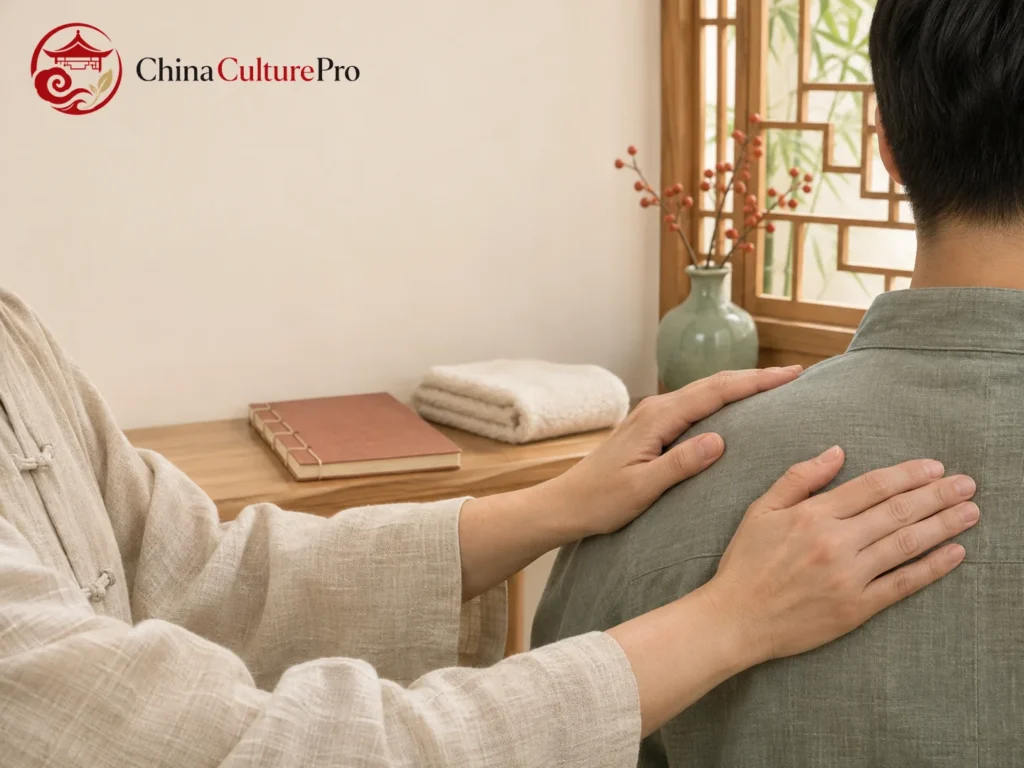

Quick Answer: What Is Tuina?
Tuina (推拿, tuīná) is Chinese manual therapy within traditional Chinese medicine (中医, zhōngyī). Practitioners use trained hand techniques rather than one standard movement for every problem.[1]
- Its two characters mean push and grasp.
- Historical texts and modern professional practice belong to different settings.
- Research must identify the actual technique, condition, comparison and outcome.
A traditional name, strong pressure or an immediate sensation does not establish clinical benefit. Suitability and proposed methods should be discussed before treatment.

Hands can press, move or work soft tissue in many ways. Understanding what a practitioner means by tuina helps separate a recognizable Chinese medical tradition from a vague promise that any massage will produce the same result.
What the Name Means and the Techniques It Uses
The related label anmo (按摩, ànmó) also refers to massage. Its characters convey pressing and rubbing, while tuina joins push with grasp. Overlapping vocabulary does not guarantee identical training or treatment.[8]
The examples below identify four manual techniques. They are a vocabulary for recognizing professional practice, rather than a treatment sequence.
| Technique | Descriptive feature |
|---|---|
| Pushing (推法, tuīfǎ) | Pressure combined with a directed movement of the hand or fingers.[1] |
| Kneading (揉法, róufǎ) | Slow circular working of tissue with the hand or thumb.[1] |
| Rolling (滚法, gǔnfǎ) | Rhythmic rolling contact through the back or side of the hand.[1] |
| Grasping (拿法, náfǎ) | A lifting and compressing action applied to soft tissue.[1] |
Traditional descriptions may refer to meridians (经络, jīngluò) when explaining where and why work is applied. That identifies part of the medical framework; a claimed health outcome still needs appropriate clinical evidence.[1]
The method name alone therefore leaves important questions open. Which tissues or movements are being addressed? What does the practitioner expect to change? Is the treatment being offered for relaxation, a functional problem or another stated purpose? Those questions are more informative than assuming one label specifies the whole encounter.
Classical Bodywork and Later Pediatric Manuals
A chapter in Suwen (素问, Sùwèn), part of the Huangdi Neijing (黄帝内经, Huángdì Nèijīng), places guided movement, or daoyin (导引, dǎoyǐn), alongside manual bodywork among different therapeutic approaches. This is evidence of a classical medical context, rather than a description of every modern tuina protocol.[2]
A later example is Xiaoer Tuina Guangyi (小儿推拿广意, Xiǎo’ér Tuīná Guǎngyì), a Qing pediatric manual associated with compilation around 1676. It organized diagnostic ideas, techniques and treatments for children. A modern critical edition used an 1832 reprint as its base, showing how an older work could continue through later editions.[3]
The two dates have different meanings: an approximate composition date and the date of a particular reprint. Neither turns the book’s historical indications into modern clinical proof, nor makes adult massage methods appropriate for a child.
These sources reveal more than simple longevity. They show different medical vocabularies, intended patients and ways of organizing knowledge. The broader traditional Chinese medicine overview explains why historical documentation and clinical evaluation need separate treatment.
Reading Research Without Mixing Comparisons
Modern studies can ask whether massage helps compared with a sham treatment, whether one tuina approach differs from another, or whether adding exercise improves outcomes. Those are distinct questions.
| Evidencia | What was compared | What the result means |
|---|---|---|
| 2024 neck-pain review: 33 studies, 1,994 participants | Massage research involving several methods, including comparisons with sham massage. | Overall evidence was mostly low certainty; findings around 12 weeks cannot be treated as proof for every tuina technique.[4] |
| 2025 tuina trial: 60 participants | Work around a neck muscle’s attachment areas versus its central portion, over two weeks. | Differences in symptom and muscle measures were reported, but both groups received tuina; this was not a comparison with no tuina.[5] |
| 2026 mechanical neck-pain trial: 90 participants, mean age 26.4 years | Tuina plus resistance exercise versus tuina alone for four weeks. | The combined group reported greater improvements on several measures; the design assessed added exercise rather than isolating tuina’s effect against sham or no treatment.[6] |
The broader 2024 review found that massage may make little or no difference in pain and other main outcomes compared with sham massage at the assessed follow-up. That uncertain finding should not be replaced by the assumption that every manual-therapy label has a proven benefit.[4]
Equally, a comparison between two active tuina methods does not answer whether either is better than no treatment. Short-term symptom scores or muscle measurements also leave questions about sustained recovery and everyday function. Read the actual comparison before adopting a broad claim from the result.
What Responsible Professional Care Should Include
Professional practice benchmarks include assessment, informed consent, treatment planning, records of the person’s response and review of outcomes. These are service standards, rather than proof of benefit for every condition.[1]
Useful questions include:
- What is the proposed goal, and how will progress be reviewed?
- Which methods will be used, and what discomfort or adverse reactions should be reported?
- How do relevant health conditions, previous injuries or medicines affect the plan?
Massage generally appears to have a low risk of harm, but rare serious reports include blood-clot problems, nerve injury and fracture. Some involved vigorous massage or people at greater risk of injury. These are not incidence estimates for every individual tuina technique.[7]
Discuss suitability with a healthcare professional when needed, and tell the practitioner about discomfort or unexpected symptoms. More force is not a reliable measure of better care. The meaningful question is whether the agreed problem and function improve without unacceptable harm.
FAQs About Tuina
Is tuina the same as every kind of massage?
No. The terms overlap, but tuina identifies a Chinese manual-therapy tradition. A particular provider’s training, methods and treatment goals still need clarification.
Does tuina require needles or cups?
No. Manual techniques define the practice. If acupuncture or cupping is proposed as well, ask how each procedure fits the plan.
Does painful pressure prove that treatment is working?
No. Pain during treatment is different from improvement in the agreed outcome. Report discomfort and ask for the approach to be reassessed when necessary.
Are historical pediatric manuals suitable as home treatment guides?
A historical manual documents a medical tradition. It does not establish the safety or effectiveness of applying its methods to a particular child today; seek appropriate professional assessment.
Fuentes
[1] World Health Organization. WHO Benchmarks for the Practice of Tuina
[2] Chinese Text Project. Huangdi Neijing, Suwen: 異法方宜論
[3] Xiong Yingxiong; University of Hong Kong School of Chinese Medicine editorial committee. 小兒推拿廣意: Critical Edition and Editorial Introduction
[4] Gross AR, Lee H, Ezzo J, et al. Massage for Neck Pain
[5] Sun Y, Ji Y, Lou H, et al. Effect of Tuina at Different Muscle Positions on Surface Electromyography in Chronic Nonspecific Neck Pain: A Randomized Clinical Study
[6] Zheng S, Wu Z, Chang Y, et al. Tuina Therapy Plus Resistance Exercise Versus Tuina Alone for Mechanical Neck Pain: A Randomized Controlled Trial
[7] National Center for Complementary and Integrative Health. Massage Therapy: What You Need To Know
[8] Ministry of Education. Revised Mandarin Chinese Dictionary: 按摩