


Quick Answer: What Is the Huangdi Neijing?
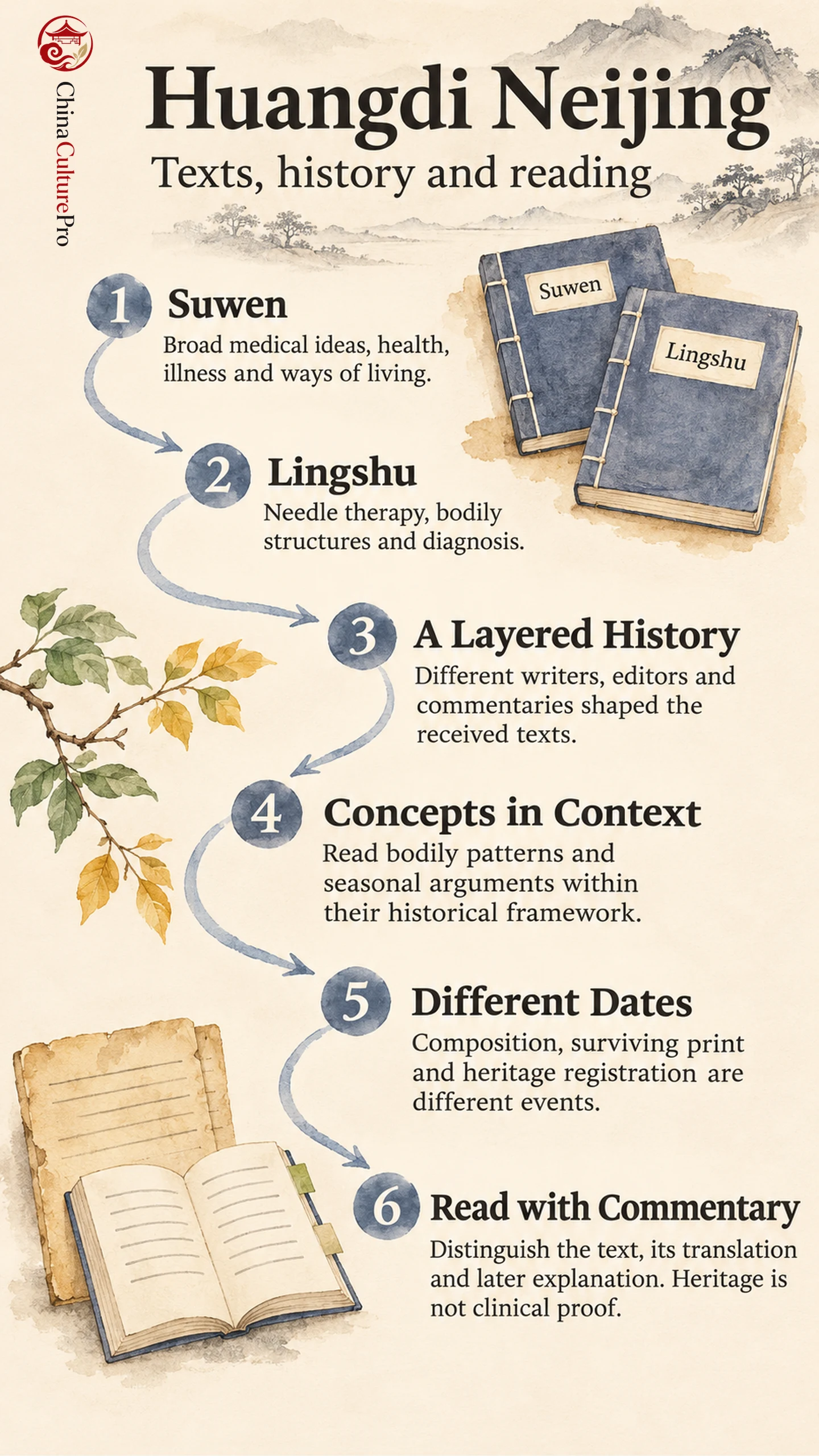
The Huangdi Neijing (黄帝内经, Huángdì Nèijīng), or Yellow Emperor’s Inner Classic, is a foundational collection of Chinese medical writing, transmitted through two major works.
- Contents: One work ranges across medical theory and ways of living; the other gives particular attention to needling.
- History: The received texts contain material and editorial work from different periods, rather than one author’s single publication.
- Reading: A translation with commentary helps distinguish ancient passages, later interpretation and modern explanation.
Its historical importance does not make every medical statement a demonstrated modern treatment claim.[2][8]
Readers often meet the title as if it named one unchanged book. A more useful approach separates the collection’s ideas from the long history of the texts that carry them. That distinction explains both its influence on traditional Chinese medicine and the care needed when reading it today.
Two Works Under One Collective Title
Suwen (素问, Sùwèn), commonly rendered Basic Questions, addresses health and illness through topics such as bodily processes, environmental change, diagnosis and ways of living. Its arguments draw together different schools of thought. It should not be treated as one author’s consistently organized modern textbook.[1]
Lingshu (灵枢, Língshū) is the companion work, with a strong focus on needle therapy. Its scope also includes bodily structures, causes of illness and diagnosis, rather than only a catalogue of needle techniques. Its received arrangement has 81 chapters; a full scholarly translation includes notes on difficult passages and textual change.[2]
The two works overlap in their medical world while emphasizing different questions. Someone researching acupuncture or the history of medical channels will therefore encounter the second work especially often. Neither should be read as an instruction manual for unsupervised treatment.
Why There Is No Single Author or Publication Date
The title invokes Huangdi (黄帝, Huángdì), the legendary Yellow Emperor. He is a figure within the work’s framing, not a securely identified historical author whose writing can be dated to a legendary reign. A title attached to an ancient sage is a different kind of evidence from an author’s surviving manuscript.[8]
The collection is associated with medical knowledge taking shape around the late Warring States and Qin–Han periods, while the received texts also bear the work of later editors. Its early essays belong to the final centuries BCE, while later editorial work helped produce the received text. Formation and transmission are different questions from a single publication date.[3][8]
Wang Bing (王冰, Wáng Bīng) completed an influential commented edition in 762. His arrangement reshaped an earlier Suwen into 24 textual divisions and 81 numbered chapters. An editor’s intervention helps explain what later readers received; it does not make him the sole author of all the underlying material.[4]
Later editions also followed commentary associated with Lin Yi (林亿, Lín Yì) in the eleventh century. The book’s authority grew through preservation, revision and explanation. “Ancient” describes the tradition’s depth, rather than guaranteeing that every printed line comes unchanged from its earliest period.[3]
What Its Concepts and Dialogues Help Readers Understand
The work is important partly because it connects the body with patterns beyond the body. Yin and yang (阴阳, yīn yáng) describe interacting relationships; the Five Phases (五行, wǔxíng) provide another way to classify change and relationships. These are organizing ideas within its medical reasoning, rather than chemical ingredients or modern laboratory measurements.[8]
For a concrete example, Suwen chapter 2 relates conduct and daily rhythms to spring, summer, autumn and winter. Its seasonal passages join bodily care to the year’s changes. They are valuable evidence for how the text imagined living within a larger natural order, rather than a substitute for present-day diagnosis.[5]
That reading helps explain later seasonal health traditions. It also prevents a familiar error: taking a short sentence out of a seasonal argument and treating it as an isolated universal health rule. The medical Five Phases framework likewise needs its own historical and conceptual context.
The question-and-answer format encourages attention to an argument: what problem is raised, how the response explains it and which conceptual connections do the work. Reading only a detached quotation can conceal that reasoning.
Reading a Classic Through Editions and Translations
Composition, a surviving printed object and a modern translation have different dates. Keeping those layers separate makes catalogues much easier to interpret.
- A Jin-period Suwen: One surviving printed edition is catalogued within the broad range 1115–1234. That is a date range for the printed object, not an exact composition year.[3]
- The 1339 edition: The woodblock-printed version nominated for the Memory of the World Register was published in 1339; its inscription was registered in 2011. Those dates refer to the edition and its heritage recognition.[6]
- Modern translations: A translation may include a historical introduction, the main text and selected commentaries. Check which work is translated and whether commentary is clearly marked.[1][2]
For a beginner, an annotated edition offers more help than a collection of wellness quotations. Keep three questions beside the page: Which text is this? Whose explanatory voice am I reading? Is the claim being described historically or recommended medically?
Heritage recognition concerns documentary importance. Whether a treatment works and is safe remains a separate question requiring evidence about the actual intervention.[7]
FAQs About the Huangdi Neijing
Did the Yellow Emperor write the book?
He is its legendary namesake and dialogue figure. The received collection developed across periods; it cannot responsibly be presented as a surviving book written by one ancient emperor.[8]
Are Suwen and Lingshu two volumes of one modern textbook?
They are two major transmitted works associated with the collective title. Their overlapping subjects and different emphases are better understood through textual history than through a modern textbook analogy.[1][2]
Does a heritage inscription endorse its medical claims?
No. Documentary recognition identifies cultural and historical importance, rather than proving the effectiveness of every therapy described.[6][7]
Which part should a beginner start with?
Choose according to the question: Suwen for broad medical ideas and ways of living, or Lingshu for the textual history of needling. In either case, prefer clear separation of text, translation and commentary.[1][2]
Fuentes
[1] Paul U. Unschuld and Hermann Tessenow. Huang Di Nei Jing Su Wen: An Annotated Translation of Huang Di’s Inner Classic – Basic Questions
[2] Paul U. Unschuld. Huang Di Nei Jing Ling Shu: The Ancient Classic on Needle Therapy
[3] Library of Congress. Huang di nei jing su wen
[4] Paul U. Unschuld and Hermann Tessenow. Huang Di Nei Jing Annotated Bibliographies
[5] Chinese Text Project. Huangdi Neijing, Suwen: Si Qi Diao Shen Da Lun
[6] UNESCO. Huang Di Nei Jing (Yellow Emperor’s Inner Canon)
[7] National Center for Complementary and Integrative Health. Traditional Chinese Medicine: What You Need To Know
[8] Paul U. Unschuld. Huang Di Nei Jing Su Wen: Nature, Knowledge, Imagery in an Ancient Chinese Medical Text