


Quick Answer: What Is Chinese Pulse Diagnosis?
Chinese pulse diagnosis (脉诊, màizhěn) interprets sensations felt at pulse sites within a traditional medical framework. It involves more than counting heartbeats.
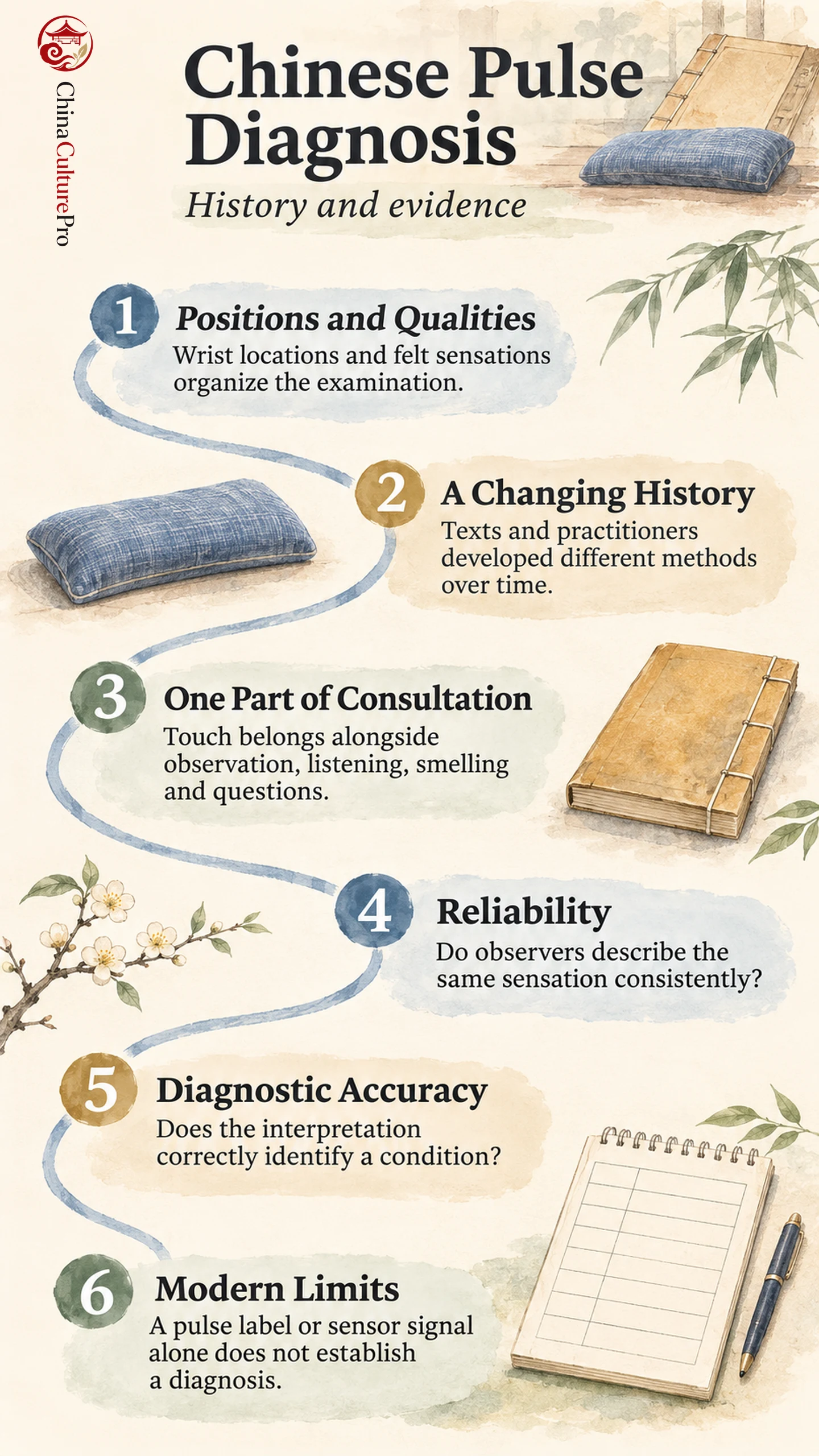
- Practice: Wrist locations, pressure and felt qualities help organize the examination.
- History: Texts and practitioners developed different methods over time.
- Evidence: Agreement about a sensation is different from proving that it identifies a disease.
A traditional pulse label alone should not be treated as confirmation of a modern medical diagnosis.[1][5][8]
The familiar scene of a practitioner resting fingers on a wrist can suggest that one touch reveals the whole body. Understanding the practice requires a more careful distinction between what is felt, how it is classified and what conclusions the classification can support.
What the Wrist Positions and Pulse Qualities Describe
A common wrist method names three neighboring locations. They are assessed on both wrists, but the names describe locations in an examination system, rather than three isolated organs sitting beneath the fingers.
| Posición | Conventional location along the wrist | Límite de la interpretación |
|---|---|---|
| Cun (寸, cùn) | On the handward side of the middle position | Not a stand-alone organ test |
| Guan (关, guān) | The middle position, related to a bony landmark | A positional reference within the method |
| Chi (尺, chǐ) | On the forearm side of the middle position | Not a stand-alone organ test |
Anatomical research has investigated the local vessels and variation around these sites. Finding a palpable vessel answers an anatomical question; it does not by itself prove the traditional interpretation attached to a position.[2]
Pulse vocabulary also records how a sensation is encountered. Floating (浮, fú) and sunken (沉, chén), for example, distinguish sensations associated with lighter or heavier pressure. Such terms belong to a learned vocabulary of touch, rather than naming a disease directly.[8]
A Historical Technique That Changed over Time
Early evidence includes case histories associated with Chunyu Yi (淳于意, Chúnyú Yì), a physician of the early Han, preserved in the Shiji (史记, Shǐjì), or Historical Records. A detailed historical study examines the vocabulary of touch in ten of those cases. These are accounts of medical encounters and reasoning, rather than modern controlled tests of diagnostic accuracy.[3]
The Maijing (脉经, Màijīng), or Pulse Classic, associated with Wang Shuhe (王叔和, Wáng Shūhé), became a major text in the tradition. Its compiler is identified with the Western Jin period, and the work is recognized as an early surviving text devoted to pulse diagnosis.[4]
Later methods did not simply repeat one unchanged ancient procedure. Manuscript and textual research has examined the development of the three-position wrist method and its possible cross-cultural history. An early mention of examining vessels should not automatically be read as evidence for every feature of a later wrist practice.[8]
The Huangdi Neijing supplies further context for the development of Chinese medical reasoning. Different texts, editions and schools need to be distinguished when someone invokes “the classical method.”
Pulse-Taking Within the Four Examinations
The four examinations (四诊, sìzhěn) place touch alongside other kinds of information in a traditional consultation.[1]
- Inspection: Observing appearance, complexion, tongue and other visible signs.
- Listening and smelling: Attending to sounds, breathing and odors.
- Questioning: Asking about symptoms, their onset, earlier illness and treatment.
- Palpation: Examining through touch, including pulse-taking.
The practitioner considers these findings together within a pattern of interpretation. Describing that traditional process does not establish the accuracy of every inference it may produce.[1]
This context matters when discussing Chinese medicine: pulse-taking is one component of an assessment, rather than a reason to ignore a patient’s symptoms or history.
Reliability Is Different from Diagnostic Accuracy
Reliability asks whether observers can produce consistent descriptions. Diagnostic accuracy asks whether a method correctly identifies a condition against an appropriate reference. A result about one does not automatically answer the other.
A 2002 study developed concrete definitions of felt pulse characteristics and a standardized examination procedure. Two independent assessors achieved average agreement of about 80 percent in an initial group of 66 people and a replication group of 30 people two months later. The study deliberately described physical sensations instead of translating them straight into ambiguously defined traditional qualities.[5]
That was an agreement result, not “80 percent accuracy” in diagnosing disease. It was presented as a step toward testing the validity of traditional assumptions, rather than validation of the whole system.[5]
A later review identified recurring limitations across reliability research, including small samples, possible influence from assessors’ prior knowledge and limited testing of whether the same assessor gives consistent results. Findings depend on the method and definitions tested.[6]
What a Traditional Pulse Reading Cannot Establish Alone
A proposed link between a wrist quality and an internal condition needs its own diagnostic evidence. Agreement on the label cannot supply that evidence on its behalf. This distinction is useful when comparing traditional and modern medical evidence.
The same applies to electronic sensors. A device may record a signal consistently, but software labels and clinical conclusions still need validation for their intended use. Measuring a waveform and proving a diagnostic interpretation are separate tasks.
For a concrete example, pregnancy tests detect the hormone hCG in urine or blood. A traditional wrist reading is not a substitute for such testing or appropriate clinical assessment.[7]
FAQs About Chinese Pulse Diagnosis
Is pulse diagnosis just counting the heartbeat?
No. Traditional examination also describes location, pressure and felt qualities, interpreting them within a medical framework.[1][8]
Do the wrist positions prove a disease in a particular organ?
No. A positional or traditional classification does not by itself establish a condition. That conclusion requires evidence about diagnostic validity.
Can pulse diagnosis confirm pregnancy?
It should not be used to confirm pregnancy. Use an appropriate pregnancy test and seek clinical assessment when needed.[7]
Does an electronic pulse sensor validate traditional interpretations?
No. Recording a signal and demonstrating that its interpretation correctly identifies a condition are different requirements.
Fuentes
[1] Hong Kong Department of Health. Diagnostic Methods and Features of Chinese Medicine Practitioners
[2] Peng Li and colleagues. Anatomy of the Cun Position at Wrist and Its Application in Pulse Diagnosis
[3] Elisabeth Hsu. Pulse Diagnosis in Early Chinese Medicine: The Telling Touch
[4] Library of Congress. Xin kan Wang shi mai jing: Shi juan
[5] Emma King and colleagues. The reliable measurement of radial pulse characteristics
[6] Karen Bilton and Chris Zaslawski. Reliability of Manual Pulse Diagnosis Methods in Traditional East Asian Medicine: A Systematic Narrative Literature Review
[7] U.S. Food and Drug Administration. Pregnancy
[8] Elisabeth Hsu. A hybrid body technique: Does the pulse diagnostic cun guan chi method have Chinese-Tibetan origins?