


Quick Answer: What Is Travelers Among Mountains and Streams?
Travelers Among Mountains and Streams(谿山行旅图,Xīshān xínglǚ tú)is a monumental landscape hanging scroll by Fan Kuan(范宽,Fàn Kuān), generally placed around 1000 CE in the Northern Song period. A towering mountain rises above trees, water and a small caravan.[1]
- Format: A vertical silk painting whose height shapes its effect.
- Viewing focus: The relationship between tiny travelers and the much larger landscape.
- Details to find: A waterfall, buildings among trees and a small signature.
“Circa 1000” is an approximate dating, not a year written by the artist on the painting.
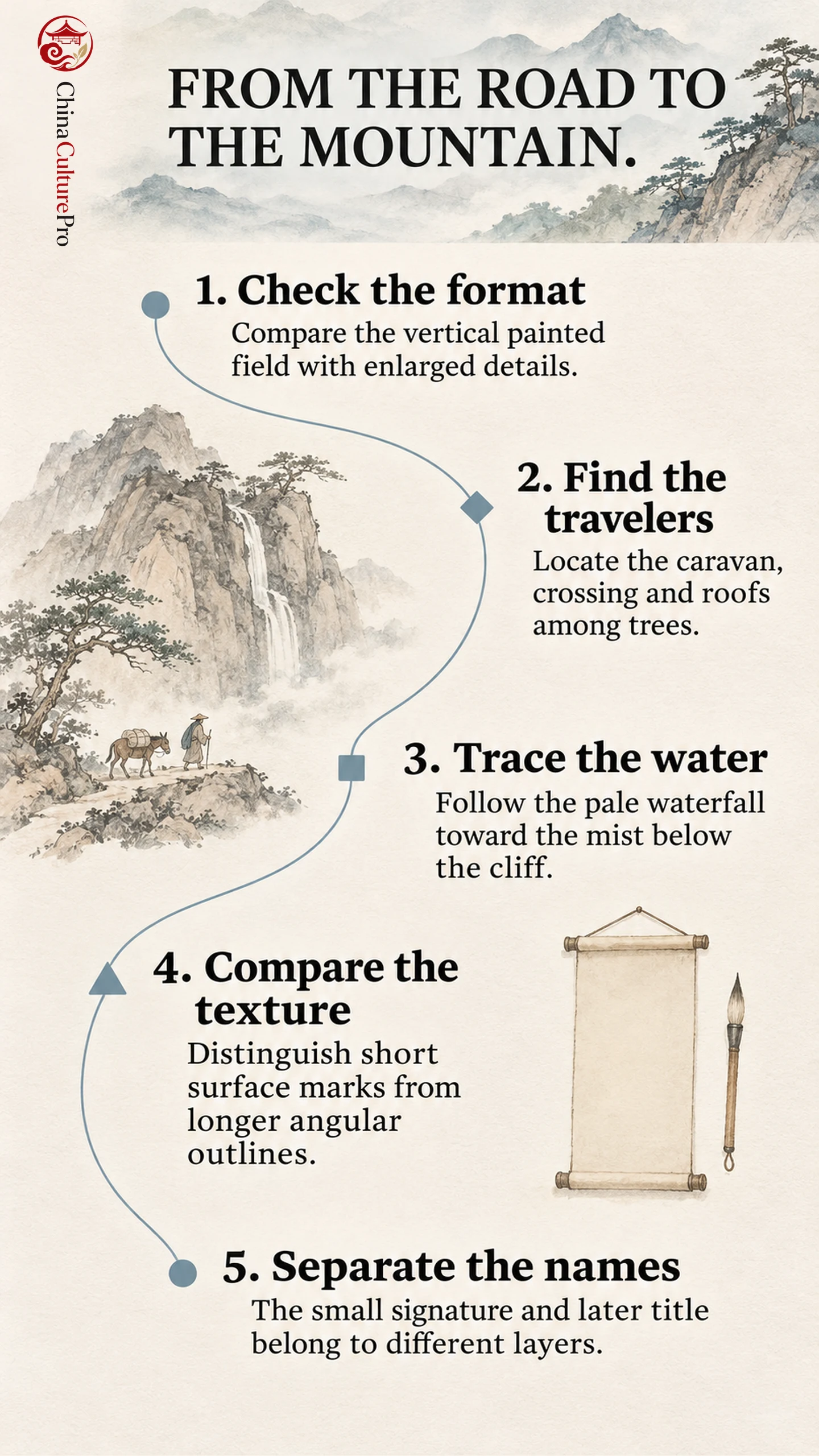
The mountain catches the eye first, but the small figures change how its size is understood. Below the cliff, loaded animals follow a road; roofs appear among trees, and water descends through the landscape. This Chinese landscape-painting guide moves between those details and the larger arrangement that contains them.
The Hanging Scroll and the Scale of Its Image
The painted field measures 206.3 × 103.3 cm. It is ink and light colour on silk, held by the National Palace Museum, Taipei, under collection number 故畫000826.[2] Those measurements refer to the image, not to the entire mounting around it.
The vertical presentation allows the eye to compare the lower road with the upper cliffs at once. A small reproduction can compress that encounter: the caravan becomes hard to locate, while the mountain’s outline remains immediately legible. Looking at both a complete image and enlarged details restores the difference between the painting’s overall structure and its smaller incidents.
This is a hanging scroll, rather than a horizontal handscroll intended to be revealed section by section. The distinction is explained in Chinese scroll formats.
Finding the Travelers, Bridge and Buildings
Look just above the foreground boulders, toward the lower right. Loaded animals follow a relatively pale road beneath densely drawn foliage. Their lowered heads, legs and packs make them identifiable without the kind of facial detail expected in a portrait. Human figures accompany the train. Together they introduce the activity named in the title.
Follow the road inward toward the uneven watercourse. A bridge provides a crossing among the rocks, while trunks and exposed roots interrupt the slope above it. These small changes of direction make the lower landscape worth exploring instead of passing over it on the way to the peak.
Farther up at the right, roofs emerge from behind trees. A separate figure on a path adds a religious journey to the scene: the curator’s account identifies a traveling monk approaching the buildings.[3] The painting therefore contains more human activity than the caravan alone.
Compare these details with the dark tree canopy above them. The buildings occupy a small part of the image, yet their straight roof edges differ from the branching trunks and clustered leaves. Their partial concealment rewards a closer look at the foliage.
Mist, Waterfall and the Mountain’s Mass
The lower wooded rise does not connect to the distant cliff through an uninterrupted, clearly mapped slope. A pale interval opens between them. Where the foreground offers roots, rocks and paths, the mountain’s base becomes less definite. The change makes the two areas feel separated in depth.
At the right of the main cliff, a narrow waterfall follows a dark cleft. Its light vertical course differs from the short marks that cover the rock. Trace it downward toward the hazier area, then compare its width with the adjacent mountain face. That narrow strip helps make the surrounding mass seem enormous.
The summit also changes when examined closely. What looks like a dark edging from a distance resolves into dense vegetation. The painting alternates between large shapes that establish the landscape and smaller patterns that give those shapes substance. It does not need a single fixed viewpoint to make these relationships convincing.
Raindrop Texture and the Meaning of Scale
The mountain’s surface contains many short, closely placed marks, traditionally called raindrop texture strokes(雨点皴,yǔdiǎn cūn).[2] The name describes a kind of brush texture; it does not mean that a rainstorm is being depicted.
Compare those marks with the longer, angular lines defining the cliff’s edges. One gives the surface density; the other helps establish its larger divisions. Darker accumulations and lighter passages also keep the mountain from reading as one uniformly filled shape. The painting-techniques guide provides context for distinguishing outlines, texturing and ink tone.
Accounts of Fan’s life associate him with the Dao(道,dào)and prolonged observation of mountains and changing weather.[4] That background supports considering the relationship between people and nature, while leaving room for interpretation. The tiny travelers can make a viewer aware of human limits without requiring every rock or stream to represent one fixed doctrine.
The figures are also doing something: carrying loads and moving along a road. Their smallness establishes scale, but their presence keeps the picture connected to lived activity.
The Signature, Title and Later Copies
The artist’s small name appears among foliage near the caravan in the lower right. On August 5, 1958, Li Lincan(李霖灿,Lǐ Líncàn)and technician Niu Xingqun(牛性群,Niú Xìngqún)jointly located the two-character signature while examining the original.[3] Its position makes it easy to overlook; discovering it is a different event from creating the painting.
The larger writing above the image belongs to a later layer. Dong Qichang(董其昌,Dǒng Qíchāng)supplied the title identifying the work with Fan Zhongli(范中立,Fàn Zhōnglì), Fan Kuan’s courtesy name. This writing occupies an added paper panel above the silk painting.[2] The familiar title probably derives from this inscription.[5]
Later artists repeated or adapted the composition. A smaller related work titled Travelers, formerly assigned to Fan Kuan, has a similar layout but differences including the bridge’s placement; modern research treats it as a later imitation.[5] A familiar title and central mountain therefore do not identify every reproduction as the original discussed here.
The inscriptions-and-seals guide helps distinguish an artist’s mark from subsequent naming and collecting.
FAQs About Travelers Among Mountains and Streams
Where is Travelers Among Mountains and Streams kept?
The original belongs to the National Palace Museum, Taipei. A collection location does not by itself establish a current display schedule.[2]
Is the painting a literal view of one mountain?
It organizes observed natural forms into a composed landscape, rather than serving as a precise map of one identifiable viewpoint.[2]
Are all works titled Travelers the same painting?
No. Later copies and related compositions must be distinguished from this large silk scroll.[5]
Fuentes
[1] National Palace Museum. Enduring Legacy: Travelers Among Mountains and Streams
[2] National Palace Museum, Taipei. Fan Kuan: Collection Record, Dimensions and Inscriptions
[3] Liu Fangru. Curating and Viewing the Museum’s Three Landscape Treasures, Pages 9–11
[4] National Palace Museum. Travelers Among Mountains and Streams: Artist and Painting
[5] National Palace Museum. The Heritage of Travelers Among Mountains and Streams and Later Imitations