

Quick Answer: What Is The Dark Forest About?
The Dark Forest (黑暗森林, Hēi’àn Sēnlín) is the second novel in the Three-Body trilogy by Liu Cixin (刘慈欣, Liú Cíxīn). With an alien fleet approaching Earth, humanity gives four people the resources to plan defenses that they keep secret even from their own allies.
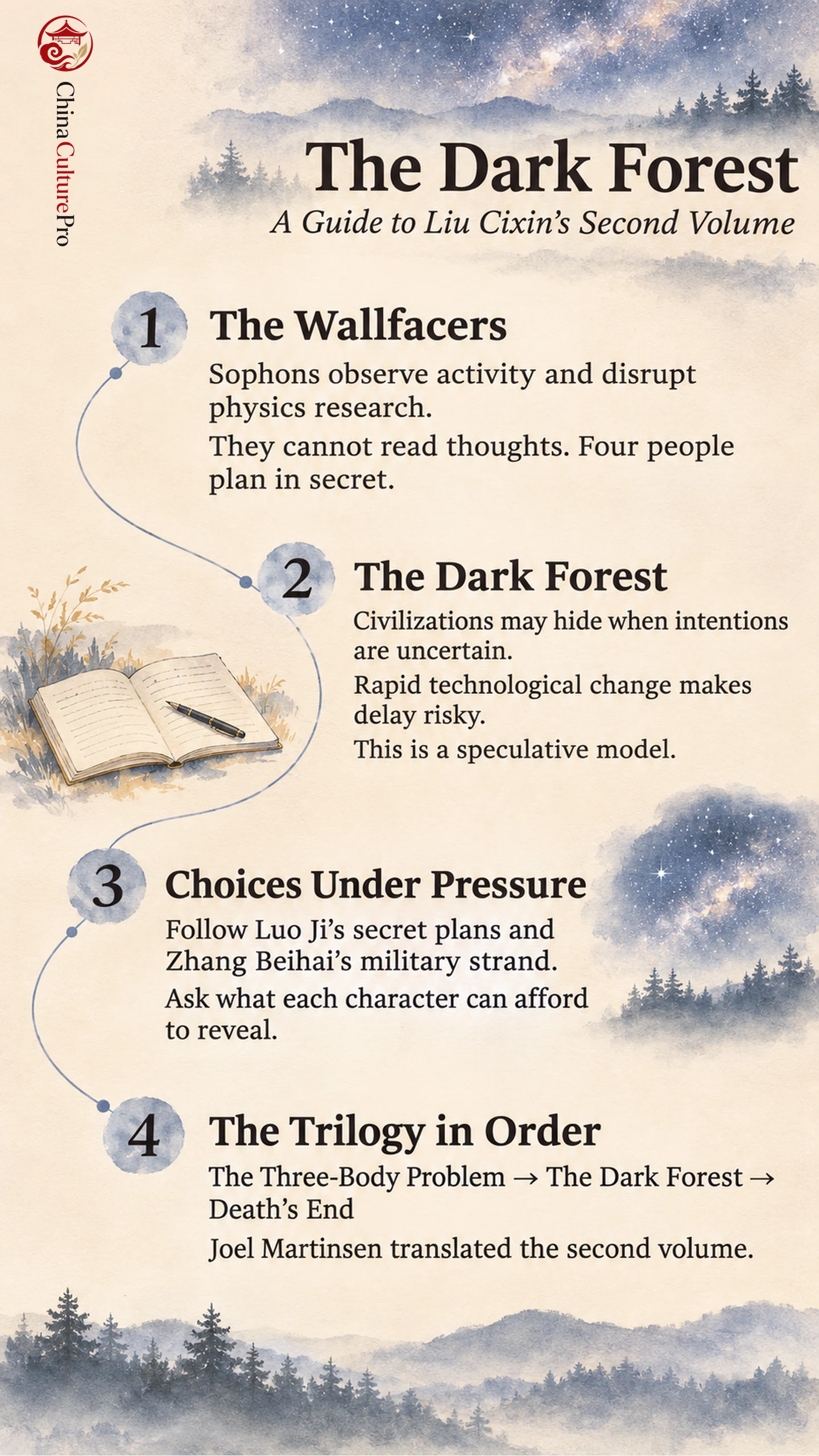
- The project: The Wallfacer Project (面壁计划, miànbì jìhuà) rests on one remaining kind of privacy, the ability to keep a thought to yourself.
- The central figure: Luo Ji (罗辑, Luó Jí) is an astronomer and sociologist whose appointment puzzles him and draws special attention from the enemy.
- The reading order: Read The Three-Body Problem first, The Dark Forest second and Death’s End third.
The title describes an argument about survival and distrust within the novel. This guide explains the argument and the setup while leaving the plans and outcomes unrevealed.
Earth has centuries to prepare for an invasion. The greater problem is that its enemy can observe much of the preparation already. That imbalance turns a story about defense into a study of who can keep a secret, who can act on it and who can still be trusted to act for others.
Why Earth Needs the Wallfacers
Trisolaris sends a fleet toward Earth with a journey of roughly four centuries ahead of it. Meanwhile, sophons (智子, zhìzǐ), fictional engineered particles, are already in place. They let Trisolaris watch human activity and interfere with fundamental physics experiments. The fleet’s travel time leaves a long interval for preparation, but the sophons make ordinary research and operational secrecy harder. [6]
The Wallfacer Project exploits the difference between observable action and private intention. Sophons can gather information about what people say or do. They cannot read an unspoken thought. A Wallfacer can therefore put people and equipment to work while keeping the actual design of the defense private. Other humans may see an order without being told what purpose it serves. [1]
That arrangement places an unusual demand on the people executing the orders. They have to distinguish legitimate secrecy from error and deliberate misdirection. A choice that looks wasteful might serve a plan they cannot see. It might also be wasteful. Liu lets that ambiguity apply to the institutions authorizing the project as much as to the watchers trying to decipher it.
Luo Ji makes the problem personal. Among the four appointees, he lacks the kind of public standing that would make his selection obvious. The enemy’s particular interest in him gives the reader a second mystery to follow alongside the choice of strategy. [1]
What the Dark Forest Metaphor Means
The novel calls its speculative framework cosmic sociology (宇宙社会学, yǔzhòu shèhuìxué). It starts with two assumptions. Civilizations put survival first, and their capacity to expand brings them up against finite resources. Imagine each civilization as a figure moving through a forest at night. The moment it makes its position known, it may lose the protection of being unseen. [3]
Two ideas explain why this could become a stable pattern inside the story:
- Chain of suspicion: The chain of suspicion (猜疑链, cāiyí liàn) arises because each side has to guess both the other’s intentions and what the other believes about its own intentions. An honest message can leave that second uncertainty unresolved.
- Technological explosion: A technological explosion (技术爆炸, jìshù bàozhà) is rapid development that can change the balance of power. Across interstellar distances, the weaker civilization someone first observes may become far stronger before the observation leads to action.
The two ideas work together. Suspicion makes an encounter hard to interpret, and technological change makes waiting seem dangerous. Silence can then appear to be self-protection even when neither side began with a desire to attack. That is a result of the novel’s assumptions, including what it makes hard to verify between strangers. [3]
The metaphor is sometimes discussed alongside the Fermi paradox, the tension between expecting signs of extraterrestrial civilizations and the lack of confirmed detections. Evidence can be hard to find for many reasons, including the kinds of signals a search is able to observe. The same silence can follow from many different causes, so it supplies no evidence by itself that civilizations are deliberately hiding. [4]
What to Follow as the Story Expands
The Wallfacers are one response to the threat. Elsewhere, military characters have to make decisions through institutions whose leaders expect to be told what their subordinates believe. An early scene places Zhang Beihai aboard a naval ship and already shows that his fellow officer cannot easily read his confidence or intentions. The scene offers a smaller version of the book’s larger problem. [1]
Read these strands together. A Wallfacer has formal permission to withhold an intention. Another character may conceal a judgment simply because the organization would act differently if it knew. Look for the gap between the reasons someone gives and the choices that person quietly makes.
The long timescale also gives the story room to compare different experiences of the same threat. For someone living through an early stage of preparation, the invasion may be a distant fact. Later generations inherit the institutions and priorities built around that threat. Watch for what feels urgent to the characters at a given moment and what they expect someone else to face. [6]
In the broader history of Chinese science fiction, scholarship places Liu among the writers associated with the genre’s twenty-first-century new wave. For this novel, one way into his approach is to follow an abstract premise through a conversation, a military decision and a civilization’s survival problem. [5]
Where the Novel Fits in the Trilogy
Read the novels in this order:
- The Three-Body Problem
- The Dark Forest
- Death’s End
The first volume introduces the encounter and why Earth needs a response. The second begins once the threat is known. If you have read the first, recall the origin of the contact and what the sophons can do. That is more useful preparation than reading a summary of the second novel’s ending.
The Chinese novel appeared in 2008. The 2015 Tor edition credits Joel Martinsen as translator. That credit distinguishes this volume from the first English volume, translated by Ken Liu. [1][2]
To choose what to read beyond the trilogy, the Liu Cixin reading guide provides author context. The Wandering Earth offers another large-scale survival story outside the trilogy.
FAQs About The Dark Forest
Can I start the trilogy with The Dark Forest?
You can follow the immediate defense problem, but book one gives the first contact, the invasion and the sophons their context. Start with The Three-Body Problem if you want those discoveries in narrative order.
Why can the sophons not expose a Wallfacer’s thoughts?
The story gives them surveillance over external actions and communications. A Wallfacer’s plan remains private until the person communicates it or reveals enough through action for others to infer it.
Is the dark forest idea a proven scientific explanation?
No. It is a speculative account of why civilizations might avoid detection. The same lack of signals could be consistent with many other explanations.
Fuentes
[1] Macmillan / Tor. The Dark Forest: Description and Excerpt
[2] CiNii Books. The Dark Forest: Bibliographic Information
[3] Tsinghua University, School of Social Sciences. Science Fiction and Sociology: The Three-Body Problem and Social Cooperation
[4] NASA Science. NASA Scientists on Why We Might Not Spot Solar Panel Technosignatures
[5] Mingwei Song, University of Illinois Press. Liu Cixin’s Three-Body Trilogy: Between the Sublime Cosmos and the Micro Era
[6] Subterranean Press. The Dark Forest