

Quick Answer: What Is The Wandering Earth About?
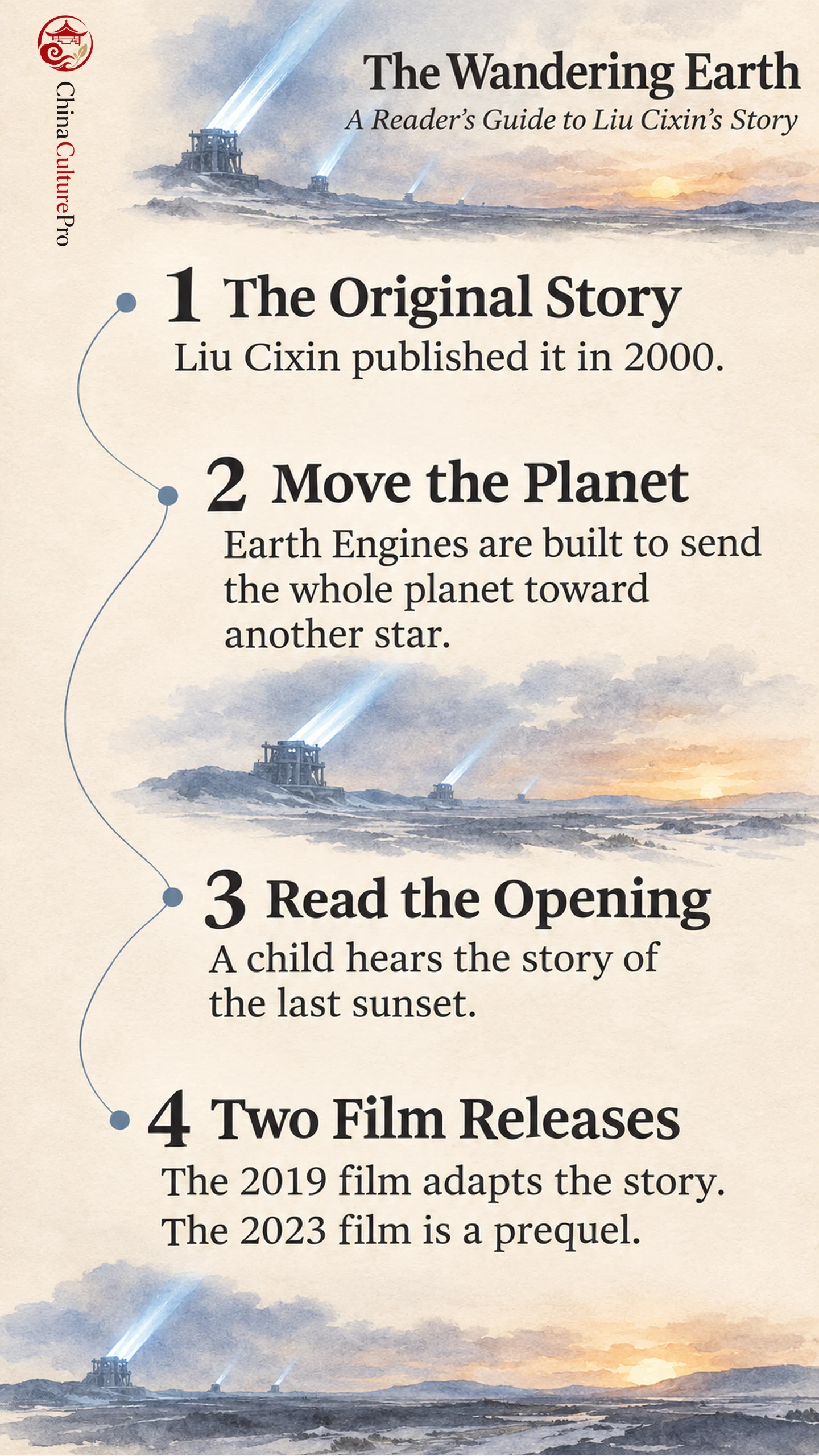
The Wandering Earth (流浪地球, Liúlàng Dìqiú) is a work of short science fiction by Liu Cixin (刘慈欣, Liú Cíxīn). Faced with a solar catastrophe, humanity builds Earth Engines (地球发动机, Dìqiú Fādòngjī) to send the whole planet toward another star. The story introduces that plan through a child born just as the Earth’s rotation stops.[3]
- The original publication: The story appeared in Science Fiction World (科幻世界, Kēhuàn Shìjiè) in July 2000 and won the top prize at that year’s Chinese Galaxy Awards.[1][2]
- Where to start: The Braking Era (刹车时代, Shāchē Shídài) section sets the family’s memory of a last sunset against the world the narrator knows.[3]
- The English book: An English collection with the same title includes this story among several works by Liu.[4][5]
- The films: Frant Gwo’s 2019 film adapts the story. The Wandering Earth II, released in 2023, is a prequel in the film’s chronology.[6][8]
This guide focuses on the premise and early scenes. It leaves the later conflicts and the outcome of the planet’s journey for the story.
The narrator’s mother remembers a sunset that took days. He grows up in its aftermath and has no memory of the ordinary nights and seasons she knew.[3]
That difference turns an idea about planetary motion into a difference between people. One generation can compare the changed world with something it remembers. The next has to reconstruct the old world from stories and lessons.
Why People Move the Planet
The original story presents an imminent solar catastrophe and identifies Proxima Centauri as the intended destination. It distinguishes agreement about the danger from disagreement about how to escape it.[1]
The plan the narrator grows up with makes the Earth itself the vehicle. A space voyage becomes something a child can enter simply by being born at home.
The engines do more than supply a spectacular view. They alter how the planet moves, and the narrative begins with the consequences of bringing its rotation to a halt. The child encounters the engine light and heat as facts of ordinary life.[1]
Real solar evolution supplies some of the vocabulary. NASA describes the Sun expanding into a red giant billions of years from now.[9] The timing of Liu’s disaster and the planetary engines belong to the fiction. If you are comparing Chinese science fiction premises, notice what changes when the planet itself is the vehicle and the passengers have to keep living on it.
What the Braking Era Looks Like to a Child
Start with what the narrator knows firsthand. He has seen the enormous beams produced by the engines. His mother remembers the last sunset as an event the family watched together. The excerpt puts the two experiences side by side.[3]
The Chinese opening also follows a school trip to watch a sunrise from a ship. The trip is part of their schooling. The adults use the ship’s movement to repeat the sunrise until the children become less afraid.[1]
The adults have a lesson to teach, while the child has a body that reacts before he can remember the lesson. That small scene shows how a public explanation of risk becomes part of growing up.
Compare this with Supernova Era (超新星纪元, Chāoxīngxīng Jìyuán). In that novel, adults have a short time to teach children what they know. Here the adults can explain why the journey began, but its timescale puts much of the outcome beyond the lives of the people who planned it. Both belong to a body of fiction in which Liu Cixin asks who inherits decisions made under pressure.
How the Story Differs From the Films
The 2019 adaptation credits Liu’s work as its source and Frant Gwo as director.[6] It makes a possible collision with Jupiter the immediate danger facing its characters.[7] This gives the film a crisis that can be followed through the choices of a small group.
The original follows a narrator growing up inside the long project. Notice the way the opening describes heat, the change of light and the last sunset before it develops other conflicts. Those details make the shared premise feel different from a film structured around a race to respond.
The second film, The Wandering Earth II, appeared in 2023. Its distributor describes it as a prequel that goes back to the planning and launch of the effort to move Earth.[8] Read the story on its own, or watch the two films in release order and use the second to revisit how the project began.
Which Edition Contains the Original Story?
Look for 流浪地球 by 刘慈欣 if you want the original in Chinese. The magazine publication is distinct from later collections that use the story’s title. For English, WorldCat lists a 2017 Head of Zeus collection whose contents begin with the title story. It also documents the first US Tor collection in 2021.[4][5]
Macmillan lists the 2022 paperback under ISBN 9781250796844 and publishes an excerpt beginning with the Braking Era. The collection has multiple translators.[3][5] If you need to cite a specific wording, use the publication information and the story’s credit in your own copy.
The opening is a good way to decide if you want to continue through the collection. Readers who know The Three-Body Problem may recognize a similar shift from a human scale to an astronomical one. The compact form here gives an accessible starting point for exploring Liu within Chinese literature.
FAQs About The Wandering Earth
Is The Wandering Earth a novel or a short story?
The original is a short work of fiction, also described as a novella. An English collection and a feature film use the same title.[4][6]
Is the 2023 film a sequel in story order?
It was released after the 2019 film. In the story timeline, The Wandering Earth II is a prequel.[6][8]
Is the Sun’s crisis in the story a scientific prediction?
The real Sun will evolve into a red giant on a timescale of billions of years. Liu gives the fictional Sun a much nearer crisis and imagines a way to move the planet.[1][9]
Fuentes
[1] Chinese Science Fiction Database. Liu Cixin’s The Wandering Earth, Original Excerpt
[2] China Writers Association. Liu Cixin’s Science Fiction Publications and Awards
[3] Macmillan. The Wandering Earth, Tor Collection and Excerpt
[4] WorldCat. The Wandering Earth, Head of Zeus Collection
[5] WorldCat. The Wandering Earth, First US Collection
[6] Netflix. The Wandering Earth Lands on Netflix
[7] Netflix. The Wandering Earth, Film Synopsis
[8] Well Go USA Entertainment. The Wandering Earth II
[9] NASA Science. Stars in an Exoplanet World