


Quick Answer: What Is Chinese Science Fiction?
Chinese science fiction (科幻, kēhuàn) is a diverse field of speculative writing about science, technology and altered societies. It includes cosmic adventures, environmental fiction, social experiments and intimate stories about everyday life; no single author or political position represents the whole field.[11]
- History: Its modern roots reach back to the early twentieth century, well before its internationally celebrated awards.[1]
- Range: Start with the kind of reading you enjoy: scientific puzzles, social inequality, ecological conflict, family relationships or surreal institutions.
- English entry points: Read one novel for sustained immersion, or an anthology to compare several voices.
“Chinese” needs context: Chinese-language work, publication in mainland China and writing by a Chinese-descended author are overlapping categories. A collection drawing from mainland China, Hong Kong and Taiwan has a different scope from a selection of mainland writers.[13]
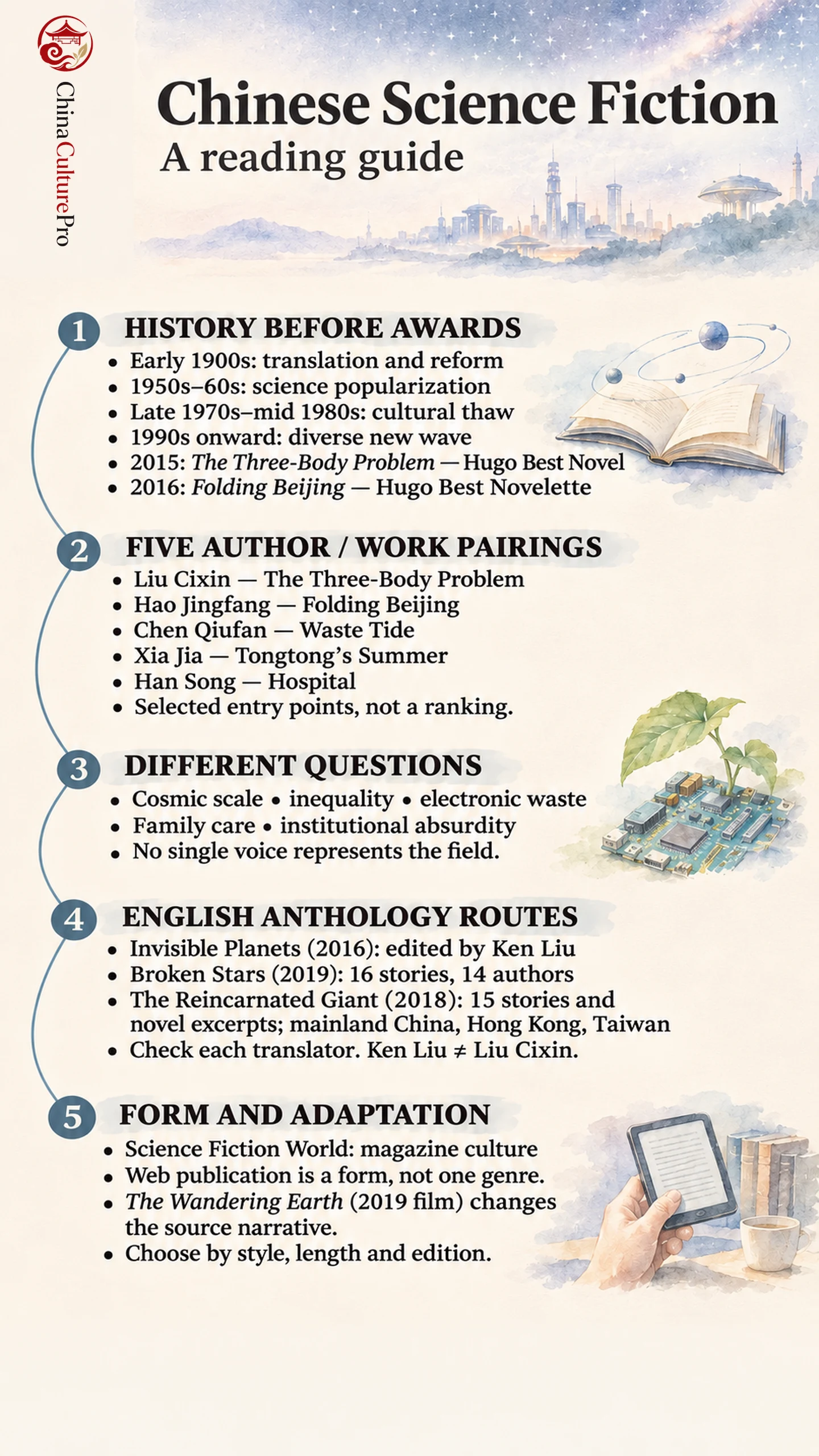
A film or television series may introduce you to Chinese science fiction through spectacular images. Reading the fiction opens other doors: a city divided by unequal access to time, workers handling discarded electronics, or a family negotiating care across generations. The useful starting question is what sort of story you want, rather than which book supposedly speaks for an entire country.
Within modern Chinese literature, science fiction can use an imagined change to test something familiar: who controls resources, how institutions work, or what people owe one another. Its literary history also includes translation, science education, magazines and experiments in form.
A Literary History Before the Global Breakthrough
During the late Qing dynasty (清朝, Qīng Cháo), translated fiction helped connect scientific imagination with debates about national transformation. Lu Xun (鲁迅, Lǔ Xùn), later central to modern Chinese writing, published translations of Jules Verne in 1903. Translation was part of the field’s beginnings, not simply a recent route out of China.[1]
| Periodo | What changed | Why it matters to readers |
|---|---|---|
| Early twentieth century | Translation and reform-minded intellectual debate helped establish modern science fiction. | Early work often asks what a changed society might become, alongside imagining new inventions. |
| 1950s–1960s | Science popularization became an important framework for fiction. | Educational purposes help explain the prominence of scientific discovery and technological promise. |
| Late 1970s–mid-1980s | The post-Mao cultural thaw brought renewed experimentation and disputes about the genre’s boundaries. | This transitional writing connects earlier popularization with later literary developments. |
| 1990s–2000s | A new wave developed more varied social, philosophical and experimental approaches. | Contemporary work cannot be reduced to optimistic accounts of scientific progress. |
These periods are a reading framework, not an uninterrupted march forward. Political pressures and changing institutions shaped what could be written and circulated. The post-Mao revival, in particular, deserves attention in its own right rather than appearing only as a prelude to recent bestsellers.[2][3]
Liu Cixin (刘慈欣, Liú Cíxīn) won the 2015 Hugo Award for Best Novel with The Three-Body Problem (三体, Sān Tǐ), translated by Ken Liu (刘宇昆, Liú Yǔkūn). Its Chinese book edition appeared in 2008; the English edition followed in 2014. In 2016, Hao Jingfang (郝景芳, Hǎo Jǐngfāng) won Best Novelette for Folding Beijing (北京折叠, Běijīng Zhédié), also translated by Ken Liu. These awards expanded international recognition of an existing field.[4][5]
Five Authors and Starting Works
The following five pairings offer different reading experiences. They are entry points, not a ranking or a complete canon. Translations and publication dates belong to particular editions, so check the credits in the copy you choose.
| Author and starting work | Qué puedes esperar | Choose it when you want… |
|---|---|---|
| Liu Cixin — The Three-Body Problem | A novel connecting historical trauma, scientific investigation and contact with an alien civilization; English translation by Ken Liu. | An unfolding scientific mystery with consequences beyond Earth.[6] |
| Hao Jingfang — Folding Beijing | A shorter work about a mechanically divided city and unequal access to its spaces and time; English translation by Ken Liu. | A concentrated social thought experiment rather than a long series.[5][7] |
| Chen Qiufan (陈楸帆, Chén Qiūfān) — Waste Tide (荒潮, Huāng Cháo) | A near-future novel about electronic waste, migrant labor, powerful local interests and technological change; English translation by Ken Liu. | Ecological conflict grounded in work and material surroundings.[8] |
| Xia Jia (夏笳, Xià Jiā) — Tongtong’s Summer (童童的夏天, Tóngtóng de Xiàtiān) | A short story about a girl, her grandfather and care involving remote-presence technology; English translation by Ken Liu. | A family-scale encounter with technological possibility.[9][14][16] |
| Han Song (韩松, Hán Sōng) — Hospital (医院, Yīyuàn) | An experimental novel following a man into an increasingly disturbing medical system; English translation with an afterword by Michael Berry. | Unsettling institutional absurdity and disorientation.[10] |
A shared national label does not mean a shared style. The difference between a tightly focused social premise and a sprawling scientific mystery may matter more to your enjoyment than the fact that both works reached English readers through the same translator.
Themes: Cosmic Scale, Work and Everyday Life
Cosmic scale can make familiar assumptions feel fragile. In Liu’s fiction, a scientific problem can become a question about humanity’s place among other civilizations. The appeal lies partly in following an idea as its implications grow. Calling this “hard science fiction” describes an emphasis on scientific reasoning; it does not turn invented events into established science.[6]
Social inequality becomes more concrete when a story changes the conditions under which people move or work. Folding Beijing makes the city’s separation an organizing premise. Hao also describes it as an exception within her own work: many of her other stories pursue different philosophical and existential questions. A useful entry story is not a complete author portrait.[7]
Waste Tide asks a different question: who bears the bodily and environmental costs of the devices other people discard? Its fictional Silicon Isle brings migrant workers, local power and international business into conflict. The imagined setting gives discarded technology a social life; it is not a documentary inventory of a real recycling town.[8]
Everyday care can carry equally substantial speculation. Tongtong’s Summer connects technological change with an older person’s relationships and capacity to participate. The grandfather is more than a passive recipient of assistance. This offers a useful alternative to reading every fictional robot as either a replacement worker or a threat to humanity.[9][14]
Hospital unsettles the relationship between explanation and authority: the protagonist enters a system that keeps acting upon him without making his situation clear. Repeated procedures deepen uncertainty rather than steadily producing an answer. A reader seeking straightforward technological problem-solving should expect a different experience here.[10]
Across these works, ask who gains agency, who pays for progress and whose experience the narrative lets you see. These questions leave room for politics without treating every plot as a coded statement of one national ideology. They also make it easier to connect science fiction with the wider forms and concerns of Chinese literature.[11]
Reading Chinese Science Fiction in English
Anthologies are useful when you do not yet know which style suits you. Their introductions and contributor notes explain selection and translation choices, but each collection reflects editorial decisions rather than representing the entire field.
- Invisible Planets: Published in 2016 and edited and translated by Ken Liu, this collection brings several contrasting writers together. Its introduction is particularly useful for resisting the idea that all Chinese science fiction should be read through the same political or cultural expectations.[11]
- Broken Stars: Published in 2019, this later Ken Liu anthology contains sixteen stories by fourteen authors, with three contextual essays. It expands the range of voices, lengths and publication venues. Check individual credits: its introduction notes exceptions to sole translation by the editor.[12]
- The Reincarnated Giant: Published in 2018 and edited by Mingwei Song (宋明炜, Sòng Míngwěi) and Theodore Huters, this collection contains fifteen stories and novel excerpts from mainland China, Hong Kong and Taiwan, translated by multiple contributors. It offers a broader regional comparison and includes material that is not a complete standalone novel.[13]
Choose by format as well as theme. For one sustained narrative, begin with a novel from the five-work table. For a shorter commitment, try a single story before moving to its author’s longer work. For comparison across styles or regions, use an anthology and note which contributor makes you want to read more.
Check whether a book is a novel, a single-author collection or a multi-author anthology; then record its translator. Similar cover branding does not mean identical scope. The habits in our guide to choosing Chinese books and translations also help with modern genre fiction.
Magazines, Web Fiction and Screen Adaptations
Science Fiction World (科幻世界, Kēhuàn Shìjiè) was central to the magazine-based publication model that Xia Jia describes when discussing the field’s development. Magazine publication, short-fiction collections and translation into international venues form part of its literary infrastructure. An author interview also describes a shift toward multiple media and publication platforms; that shift does not make earlier magazine writing obsolete.[9]
Science fiction and Chinese web novels describe different things: one is a genre, the other a publication form. A science-fiction story can appear online, but online Chinese fiction also includes romance, martial-arts adventure and fantasy. Likewise, a translated story originally published in a magazine does not become a web novel merely because you read it on a website.
The Wandering Earth (流浪地球, Liúlàng Dìqiú) offers a clear adaptation distinction. The 2019 film takes the premise of moving Earth with enormous propulsion systems from Liu’s fiction, while building a different dramatic narrative around it. The film’s choices belong to the adaptation; they do not prove that the source text contains the same character relationships or sequence of events.[15]
Treat Chinese cinema as another way to interpret speculative ideas. When an adaptation interests you, identify the exact source work and edition before buying: a story, a collection containing that story and a novel in a similarly branded series are different reading commitments.
FAQs About Chinese Science Fiction
Did Chinese science fiction begin with The Three-Body Problem?
No. Modern Chinese science fiction has roots in early twentieth-century translation and intellectual debate, followed by several distinct periods of development. The novel’s 2015 Hugo helped bring wider international attention to that longer history.[1][2][4]
Do I need a science degree to read Chinese science fiction?
No. Some works emphasize scientific reasoning, while others focus on social arrangements, environmental conflict or relationships. Choose by narrative style and subject; a shorter story can help you test your interest before committing to a novel.
Is Ken Liu the same person as Liu Cixin?
No. Liu Cixin wrote The Three-Body Problem; Ken Liu translated its first English edition and is also an author and anthology editor. Similar English spellings of names should not replace checking a book’s author and translator credits.[4][11]
Is Chinese science fiction the same as xianxia?
No. Xianxia (仙侠, xiānxiá) centers on cultivation and extraordinary or immortal existence. Science fiction usually builds speculation around scientific, technological or social changes. Individual works can mix conventions, so read the premise as well as the marketing label. Our wuxia and xianxia comparison explains the neighboring fantasy categories.[17]
Fuentes
[1] Hong Kong University Press, Oxford Academic. Lu Xun and World Literature: Preface
[2] University of Toronto Press. Chinese Science Fiction during the Post-Mao Cultural Thaw
[3] Columbia University Press. Fear of Seeing: A Poetics of Chinese Science Fiction
[4] The Hugo Awards. 2015 Hugo Awards
[5] The Hugo Awards. 2016 Hugo Awards
[6] Tor Books, Macmillan. The Three-Body Problem
[7] Emily Yu Zong and Hao Jingfang, Mascara Literary Review. Chinese Science Fiction Beyond Politics: An Interview with Hao Jingfang
[8] Tor Books, Macmillan. Waste Tide
[9] Chiara Cigarini and Xia Jia. Crossing the Boundaries: An Interview with Chinese SF Writer Xia Jia
[10] Michael Berry. Hospital
[11] Tor Books, Macmillan. Invisible Planets: Contemporary Chinese Science Fiction in Translation
[12] Tor Books, Macmillan. Broken Stars: Contemporary Chinese Science Fiction in Translation
[13] Columbia University Press. The Reincarnated Giant: An Anthology of Twenty-First-Century Chinese Science Fiction
[14] Xi’an Jiaotong University. Chinese science-fiction writer reads in the Arctic
[15] US-China Today, University of Southern California. The Growth of Chinese Science Fiction: Q&A with Mingwei Song
[16] Ken Liu. Translations
[17] Seven Seas Entertainment, Penguin Random House Comics. DANMEI and More: Terms to Know