


Quick Answer: What Do Tang Ping and Nei Juan Mean?
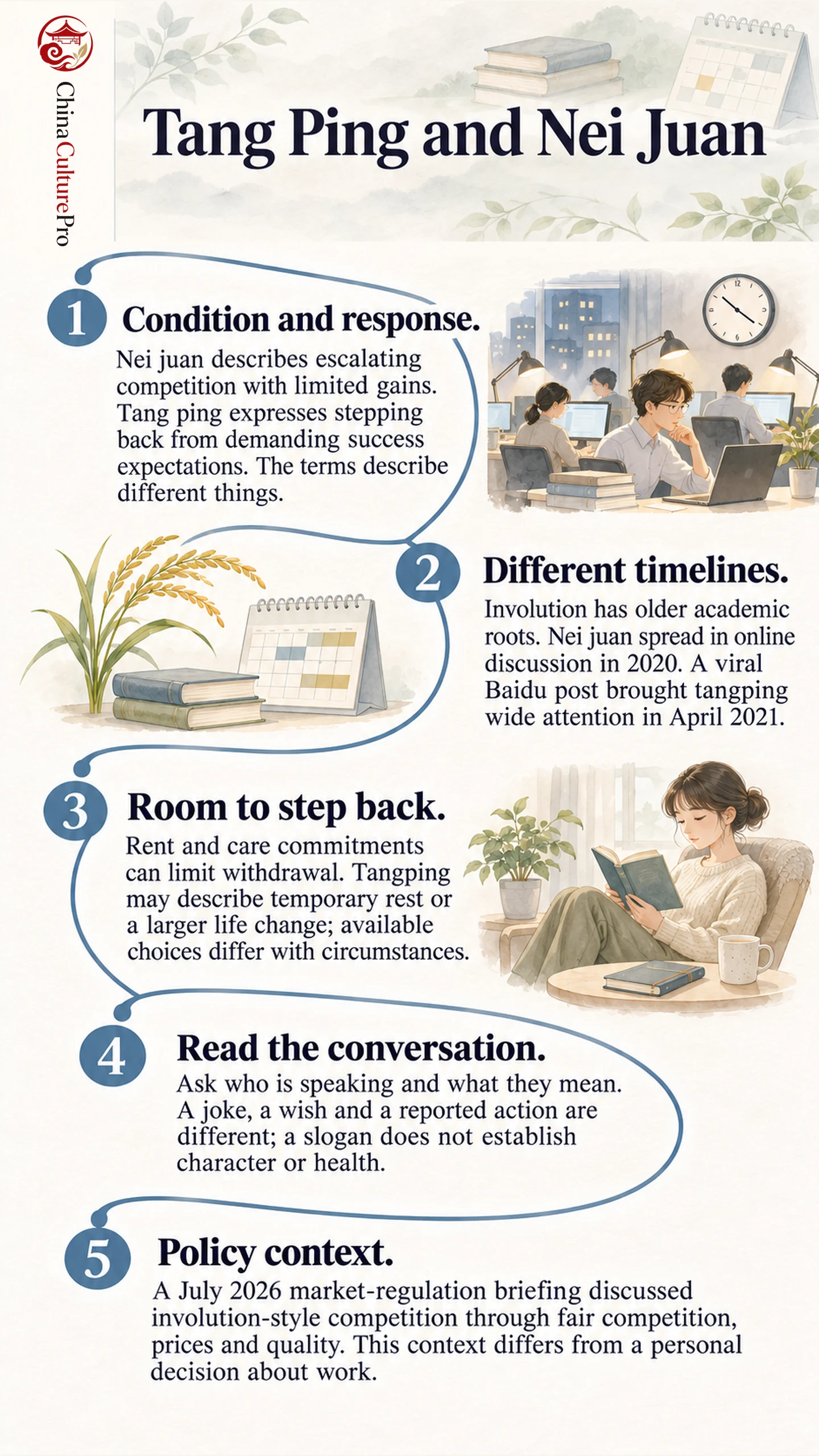
Tang ping (躺平, tǎngpíng), usually translated as “lying flat,” expresses stepping back from demanding expectations of success. Nei juan (内卷, nèijuǎn), commonly translated as “involution,” describes escalating competition whose extra effort brings limited gains. They are related expressions in contemporary mainland Chinese discussion.[1][2]
- Nei juan: Attention falls on a competitive situation and its diminishing rewards.
- Tang ping: Attention falls on a stance of withdrawal or reduced striving.
- Context: A joke, a personal decision and a policy statement require different readings.
Neither term establishes how every young person lives, and saying one wants to lie flat does not prove that one has stopped working.
Complaining about competition can coexist with studying or working intensely. Joking about lying flat may involve no change of routine. These distinctions help explain two widely discussed expressions within modern Chinese culture and the different situations they describe.
How Tang Ping and Nei Juan Differ
The simplest distinction is between the pressure being described and a possible response to it. These are useful meanings to begin with, while actual conversations can be more playful or judgmental.
| Término | Main focus | Lo que no demuestra |
|---|---|---|
| Nei juan | A cycle of intensifying competition with limited additional reward. | That all effort, skill development or competition is pointless. |
| Tang ping | Stepping back from the pursuit of demanding success expectations. | A fixed employment status or one compulsory lifestyle. |
Consider a hypothetical office where colleagues stay late to show commitment, prompting others to match them without improving results. Calling that situation neijuan criticizes the escalation. Expressing a wish to stop chasing recognition can be tangping. One describes the competitive pattern; the other names a response.[1]
Discussions of working life or school competition need their own institutional context. A difficult task with a useful outcome is not automatically neijuan.
How the Terms Entered Public Discussion
Involution was an academic concept before it became internet vocabulary. Anthropological discussions included Clifford Geertz’s 1963 work on agricultural involution. A 2025 ethnographic study traces Chinese students’ and young office workers’ use of neijuan for competition and overwork to 2020. The contemporary slang therefore adapts an older term rather than inventing it.[3]
Tangping gained wide online attention in April 2021 through a Baidu post titled “Lying Flat Is Justice.” The author described withdrawing from conventional demands and maintaining a minimal lifestyle. That viral episode helps explain the expression’s public visibility; it does not make the author’s precise choices a definition everyone must follow.[4]
Their connection in discussions of youth culture does not make them interchangeable.
Pressure, Resources and the Possibility of Stepping Back
The pressure under discussion can extend beyond office hours. Tangping can be understood in relation to expectations around education, employment, marriage, children and consumption. Practices range from substantial changes of life to temporary rest or a way of signaling distance from dominant expectations. Social position affects the possibilities available.[2]
Rent and care commitments can make withdrawal difficult. Conversations documented in 2023 record this concern among people who talked about lying flat but still needed income. A wish to step back may not become a sustainable practice.[1]
A laboratory ethnography offers a specific example: young rice scientists trying to reconcile plant-growth cycles with academic career schedules. The ethnographic fieldwork was conducted in 2019. Here, the pressure involves a clash of institutional and biological timings.[3]
Connections with family life also matter. An expression about personal ambition may arise alongside continuing responsibilities to relatives, rather than a clean break from them.
Speaker, Tone and the Difference Between Words and Actions
A 2026 linguistic study analyzed online and media discourse from 2021–2024. It traced how the bodily image of lying flat became a social attitude with several connected meanings. The researchers emphasize speaker position and changing context. Its focus is how language was used, rather than a count of how many people changed their lives.[5]
When reading internet slang, distinguish three questions: Who is using the term? What situation are they describing? Are they reporting an action, expressing a wish, or judging someone else? A humorous self-description and a criticism directed at another person can carry different implications.
Evaluations also depend on the circumstances presented. A 2022 study asked 210 online participants to judge imagined workplace scenarios. Effort received positive evaluations in both return conditions, while lying-flat behavior received a neutral evaluation when returns were low and a negative one when returns were high. These results concern the study’s participants and scenarios, not a unanimous national opinion.[6]
These words can open a conversation about effort and reward, but do not establish someone’s character or health.
Why Involution Also Appears in Policy News
In news about businesses, “involution-style competition” has a different immediate setting. At a press conference on July 7, 2026, China’s State Administration for Market Regulation discussed action involving fair-competition review, antimonopoly enforcement, price enforcement and product quality. This was an official account of market regulation, rather than advice for individuals to withdraw from work.[7]
The distinction matters when reading headlines about anti-involution. A discussion of destructive price competition among firms is not identical to a student’s complaint about competitive study. Check the speaker, sector and stated measures before transferring a meaning from one context to another.
FAQs About Tang Ping and Nei Juan
Are tang ping and nei juan synonyms?
No. Neijuan describes intensifying competition with limited gains; tangping describes a stance toward demanding expectations. Someone can criticize one without adopting the other.
Does tang ping mean being unemployed?
No. It can express a wish, a temporary retreat or a broader life choice. The word alone does not tell you whether someone has a job.
Is nei juan just another word for working hard?
No. Its critical meaning concerns escalating effort without corresponding benefits. Working hard on a useful task does not automatically fit that description.
Is lying flat an organized movement?
It is a varied social phenomenon. A 2025 analysis describes it as having no organization or leaders, rather than a unified membership or program.[2]
Does anti-involution mean ending competition?
No. In the July 2026 regulatory account, the focus includes unfair and disorderly competition. That is different from declaring every form of competition undesirable.[7]
Fuentes
[1] Wanning Sun, University of Technology Sydney. The One Word That Captures the Pulse of Urban China
[2] Jean-Louis Rocca, Sociétés politiques comparées. Tangping (Lying Flat): Subjectivation, Lifestyles, and Voice among Young Chinese
[3] Lyle Fearnley and Chen Sun, Cultural Anthropology. Green Involution: Mediating Plant Times and Lifetimes in a Chinese Rice Genetics Laboratory
[4] David Bandurski, China Media Project. Lying Flat
[5] Min Yang, Wuttipong Prapantamit and Kanokporn Numtong, Language and Linguistics. Cognitive Sociolinguistic Perspective on the Semantic Construction and Deconstruction of Tangping
[6] Han-Yu Hsu, Frontiers in Psychology. How Do Chinese People Evaluate Tang-Ping (Lying Flat) and Effort-Making: The Moderation Effect of Return Expectation
[7] State Administration for Market Regulation. 2026年上半年深入整治“内卷式”竞争专题新闻发布会实录