
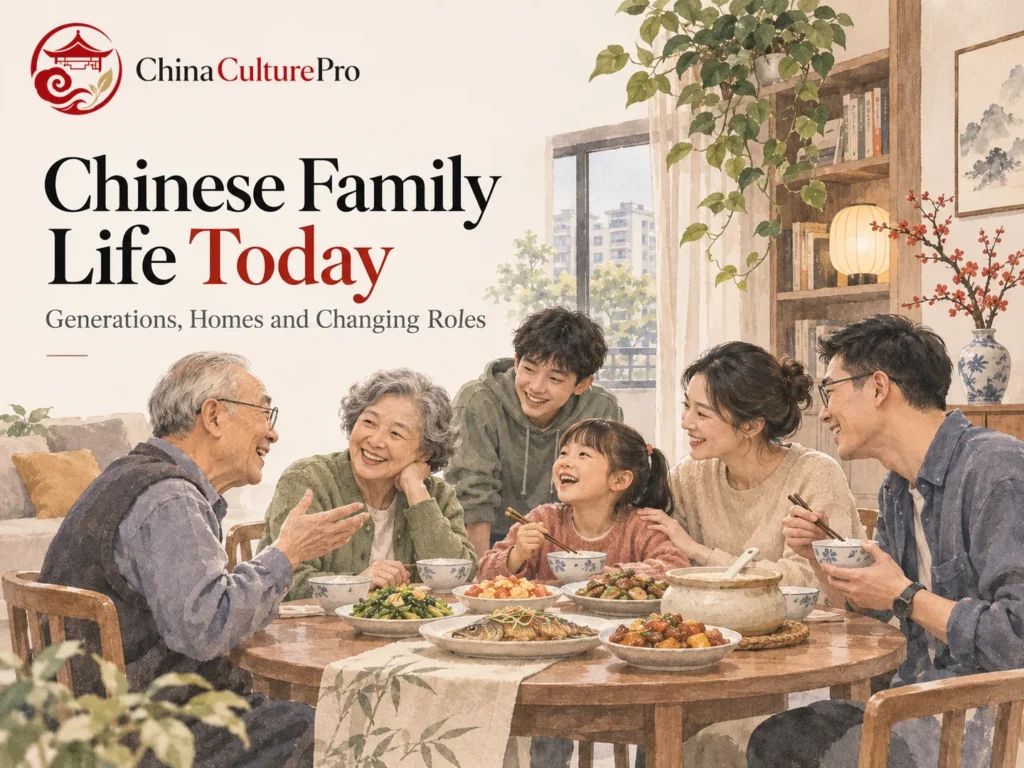

Quick Answer: What Is Chinese Family Life Like Today?
Chinese family life today includes small households, relatives sharing a home and family networks extending across several cities. This guide focuses on mainland China. Living arrangements, care responsibilities and relationships are different parts of the picture; they cannot be read from the number of people at one address alone.[1][3]
- Households: Who lives together can change with work, age and childcare needs.
- Support: Help flows between generations, including money, time and practical care.
- Relationships: Respect, affection and personal choices are negotiated within particular families.
There is no single daily routine or family structure that represents everyone.
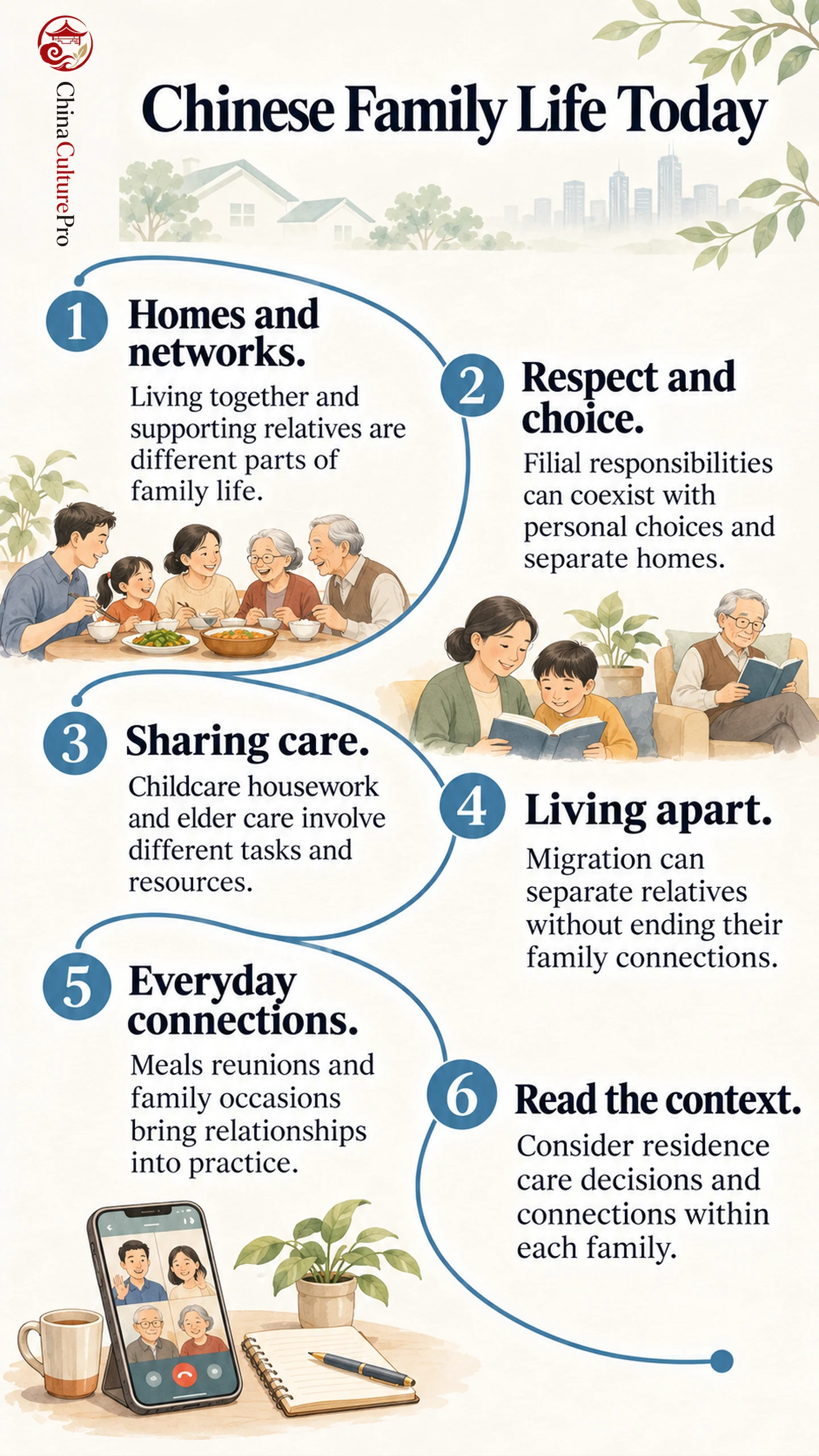
Family life involves deciding where to live, who provides care and how relatives stay connected. Following those everyday arrangements makes it easier to understand the relationship between personal choices, inherited expectations and the wider changes in modern Chinese culture.
Smaller Households, Wider Family Networks
The average family household contained 2.52 people in the 2025 national population sample survey, released in May 2026. Its reference date was November 1, 2025. Here, a family household means relatives staying under one roof and sharing living arrangements. The figure counts co-residence, not everyone someone regards as family.[1]
A couple with a child, an older person living alone and three generations sharing a home therefore represent different household arrangements. Relatives in separate homes may still exchange childcare, visits or financial help. Research on contemporary intimacy shows that a couple’s own household can remain closely connected to wider kin.[3]
Broader family traditions help explain why relatives outside a household remain important. Sharing an address and sharing responsibilities are related, but they are not the same thing.
Respect, Independence and Decisions Across Generations
Filial piety (孝, xiào) concerns responsibilities and respect toward parents and elders. Its continuing importance does not mean its expression remains unchanged. Contemporary scholarship distinguishes enduring obligations from the changing expectations and practices through which families meet them.[2]
The meaning of support is negotiated: an older parent may value nearby help while also wanting a separate home. Research following generations of women also finds married daughters maintaining close ties with their own parents. Descent through the male line is therefore insufficient as a description of all present-day family relationships.[3][4]
Education can combine affection with demanding expectations. A study published in 2022, based on 95 life-history interviews across 25 urban families, found greater expressive closeness in the only-child generation alongside tighter parental organization of childhood. Investment in education therefore cannot be read simply as either emotional distance or unrestricted freedom.[11]
Kinship names identify relationships, while wedding customs make some family expectations ceremonial. Everyday decisions still depend on the people involved.
Childcare, Housework and Care for Older Relatives
Care runs in several directions. Grandparents may help raise grandchildren while adult children support older parents. In a 2023 study of ten middle-class families in Tianjin, some members balanced both responsibilities. Families organized care themselves, bought outside help or combined nearby residence with regular visits. Resources, proximity and needs shaped the arrangements.[4]
The cases also show relatives remaining involved while arranging paid help. Their choices reflect these families’ circumstances; they do not establish a national rule about who should provide care.[4]
Housework is a separate part of that workload. In the 2024 national time-use survey, women who participated in unpaid labor averaged 3 hours 29 minutes daily, compared with 1 hour 52 minutes for male participants. These are participant averages across a seven-day week, not figures for every woman or man. Unpaid labor is broader than childcare alone.[5]
A shared home can make help available, but the division of tasks still needs explanation. Ask who cooks, supervises homework, accompanies older relatives and manages paid employment. The relationship between working life and time at home matters alongside cultural expectations.
Migration and Families Living Apart
Migration does not produce only one family arrangement. Children may move with a parent, remain in their hometown while one or both parents work elsewhere, or change arrangements as schooling and family circumstances change. A joint report using the 2020 census explicitly distinguishes these situations; its data describe that census year.[6]
Living apart also occurs between cities. A 2024 interview study focused on 12 split households among urban migrants, examining how women negotiated care, autonomy and relationships. Its cases challenge the assumption that geographically separated families are exclusively a rural-to-urban phenomenon.[7]
Distance changes who can provide daily help, but does not itself reveal the strength of affection. Understanding contemporary rural communities requires attention to employment and movement as well as the relatives who remain.
Meals, Festivals and Everyday Connections
A shared meal can create time for conversation and practical coordination. Home cooking belongs to this ordinary side of family life, although working schedules and separate residences mean relatives need not eat together every day.
Spring Festival (春节, Chūnjié) gives reunion a more explicit place in the calendar. Family reunions and community connections are central to its documented social practices. The reunion dinner is one important expression; its menu and the people present depend on the household.[9]
Weddings, funerals and ancestor remembrance also bring kinship into visible practice. A 2025 study using the Chinese Cultural Values Survey examined participation and emotional responses across these rituals. Such occasions connect relatives, but a family’s involvement should not be assumed to follow one identical religious or ceremonial pattern.[8]
Understanding Differences Between Families
Two families in the same city may differ because of housing, work, health needs or the ages of their members. Regional traditions add further context. A useful interpretation separates the following questions:
| Nivel | En qué fijarse |
|---|---|
| Residence | Who shares a home, and who lives nearby or elsewhere? |
| Care | Who provides daily help, and what outside support is available? |
| Decisions | How are personal preferences and relatives’ expectations discussed? |
| Relación | Which visits, meals and occasions matter to this family? |
Family-planning history is another influence, not a description of every household. The 2021 legal amendment permitted a third child, following the earlier two-child policy. That historical change should not be mistaken for evidence that all couples have three children, or that every older adult grew up without siblings.[10]
FAQs About Chinese Family Life Today
Do Chinese families always live in multigenerational homes?
No. Relatives may share a home, live nearby or maintain contact across cities. The national household-size average does not establish how many families live with grandparents.
Does filial piety require adult children to give up independence?
No. Respect and care can be expressed while maintaining a separate home and personal choices. What support looks like depends on needs, resources and family relationships.
Is every Chinese family a one-child family?
No. The one-child-policy era shaped particular generations and circumstances; it never made every family identical. Later policy changes also do not determine how many children a couple actually has.
Are grandparents always responsible for childcare?
No. Grandparents can provide substantial help, but parents, other relatives and outside services can also be involved. Their availability and preferences differ.
Does living apart mean family relationships are weaker?
Not necessarily. Distance can restrict everyday practical help while relatives continue exchanging support and maintaining emotional connections. Residence and relationship quality are separate questions.
Fuentes
[1] National Bureau of Statistics of China. Communiqué of the 1% National Population Sample Survey in 2025
[2] Xiaoying Qi, Journal for the Theory of Social Behaviour. Filial Obligation in Contemporary China: Evolution of the Culture-System
[3] European Commission, CORDIS, Intimacy project. Shining a New Light on Modern Chinese Families and Gender Roles
[4] Lu Wang, Rose Gilroy and Andrew Law, PLOS One. Shifting Elder-Care Practices in Chinese Middle-Class Families
[5] National Bureau of Statistics of China. Communiqué on China’s Third National Time Use Survey (No. 3)
[6] UNICEF, National Bureau of Statistics of China and UNFPA. What the 2020 Census Can Tell Us About Children in China: Facts and Figures
[7] Yali He-Schaefer and C Cindy Fan, Transactions in Planning and Urban Research. Urban-Urban Split Households in China: Gender, Migration, and Stay-Behind Women
[8] Anning Hu, Chinese Journal of Sociology. Family Rituals in Today’s China: Unveiling Empirical Patterns and Participant Consequences
[9] UNESCO Multimedia Archives. Spring Festival, Social Practices of the Chinese People in Celebration of Traditional New Year
[10] National Health Commission of China. Third-Child Policy Introduced
[11] Jieyu Liu, Current Sociology. Childhood in Urban China: A Three-Generation Portrait