


Quick Answer: What Is Chinese Internet Slang?
Chinese internet slang includes informal expressions whose meanings depend on online communities and conversational context. The broader label for Chinese internet expressions is 网络用语 (wǎngluò yòngyǔ). Familiar forms include pinyin initials, number codes, repurposed words and expressions mixed with images or emoji. Reading them involves more than translating characters.[2][3]
- Form: Letters, digits and characters can all carry a message.
- Meaning: A literal gloss may differ from what the writer is doing.
- Context: The relationship, platform and preceding exchange help establish the tone.
The examples below illustrate documented patterns, rather than a ranking of the newest expressions.
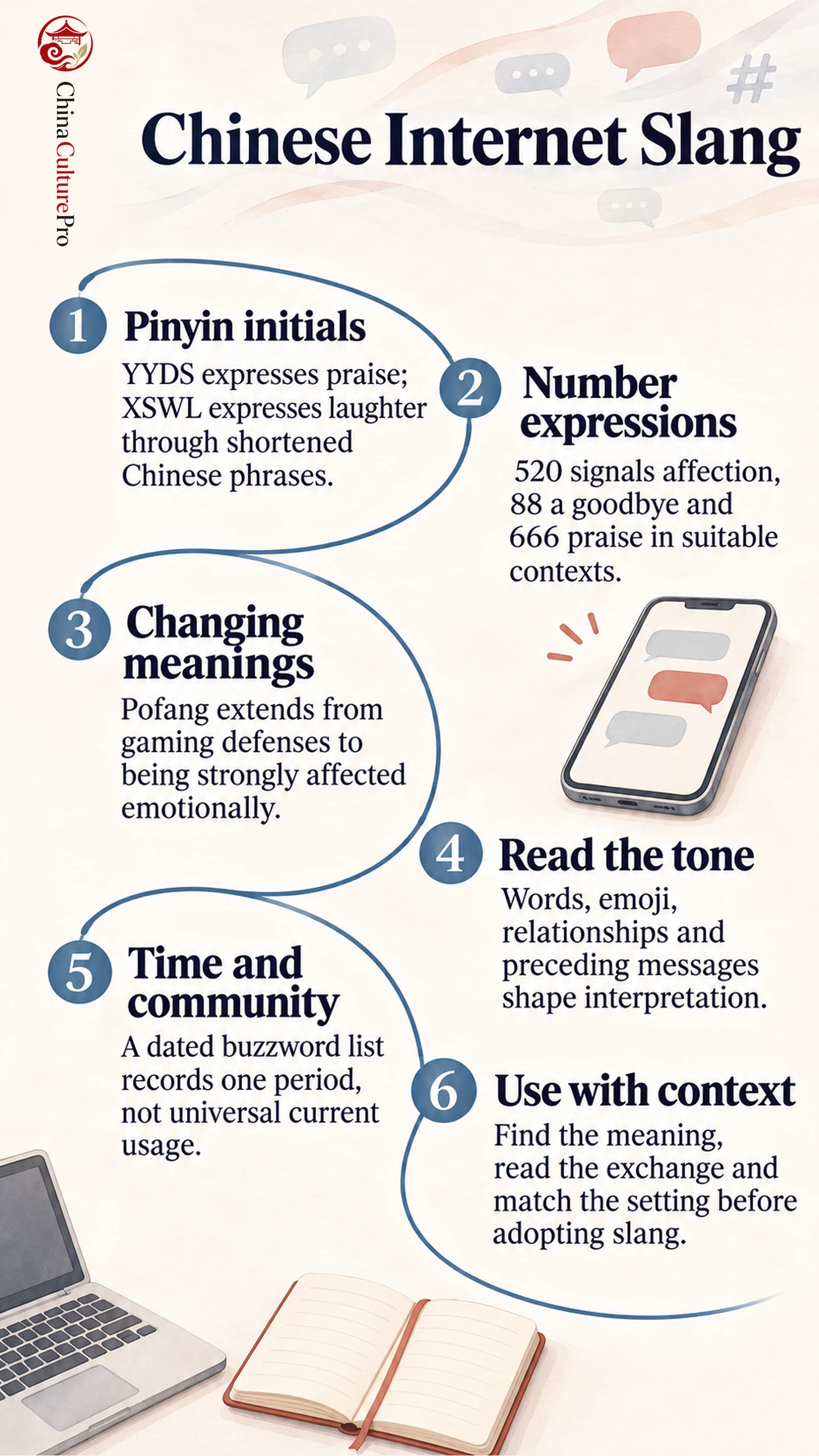
A comment containing only four letters or three digits can express praise, laughter or affection. Learning how these forms work makes Chinese popular culture easier to follow, while the surrounding conversation explains whether a familiar expression is sincere, playful or pointed.
Pinyin Initialisms: YYDS and XSWL
Pinyin represents Mandarin pronunciation in the Latin alphabet. An initialism takes the first letters of a phrase’s pinyin syllables. The resulting letters can stand for a Chinese expression without being an English word. Research comparing Chinese and Japanese social media documents both local-language initialisms and forms involving other languages.[2]
| Initialism and expansion | Significado típico |
|---|---|
| YYDS — 永远的神 (yǒngyuǎn de shén) | Literally “eternal god”; emphatic praise for someone or something outstanding. |
| XSWL — 笑死我了 (xiào sǐ wǒ le) | Literally “laughing myself to death”; a reaction to something very funny. |
These expansions explain the letters: the four syllables of each phrase supply its four initials. Their practical meanings resemble enthusiastic praise and “I’m dying laughing” in English. The reference to death in XSWL is figurative in this humorous use. A literal translation alone misses its conversational function.[8]
Recognizing an expansion does not settle whether a particular comment is sincere. Read what it responds to before treating enthusiastic wording as a measured judgment.
Number Codes: 520, 88 and 666
Digits can do work beyond counting. Yi Zhang’s study of Chinese online discourse documents numerical expressions used for compliments, farewells and other communicative purposes. Sound associations are one mechanism; shared conventions are another.[1]
| Number form | Lectura en mandarín | Conventional message |
|---|---|---|
| 520 | wǔ èr líng | An affectionate “I love you,” associated with 我爱你 (wǒ ài nǐ). |
| 88 | bā bā | An informal written goodbye, through an association with “bye-bye.” |
| 666 | liù liù liù | Praise for skill or an impressive performance; linked with 溜 (liù), “smooth or skillful.” |
The association behind 520 is approximate, rather than an exact phonetic match; its meaning is conventional.[1] For an illustrative contrast, replying “666” to a skillful gaming move can offer applause. In “The parcel number ends in 666,” the same digits belong to an identifier. The topic and position in the exchange help distinguish these uses.
These practices connect with a longer interest in Chinese sound-based wordplay, although online conventions can be looser than strict homophones.
Familiar Words with New Online Meanings
Online language also gives familiar words new uses. Pofang (破防, pòfáng) literally evokes breaking through defenses. An explanation accompanying the 2021 internet-expression list traces the term from gaming defense to a strong emotional impact: someone’s psychological defenses have been breached.[7]
The emotional direction comes from context. A moving reunion story can leave someone deeply touched; criticism can leave someone upset. The event and the speaker’s stance tell you how to translate that emotional impact.[7]
Other online expressions enter discussions of study, work and social pressure. The guide to competition and opting out explores that separate social vocabulary. A short post can use this vocabulary playfully or to make a more sustained criticism.
Tone, Emojis and the Surrounding Conversation
Words, emoji and surrounding messages work together. Yang and Qian’s experimental research on WeChat found that the smiling-face emoji could reduce perceived politeness, with interpretation related to age and the situation. The finding illustrates how a seemingly friendly image can be interpreted differently across interactions.[4]
Consider an illustrative English message: “Another perfect day.” After welcome news, it may express satisfaction; after a broken laptop and missed train, it may be ironic. An accompanying face, the previous exchange and the relationship supply further clues. A slang expression can require the same kind of contextual reading.
Abbreviations and altered forms can also be indirect. Research on Chinese social-media euphemisms examines how readers infer meanings from mixed linguistic resources and comment threads. Indirection has several possible purposes; an unusual spelling by itself does not establish one motive.[5]
Why Usage Changes Across Time and Communities
A dated buzzword list records a particular moment. The Commercial Press’s account of the 2021 annual language review includes YYDS and pofang among that year’s internet expressions. The selection drew on a language-monitoring corpus and expert evaluation. It demonstrates visibility in that period, rather than present popularity in every community.[6]
Platforms and communities also shape use. Li and Wang’s study of Douyin examined combinations of languages, pinyin initials, numerals and other expressive resources as part of online self-presentation. A short comment can show familiarity with a group’s references as well as communicate its surface meaning.[3]
Most examples here use Mandarin-based forms. They do not stand for every Chinese-language community; Chinese languages and regional varieties have different sound systems and cultural references. Different uses also reflect varied Chinese youth identities.
How to Read and Use Slang in Context
- Find the expansion or convention. Identify whether the form uses pinyin initials, a number association or a changed word meaning.
- Read the exchange. Check what prompted the expression and whether it conveys praise, affection, humor, complaint or irony.
- Match the relationship and setting. Observe the group’s usage before adopting a term, especially where informality could cause confusion.
A clear full phrase is often the better choice for a formal request, an unfamiliar recipient or an important instruction. Ask what an expression means if the context remains unclear. These choices help you understand interactions in contemporary Chinese life.
FAQs About Chinese Internet Slang
Why do Chinese expressions use Latin letters?
Some expressions use initials from pinyin, the Latin-alphabet representation of Mandarin pronunciation. The letters can abbreviate a Chinese phrase rather than an English one.
Does 520 sound exactly like “I love you”?
No. It is a conventional, approximate sound association with the Mandarin phrase. The number reading and phrase are not phonetically identical.
Does a smiling emoji always mean friendliness?
No. Studies show that interpretation can depend on the situation and the participants. Read the words and preceding exchange alongside the emoji.
Can I use internet slang in formal messages?
Use care. A fully written phrase is usually clearer for an unfamiliar recipient or a formal request. Familiarity with a term does not make it suitable for every setting.
Fuentes
[1] Yi Zhang, Language@Internet. The Semiotic Multifunctionality of Arabic Numerals in Chinese Online Discourse
[2] Contrastive Pragmatics. A Morpho-Pragmatic Study of Roman Alphabetic Initialisms on Chinese and Japanese Social Media
[3] Ziqi Li and Li Wang, Applied Linguistics Review. Investigating Translanguaging Strategies and Online Self-Presentation Through Internet Slang on Douyin
[4] Kun Yang and Shuang Qian, SAGE Journals. Your Smiling Face Is Impolite to Me: A Study of the Smiling Face Emoji in Chinese Computer-Mediated Communication
[5] Xinren Chen and Tiancheng Chen, Studies in Pragmatics. A Morpho-Pragmatic Study of Translanguaging Euphemisms on Chinese Social Media
[6] The Commercial Press. Hanyu Pandian Annual Words and Expressions Announced
[7] China University Student Online. Interpretations of the Annual Internet Expressions
[8] That’s Mandarin, via Shanghai Municipal Government. Must-Know Chinese Internet Slang Abbreviations