


Quick Answer: Who Was Shenxiu?
Shenxiu (神秀, Shénxiù) was an early Chinese Chan teacher who studied with Hongren and taught at the court of Wu Zetian. He died in 706. Later Chan debates associated his followers with the Northern School (北宗, Běizōng).[1][2][3]
- Training: He belonged to the generation that spread the East Mountain teachings.[2][5]
- Career: Wu Zetian invited him to Luoyang in 701.[2]
- Later image: The Platform Sutra assigns him a verse about keeping a mirror clear of dust.[4]
The verse is part of a story about succession. Other sources record a teacher whose influence reached the imperial court.
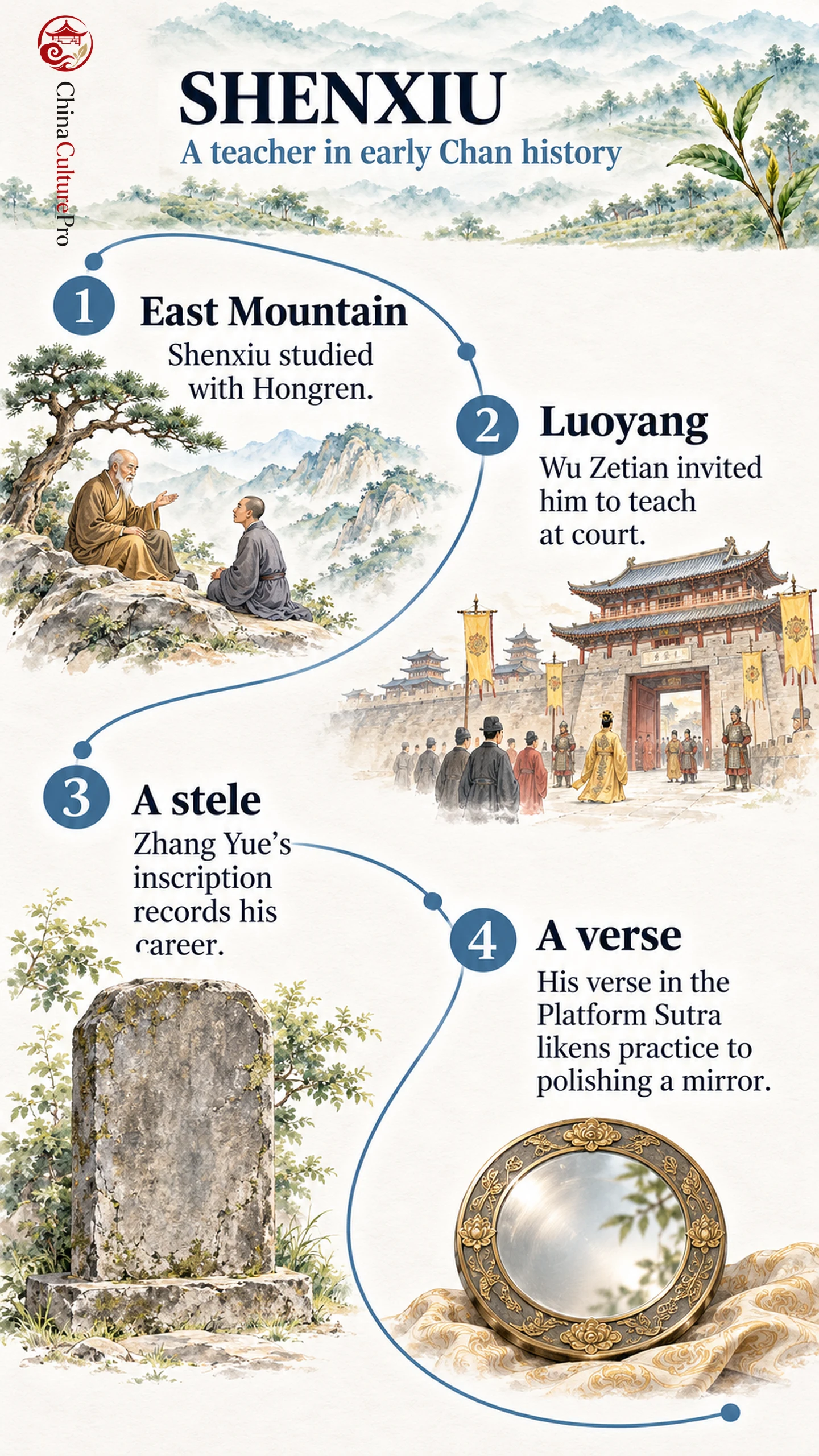
Shenxiu (神秀, Shénxiù) appears in two quite different settings in Chinese Buddhist history. Records of his career place him among respected teachers of his time. A later text gives him a role in a contest over religious understanding. Reading both helps explain his place in early Chan.
From East Mountain to the Court
Shenxiu studied with Hongren, the teacher associated with the East Mountain community at Huangmei. In 701 Wu Zetian invited him to teach at the court in Luoyang. The invitation marks a change of setting, from a monastic training community to an imperial capital and a new circle of patrons.[1][2][5]
What the Stele Records
The official and writer Zhang Yue composed a commemorative inscription for Shenxiu. The text describes stages in his training and career. A stele can preserve names and places while also honoring the person it commemorates. The inscription and the court record help explain Shenxiu’s standing independently of the later verse story.[3]
How the Mirror Verse Shaped His Image
In the Platform Sutra, Shenxiu’s verse compares practice with polishing a mirror to keep dust from settling. A response assigned to Huineng invokes original purity. The mirror gives readers a visual way to follow the debate staged in the text. Later Chan disputes applied the Northern School (北宗, Běizōng) label to Shenxiu’s followers. That label belongs to the history of Chan Buddhism, including contests over how teachers were remembered.[1][4]
FAQs About Shenxiu
Who was Shenxiu’s teacher?
Shenxiu studied with Hongren, an important teacher in the East Mountain community.
Is the mirror verse a complete account of his teaching?
It presents one image of practice in a later work. His career and his followers’ teachings are also part of the historical evidence.
Why is he called a Northern School teacher?
Later Chan discussions used the label for the lineage associated with Shenxiu and his followers.
Fuentes
[1] University of California Press, Oxford Academic. John McRae, Metropolitan Chan: Imperial Patronage and the Chan Style
[2] Encyclopedia of Religion. Chan
[3] Buddhist Culture in the Greater Hangzhou Region. Shenxiu’s travel and study in Zhang Yue’s stele inscription
[4] Columbia University, Asia for Educators. Excerpts from the Platform Sutra of the Sixth Patriarch
[5] Encyclopedia of Buddhism. Yuquan Shenxiu