

Quick Answer: Who Was Nurhaci?
Nurhaci (努尔哈赤, Nǔ’ěrhāchì, 1559–1626) was a Jurchen (女真, Nǚzhēn) leader who founded the Later Jin (后金, Hòu Jīn) in 1616. His state challenged the Ming dynasty and became the predecessor of the Qing.[1][2]
- State building: He brought Jurchen communities under his rule and proclaimed a new reign in 1616.[6]
- Organization: The Eight Banners (八旗, Bāqí) organized troops and the households associated with them.[4]
- Succession: His son Hong Taiji (皇太极, Huáng Tàijí) succeeded him and later proclaimed the Qing.[2]
The state he established preceded the use of the name Qing, which dates to 1636.[2]
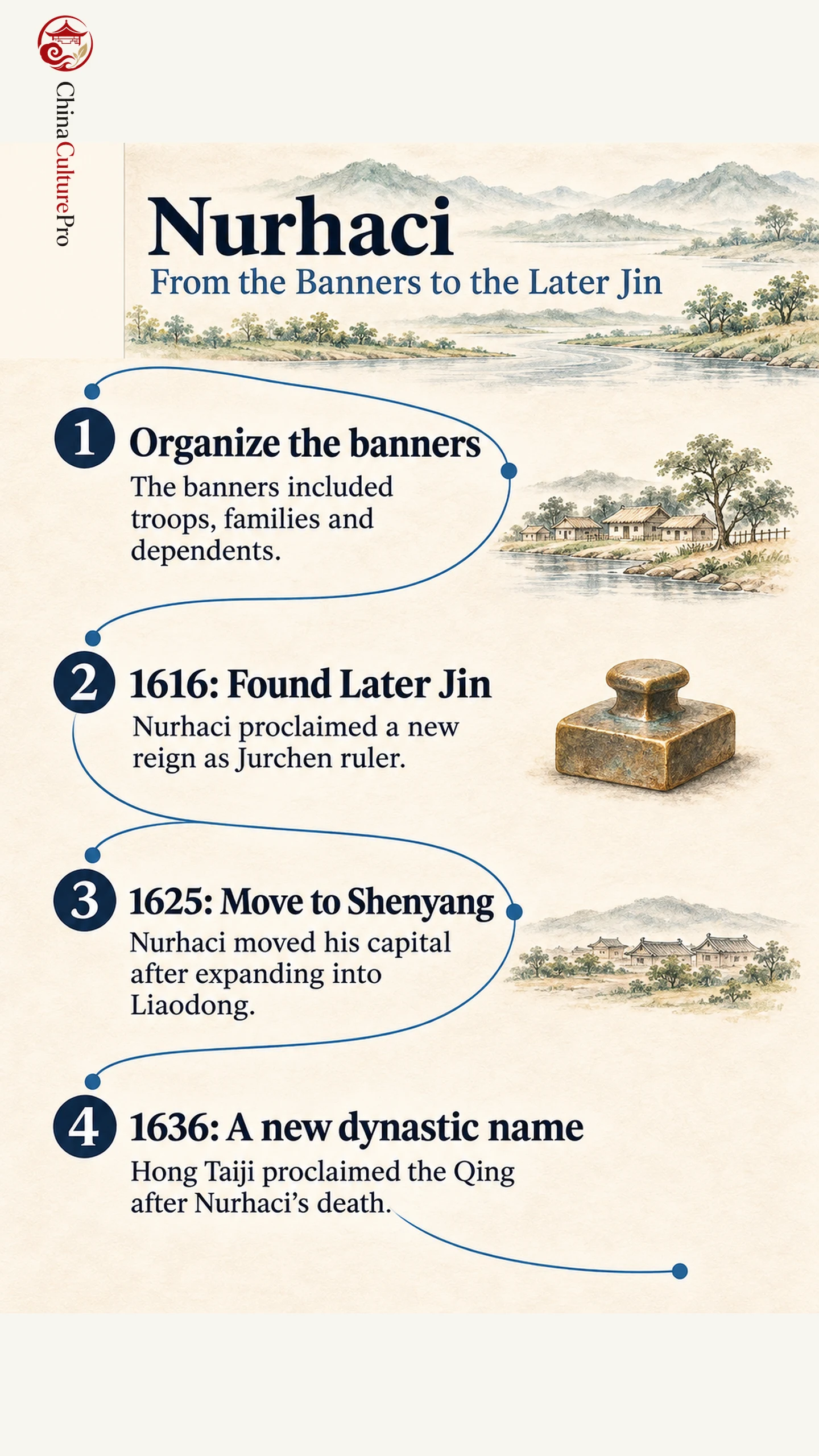
A banner in Nurhaci’s state organized troops in the field and households under the government’s authority. That combination of military and social organization helped his expanding state absorb communities and retain control over them.
How Nurhaci Founded the Later Jin
Nurhaci began as a leader among the Jianzhou Jurchens and held titles granted by the Ming. His early relationship with the Ming court thus preceded the open conflict between the two states. As his authority expanded, he brought other Jurchen groups under his rule. In 1616 he took the title of khan and founded the Jin state, usually called Later Jin to distinguish it from the earlier Jurchen Jin dynasty.[1][2]
The later Qing court record describes his accession as a ceremony in which leaders of the banners assembled to honor him. It dates the start of his Tianming reign to that year.[6]
Nurhaci also commissioned a written form of his people’s language in 1599. Scholars adapted the Mongolian script for Jurchen sounds, giving the emerging government a way to keep records and send written messages. The National Palace Museum preserves archives from the first decades of the seventeenth century that include this early Manchu writing.[7]
Who Belonged to the Eight Banners?
By 1615 Nurhaci had established eight banners. Smaller companies formed their basic units, and plain and bordered versions of four colors distinguished the banners. Their role was permanent, unlike temporary groups gathered for a particular campaign or hunt.[3][4]
A banner included dependents, women and children as well as men available for military service. Communities brought under Nurhaci’s rule entered the system in different circumstances. Some people were incorporated through conquest, and banner membership could carry obligations for labor or military service.[3]
From the Seven Grievances to the Move to Shenyang
In 1618 Nurhaci declared his Seven Grievances (七大恨, Qī Dà Hèn) against the Ming. The declaration presented a case for conflict, listing complaints about earlier deaths in his family, frontier disputes and Ming treatment of rival groups.[5]
The victory at Sarhu (萨尔浒, Sà’ěrhǔ) in 1619 was followed by further expansion into Liaodong (辽东, Liáodōng). Nurhaci moved his capital to Liaoyang in 1621 and then to Shenyang in 1625. His advance met a setback at Ningyuan (宁远, Níngyuǎn) in 1626. He died later that year.[1]
FAQs About Nurhaci
Did Nurhaci Name the Qing Dynasty?
He founded the state historians call Later Jin. His successor Hong Taiji proclaimed the Qing dynasty in 1636.[2]
Were the Eight Banners Only a Military Organization?
The banners were also administrative units that included families and dependents. They organized obligations that extended beyond military service.[4]
Who Succeeded Nurhaci?
Hong Taiji, one of Nurhaci’s sons, succeeded him after his death in 1626.[1]
Fuentes
[1] Palace Museum, Beijing. Nurhaci, Life and Chronology
[2] The Cambridge History of Inner Asia. The Qing and Inner Asia, 1636–1800
[3] International Review of Social History. Tributary Labour Relations in China During the Ming–Qing Transition
[4] Sugiyama Kiyohiko. Study of the Early Eight Banners
[5] Palace Museum, Beijing. The Wanli Emperor, The Seven Grievances
[6] Veritable Records of the Qing, Shidian Guji. Veritable Records of Qing Taizu Nurhaci, Volume Five
[7] National Palace Museum, Taipei. Archives in Old Manchu