


Quick Answer: Who Was Zu Chongzhi?
Zu Chongzhi (祖冲之, Zǔ Chōngzhī), born in 429, was a mathematician and calendrical astronomer in southern China. A later history credits him with narrow bounds for pi and the approximation 355/113. He also proposed the Daming Calendar (大明历, Dàmíng Lì), which came into use after his death.[1][2][3]
- Mathematics: The numerical results survive in the Book of Sui.
- Method: His own mathematical treatise is lost.
- Calendar: A proposal submitted in 462 was adopted under a later dynasty in 510.
The sources preserve the numerical result and the calendar proposal in different ways.
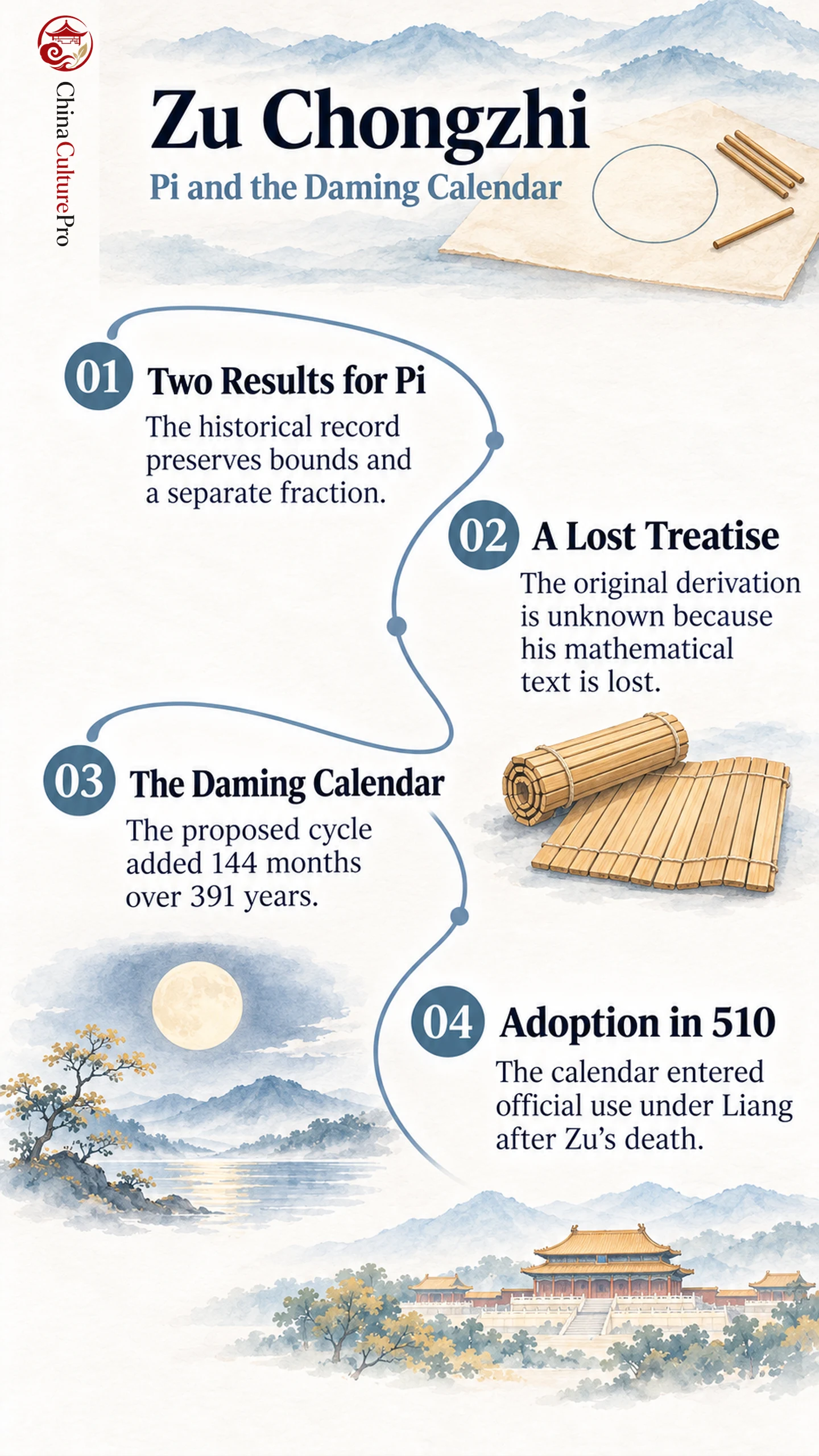
A narrow interval and a useful fraction tell readers different things about a circle. Zu Chongzhi left both kinds of result. His work on the calendar shows a further distinction, between a computation a scholar could propose and a system the court would put into use.
What the Book of Sui Records About Pi
The Book of Sui records a lower and an upper bound credited to Zu. Pi is greater than 3.1415926 and less than 3.1415927. It separately records 22/7 as a rough fraction and 355/113 as a closer one. The interval is a statement about where the value lies. A fraction supplies a convenient number for calculations.[1][2]
The distinction is visible if you divide 355 by 113. The result begins 3.1415929203, just above the upper end of Zu’s recorded interval. Both the fraction and pi round to 3.141593 at six decimal places. The fraction and the interval are two different achievements.[1][2]
What Survives of His Method
The Book of Sui names Zu’s mathematical work as the Zhui shu (缀术, Zhuì Shù). The text has not survived. Earlier Chinese work on circles, including Liu Hui’s use of polygons, gives historians a starting point for conjectures about Zu’s approach. A plausible reconstruction and a surviving account of Zu’s own steps would be different evidence.[1][2]
This matters when reading historical sources. The later history reports bounds and fractions. Its numbers can be checked against modern arithmetic, while its silence about the derivation leaves that part of Zu’s work open.[1][2]
Why Zu Proposed the Daming Calendar
A lunisolar calendar has to keep months aligned with the moon while keeping the calendar in step with the seasons. Zu’s proposal assigned 144 additional months across a cycle of 391 years. The extra months bring the average calendar year closer to the seasonal year. The 391-year cycle contains 4,836 months in total. A much older rule added seven months over nineteen years. Both approaches address the same mismatch, using different ratios of extra months to years.[2][3][4]
Zu also argued that the position of the winter solstice relative to the stars had changed over time. His memorial used comparisons with older records in making the case for new calculations. The calendar had to address two different questions. One was how to add months. The other was how to keep the calculated seasonal positions aligned with observations.[3][4]
How the Calendar Moved From Proposal to Use
Zu submitted the proposal to the Liu Song court in 462. The proposal was debated at court. Dai Faxing opposed it, and the emperor died before the new calendar went into effect. A court could consider a new calculation for years before choosing which system its officials would use. The Book of Southern Qi records a later attempt to adopt it that also stalled. These changes of government are part of the history of the Northern and Southern Dynasties.[2][3][4][5]
His son Zu Geng (祖暅, Zǔ Gèng) promoted its adoption. The Liang court put the calendar into use in 510. That sequence makes the proposal, debate and implementation three separate moments in Chinese calendar reform.[2][3][5]
FAQs About Zu Chongzhi
Is 355/113 exactly equal to pi?
It is a very close rational approximation. Pi is irrational and cannot equal any ratio of whole numbers.
Does Zu Chongzhi’s original calculation survive?
The later dynastic history preserves his results. The treatise that might have explained how he obtained them is lost.
When did the Daming Calendar come into use?
Zu submitted it in 462. It came into official use under the Liang in 510, after his death.
Fuentes
[1] Book of Sui. Chapter 16: Treatise on Harmonics and Calendrics
[2] University of St Andrews, MacTutor History of Mathematics. Zu Chongzhi
[3] Hong Kong Education Bureau. Selected Explanations of Zu Chongzhi’s Daming Calendar Algorithms
[4] Imperially Commissioned Collection of Ancient and Modern Books. Calendrics, volume 5
[5] Book of Southern Qi. Chapter 52: Zu Chongzhi