

Quick Answer: What Changed in Chinese Calendar Reforms?
Chinese calendar reforms changed how officials calculated and assigned dates. Court astronomers used observations and mathematical rules to keep lunar months aligned with the solar year. The court used the results to issue official dates. Reform could change a rule for assigning months, a model of the heavens or the astronomical tables used to calculate dates.[1][2][4][5]
- Observe: Record evidence such as solar shadows or eclipses.
- Calculate: Use a model to predict when astronomical events will occur.
- Issue: Publish dates and month assignments for official use.
Different reforms revised different parts of this process.

A calendar has to tell people what date it is. Its makers also need ways to predict where the Sun and Moon will be. Chinese reforms changed those calculations while leaving the court responsible for issuing dates.
What a Lunisolar Calendar Has to Calculate
A lunisolar calendar (阴阳历, yīnyánglì) coordinates two cycles. A lunar month follows the Moon’s phases, while the solar year tracks the seasons. Twelve lunar months run about eleven days short of a solar year. An additional month, inserted when the calendar’s rules require it, prevents the numbered months from continually shifting through the seasons.[1][2]
The twenty-four solar terms mark positions in the Sun’s annual cycle. A calendar can use these markers to decide how to number months or assign an extra one. Observations help test the predictions, but officials must still choose the rules that turn an astronomical event into a date.[1][2][7]
Taichu: Reform Under Emperor Wu of Han
Emperor Wu of the Han dynasty adopted the Taichu calendar (太初历, Tàichū lì) in the reform of 104 BCE. The reform is associated with beginning the year with the first numbered month and fixing the winter solstice in the eleventh month. It also gave the court an occasion to declare a new arrangement of official time.[2][3][7]
The surviving accounts in the Records of the Grand Historian and the History of the Han emphasize different details. Christopher Cullen’s comparison suggests that an initial scheme and a subsequent revision used different mathematical constants. The two accounts help distinguish what officials proposed from the system subsequently associated with the name Taichu.[3]
Shoushi: Measuring the Sun for a Yuan Calendar
The Yuan dynasty commissioned an effort that produced the Shoushi calendar (授时历, Shòushí lì), completed in 1280 and put into use from 1281. Wang Xun directed the calculations and Guo Shoujing supervised observations. They worked in the same project, but recording a shadow and constructing tables from the observations called for different work.[4]
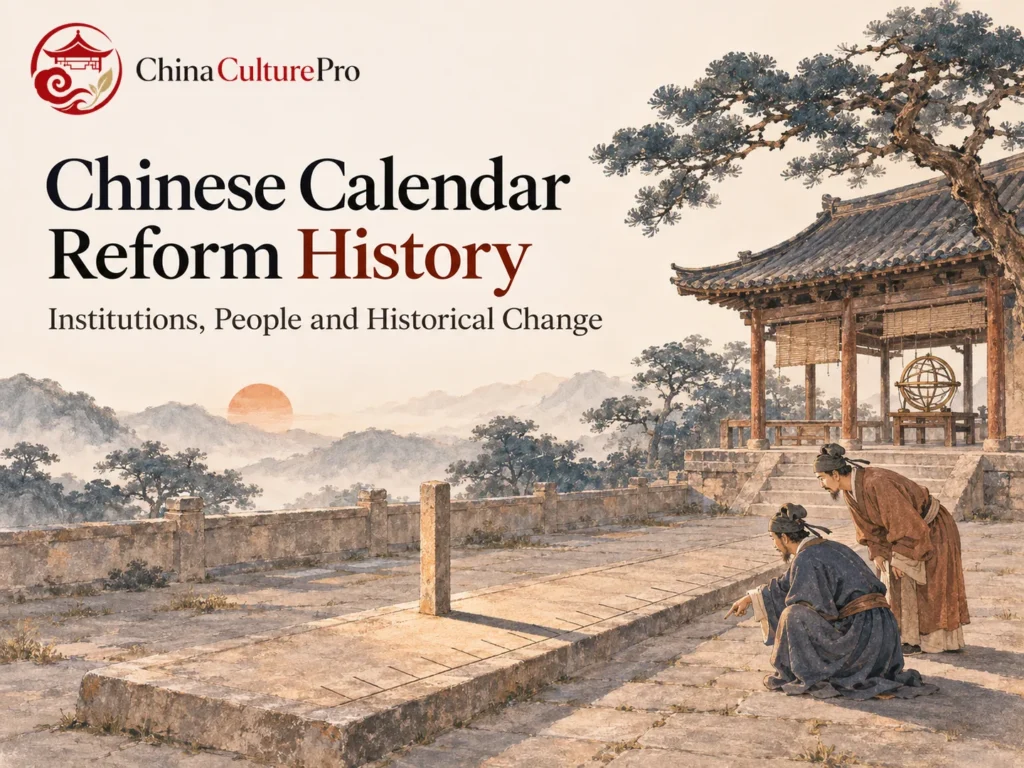
One series of observations tracked the changing length of the Sun’s midday shadow around winter. A gnomon and a marked scale let astronomers measure the shadow on different dates. A series of readings around winter helped estimate the solstice. Astronomers then used the measurements to calculate future dates.[4]
Shixian: A Late Ming Project Adopted by the Qing
In 1629 the late Ming court commissioned a calendar revision led by Xu Guangqi. Li Tianjing succeeded him, and Jesuit astronomers contributed to the project. The compendium incorporated methods for predicting eclipses and working with astronomical instruments. The Library of Congress’s digitized copy of the later compilation illustrates the range of material, from eclipse tables to treatises on instruments.[5][6]
The Qing adopted revised methods for the Shixian calendar (时宪历, Shíxiàn lì) in 1645. One change was to determine solar terms using the calculated position of the Sun, which makes the time between successive terms unequal. Lunar months and solar terms still worked together. The comparison with the Gregorian calendar explains the difference between their organizing rules.[5][7]
FAQs About Chinese Calendar Reform
Why did the Chinese calendar need leap months?
Twelve lunar months fall short of a solar year. Inserting an extra month when needed keeps the numbered months within roughly the same part of the seasonal cycle.
Did the Shixian reform adopt the Gregorian calendar?
The Qing reform introduced revised astronomical methods within a calendar that retained lunar months and solar terms. The Gregorian calendar organizes its months separately from Moon phases.
Can a modern conversion table date an early imperial record?
Check the reign, region and calendar in force. Modern rules projected backward can differ from the dates officials originally calculated and recorded.
Fuentes
[1] Hong Kong Observatory. Calendario
[2] Christopher Cullen, Oxford University Press. Heavenly Numbers: The Astronomical Empire
[3] Christopher Cullen, Journal for the History of Astronomy. Motivations for Scientific Change in Ancient China
[4] Biographical Encyclopedia of Astronomers, University of St Andrews. Guo Shoujing
[5] Catherine Jami, Science in Context. European Science in China or Western Learning?
[6] Library of Congress. Xi yang xin fa li shu, digitized treatises on calendrical astronomy
[7] Helmer Aslaksen, Berkeley Math Circle. The Mathematics of the Chinese Calendar