


Quick Answer: Who Was Zheng Chenggong?
Zheng Chenggong (鄭成功, Zhèng Chénggōng), known as Koxinga, was a maritime commander who supported the Ming against the Qing. He landed in southwestern Taiwan in 1661 and accepted the surrender of the Dutch East India Company’s Fort Zeelandia (熱蘭遮城, Rèlánzhē Chéng) in 1662. His family governed from Taiwan until 1683. [1][3][6][7]
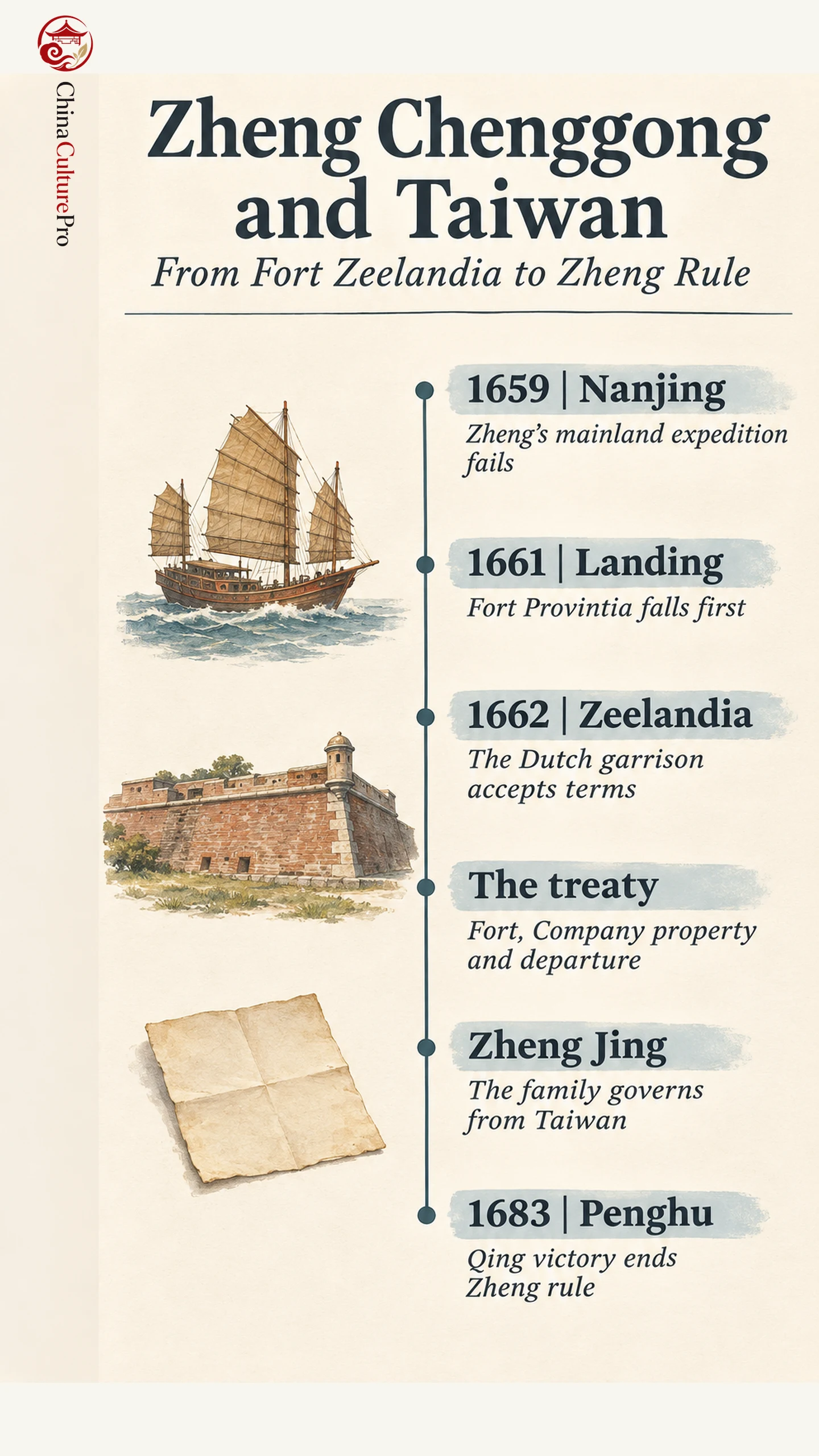
- 1661: Zheng’s forces landed and took Fort Provintia before Zeelandia fell.
- 1662: The Dutch garrison surrendered Zeelandia under written terms.
- 1683: The Qing defeated Zheng forces at Penghu and accepted the family’s surrender. [3][4][7]
The fall of the fort ended the Company’s colonial government at its southwestern base. Zheng’s family still had to build and maintain its own government there. [2][3][6]
The document signed at Zeelandia describes who could take goods out of the fort, which stores had to be handed over and what would happen to prisoners. Those details make the treaty a useful starting point for understanding the transfer of power.
Why a Ming Loyalist Turned to Taiwan
Zheng was born in Japan to a Japanese mother and a Chinese father, Zheng Zhilong, whose organization combined overseas trade and armed power. After the Ming lost Beijing in 1644, Zheng Chenggong served the Southern Ming cause. His title, Lord of the Imperial Surname (國姓爺, Guóxìngyé), gave rise to the name Koxinga. In 1659 his attempt to take Nanjing failed, and Taiwan offered a harbor and a new political base within the maritime region his organization already knew. [1][6]
The coast he approached was already part of a busy trading region. Indigenous peoples had long lived on Taiwan. The Dutch East India Company built its southwestern base in the 1620s, relied on Chinese migrants in farming and trade, and extended its authority over some Indigenous communities. Its authority depended on place and on local relationships. A treaty between two commanders tells us little by itself about how Indigenous communities experienced the change. Taiwan therefore enters Zheng’s story with a history of its own, alongside the collapse of the Ming dynasty on the mainland. [1][2][6]
From the 1661 Landing to the 1662 Surrender
Zheng’s forces arrived near present-day Tainan in spring 1661. Fort Provintia, on the settlement side of the old Taijiang lagoon, fell early. Zeelandia, which guarded the harbor from a coastal position near present-day Anping, held out for roughly nine months. Taking Provintia gave Zheng control of the Company’s settlement on the mainland side of the lagoon. Zeelandia remained in Dutch hands across the water. [1][4][5]
On 1 February 1662, Zheng and Governor Frederik Coyett’s side agreed to terms. The Company relinquished the fort and its property, while the Dutch party could leave under specified conditions. The treaty also provided for the return of prisoners held on both sides. The text also regulates how the Dutch could remove their records and personal belongings. It reads as a transfer of a working colonial headquarters, down to its stores and account books. [3][4]
What the Treaty and Other Records Can Tell Us
The National Taiwan Museum catalogs a photographic copy of the Dutch text and identifies the original as held in the Dutch National Archives. Its catalog describes 18 articles in Dutch and 16 in Chinese. The figures establish that the texts are arranged differently. The English clauses discussed here follow the Dutch version. [3][4]
Other records answer other questions. Hsu compares Dutch and Zheng maps and accounts to reconstruct where troops first came ashore and where they set up camp. Coyett’s published defense, presented in a Taiwan history museum exhibition, argues that Company officials failed to support him. Coyett wrote after the defeat and had a reason to defend his decisions. His explanation is best read alongside records from the siege itself. [5][9]
How the Zheng Family Ruled After 1662
Zheng Chenggong died in 1662. His son Zheng Jing (鄭經, Zhèng Jīng) emerged as his successor and governed from Taiwan. Under Jing the organization developed a more durable base and continued trading with overseas markets, including Japan. Jing inherited a claim to act for the Ming, but his rule also depended on commerce. Xing Hang traces how those interests shaped his choice to build up the economy in Taiwan and to negotiate over his relationship with the Qing. [6][8]
In 1683 the Qing admiral Shi Lang defeated Zheng forces at Penghu, west of Taiwan. Zheng Keshuang, the founder’s grandson, then surrendered. The end of Zheng rule brought its western settlements and coastal bases under the Qing dynasty. The transfer in 1683 took place through a second surrender, this time by the family that had accepted the Dutch capitulation. [6][7][8]
FAQs About Zheng Chenggong and Taiwan
Why is Zheng Chenggong called Koxinga?
Koxinga is a European rendering of a title meaning Lord of the Imperial Surname. Zheng Chenggong is his name in modern pinyin. [1]
When did the Dutch surrender Fort Zeelandia?
The capitulation agreement was concluded on 1 February 1662. Zheng had arrived the previous spring, and Fort Provintia had already fallen. [1][3][4]
Did Zheng Chenggong rule Taiwan until 1683?
He died in 1662. His son Zheng Jing succeeded him, and his grandson Zheng Keshuang surrendered to the Qing in 1683 after the defeat at Penghu. [6][7][8]
Fuentes
[1] Bruce A. Elleman. Ming Loyalists Flee to Taiwan (1661–83)
[2] Tonio Andrade. How Taiwan Became Chinese
[3] University of Oregon teaching collection. Treaty at Castle Zeelandia, 1 February 1662
[4] National Taiwan Museum. Collection record for a photograph of the Dutch treaty text
[5] Joseph Chih-Shun Hsu. Zheng Chenggong’s Landing Sites
[6] Xing Hang. Between Trade and Legitimacy, Maritime and Continent
[7] Penghu County Government. History of Penghu
[8] Xing Hang. Contradictory Contingencies
[9] National Museum of Taiwan History. Illustration of Negotiation Between the Dutch Envoy and Zheng Cheng-gong