

Quick Answer: What Was the Ming-Qing Transition?
The Ming-Qing transition (明清易代, Míng Qīng Yìdài) was the decades-long process in which the Ming empire fragmented and the Qing expanded. The Later Jin (后金, Hòu Jīn) became the Qing in 1636. Qing troops entered Beijing in 1644, but Southern Ming (南明, Nán Míng) courts and other rivals continued to fight. [1][2][3][4]
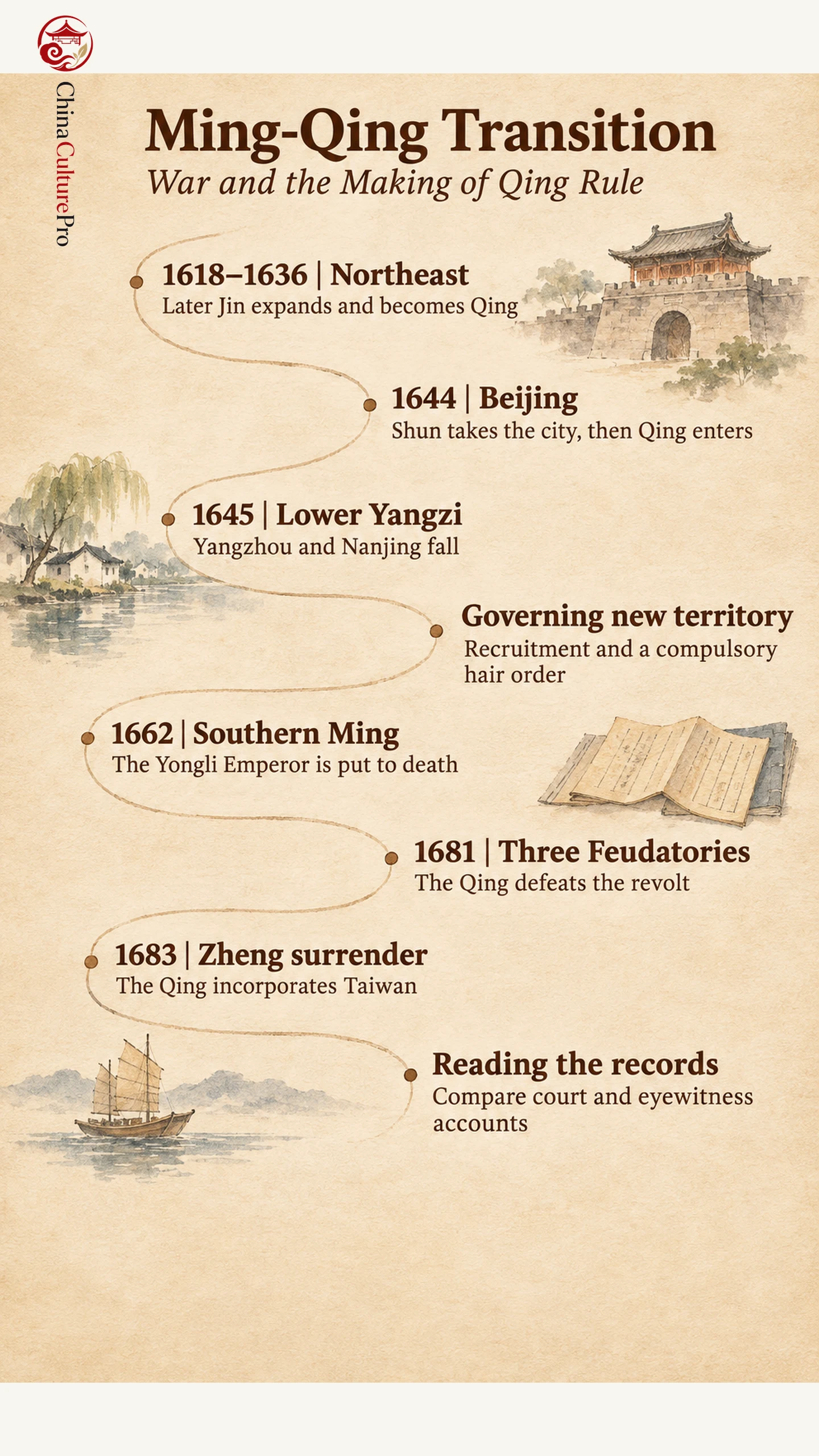
- 1636: The Qing dynastic name was adopted before the conquest of Beijing.
- 1644: Li Zicheng’s army took Beijing from the Ming. Qing forces took the city after defeating Li.
- 1662–1683: The last major Southern Ming court was gone by 1662. Other conflicts continued into the 1680s. [1][2][3][4][5][10]
The date 1644 marks a change of power in Beijing. Control of the provinces and the coast was still being fought over. [1][2][5]
When Beijing fell, control of the capital, command of regional armies and the right to claim the Ming throne passed into different hands. Which forces could turn those claims into government varied by region.
How the Qing State Formed Before 1644
In the northeast, Nurhaci (努尔哈赤, Nǔ’ěrhāchì) united Jurchen groups and built the Later Jin state. Its forces seized the Ming frontier town of Fushun in 1618. The Eight Banners (八旗, Bāqí) organized households as well as military units, giving the state a way to mobilize people and resources. Under Nurhaci’s successor Hong Taiji (皇太极, Huáng Tàijí), the state expanded and took the dynastic name Qing in 1636. [1][2][3][7]
This frontier war drew resources from the Ming dynasty while rebellions and economic distress weakened its position inside China. Qing forces invaded Joseon Korea in 1636 to prevent it from aiding the Ming. The settlement that followed took Joseon princes to the Qing court as hostages. [1][2][3][5]
Why Beijing Changed Hands Twice in 1644
Li Zicheng’s Shun army took Beijing in April 1644, and the Chongzhen Emperor died by suicide. At Shanhai Pass, the former Ming commander Wu Sangui secured military support from Dorgon (多尔衮, Duō’ěrgǔn), the Qing regent. Their forces defeated Li’s army. The Qing entered Beijing after Li withdrew and made it the seat of the government of the Shunzhi Emperor. [2][3][5]
Nanjing already had administrative institutions as a secondary Ming capital. After news of Chongzhen’s death reached it, officials installed the Prince of Fu as the Hongguang Emperor. They claimed to continue the Ming from the south while the Qing and remaining Shun forces fought in the north. [4][5]
How Conquest Continued After Beijing
Qing forces took Yangzhou and Nanjing in 1645. Southern Ming leaders then established courts elsewhere. The Yongli Emperor (永历帝, Yǒnglì Dì) and his supporters shifted through the southwest as Qing armies advanced. He fled into Burma, was brought back to Yunnan by Qing forces and was put to death in 1662. That ended the last major Southern Ming court. [1][2][4][5][6][8]
Other opposition had different bases. The Revolt of the Three Feudatories challenged the Qing from within the system of regional commands and was suppressed by 1681 under the Kangxi Emperor. The Zheng family’s maritime regime survived on Taiwan until its surrender in 1683. The Qing then incorporated Taiwan, where the reach of its administration developed unevenly. [1][2][10]
How the Qing Governed New Territory
The Qing dynasty drew on officials who had served the Ming and needed existing administrative offices to function. The Shunzhi reign records, for instance, note the appointment of a former Ming personnel official as an inspector in Henan. The Qing also recruited former Ming military personnel. The Green Standard Army (绿营, Lǜyíng) expanded alongside the Banner forces and took part in the conquest. Chinese officials and soldiers helped extend and staff a government led by the Manchu dynasty. [3][5][6][7]
Qing rule also carried demands that made allegiance visible. In 1645 the court renewed and broadened its order for men to shave the front of the head and wear their remaining hair in a queue. The decree treated compliance as a sign of submission and threatened punishment for refusal. It gave authorities in the provinces ten days from receipt of the order to enforce it. [5][6]
What Different Sources Reveal About the Transition
The Veritable Records describe the Qing conquest of Nanjing in a ceremonial account of victory. The narrative attributed to Yangzhou survivor Wang Xiuchu describes killings, looting and attempts to hide from soldiers during and after the taking of his city. The Qing record celebrates a victory and the opening of the route to Nanjing. Wang’s account follows a family trying to stay alive in the city the army had just taken. [6][8][9]
Accounts also traveled across borders. Historian Chui-Joe Tham follows the Mingji yiwen, a Chinese narrative published in 1657, from a Joseon envoy’s acquisition of the text to its appearance in an annotated Japanese edition. Diplomatic travel and commercial publication helped readers elsewhere in East Asia follow events that had begun as a contest for power across the Ming empire. [2]
FAQs About the Ming-Qing Transition
Did the Qing dynasty begin in 1636 or 1644?
Hong Taiji proclaimed the Qing dynastic name in 1636. The Qing entered Beijing in 1644 and ruled from it thereafter. The dates refer to different stages in the history of the same state. [1][2][3]
What was the Southern Ming?
Southern Ming is the collective name for Ming courts and claimants that continued in southern and southwestern China after Beijing fell. The first formed at Nanjing in 1644. [2][4][5]
Why do some histories end the transition in 1683?
The Zheng regime surrendered in 1683 after earlier Qing victories over the Southern Ming and the Three Feudatories. That makes 1683 a useful endpoint for the main military conflicts of the transition. Qing administration continued to evolve afterward. [1][2][10]
Fuentes
[1] Pamela Kyle Crossley. The Qing Unification, 1618–1683
[2] Chui-Joe Tham. The Transnational Historiography of a Dynastic Transition
[3] Jerry Dennerline. The Shun-chih Reign, in The Cambridge History of China
[4] Lynn A. Struve. The Southern Ming, 1644–1662, in The Cambridge History of China
[5] Frederic Wakeman Jr.. The Great Enterprise, Volume 1: The Manchu Reconstruction of Imperial Order in Seventeenth-Century China
[6] Qing court compilers. Veritable Records of the Shunzhi Emperor, Volume 17
[7] Yingcong Dai. The Qing Empire and Its Military
[8] Lynn A. Struve, editor and translator. Voices from the Ming-Qing Cataclysm: China in Tigers’ Jaws
[9] Wang Xiuchu. Record of Ten Days in Yangzhou
[10] National Palace Museum. The Qing Empire and Taiwanese Indigenous Peoples