


Quick Answer: What Is a Lingnan Qilou?
A qilou (骑楼, qílóu) is an arcaded street building. In Lingnan (岭南, Lǐngnán), a projecting upper floor stands on columns above a sheltered pedestrian passage. When adjoining buildings align their columns and shopfronts, the passages link up along the block.[2][6]
- Below: Shops can open onto the covered route, where customers walk out of the sun and rain.[2]
- Above: Upper rooms project over the pavement and often housed residents.[2][6]
- Along the street: Early twentieth-century street works and commercial development helped shape surviving arcade districts in Guangzhou (广州, Guǎngzhōu).[1]
The arcade is one of the street forms associated with Lingnan culture. It appears in large city streets and smaller market towns.
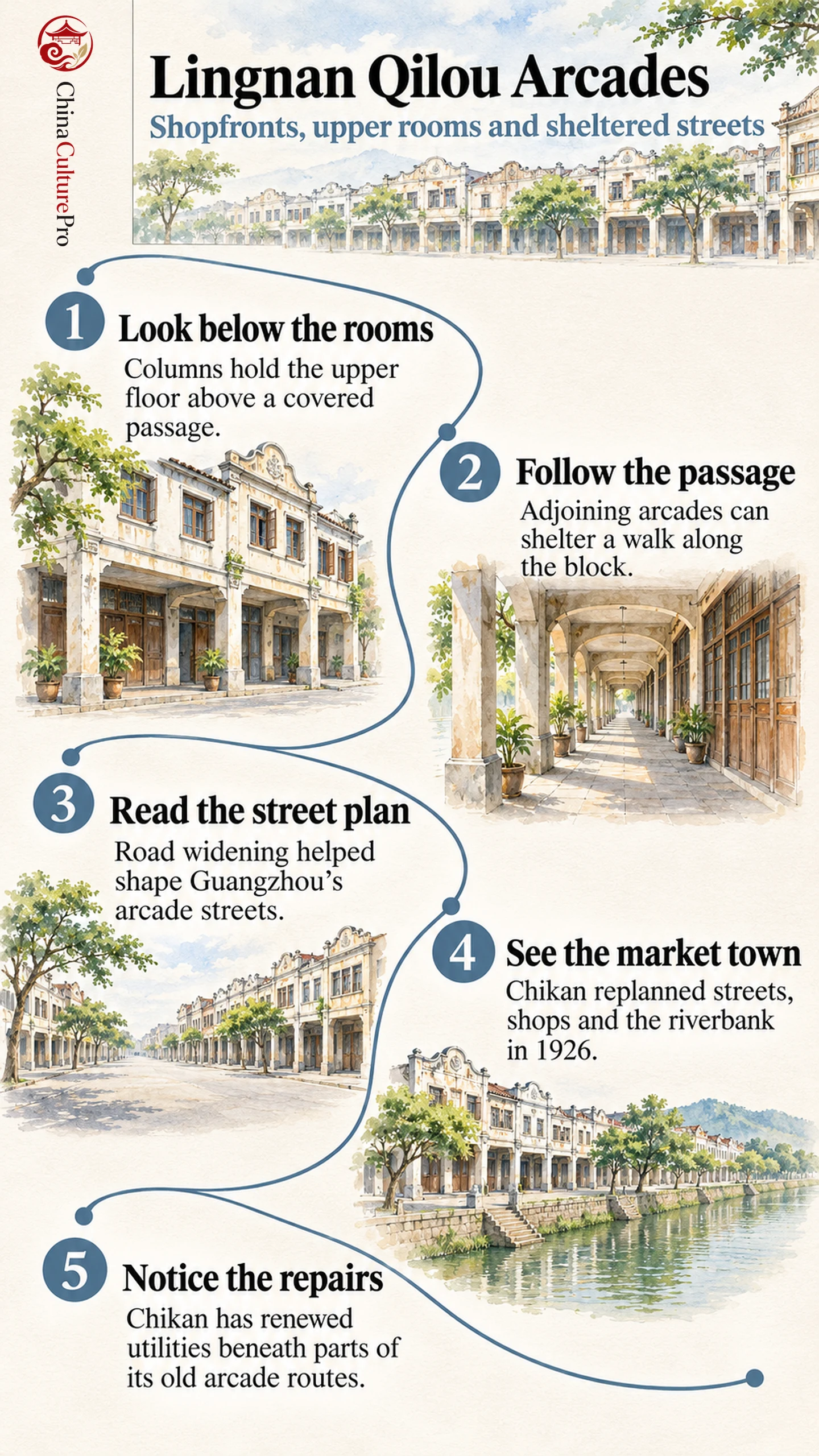
Walk beneath a row of qilou and look at the upper windows. The details may change as you cross from one property to the next. Under them, the covered route can carry on through the block.[6]
How One Building Forms Part of a Street Arcade
The columns and shop doors sit on different lines. The columns stand near the road edge, while the shop doors are set back below the upper rooms. The result is a covered zone that serves both the adjoining business and people walking past it. Each facade can carry a different design, above the same walking route.[2][6]
Guangzhou’s Arcades and Street Widening
In 1912, the Guangdong provincial police department issued building rules that addressed arcade construction. Road widening and commercial development helped shape the rows built over the following decades.[1] Guangzhou’s tourism authority identifies Shangxiajiu (上下九, Shàngxiàjiǔ) among the areas with arcades.[2] The nearby tradition of Guangzhou’s Xiguan houses offers another way to see how the city organized housing and the street edge.
Chikan’s Arcades and Riverfront Trade
In Chikan (赤坎, Chìkǎn), a market town in Kaiping (开平, Kāipíng), the local government dates a major replanning effort to 1926. Planners came from Guangzhou. The town rebuilt roads, improved the embankment and developed rows of shops with arcades. The covered passage belonged to a broader effort to give the market more usable commercial space.[3]
The same corridor still affects what can be changed in the district. A recent municipal account describes installing sewer lines beneath parts of the arcade and beside lanes to limit disturbance to old foundations.[5] The market-town setting connects the arcades to the history of Chinese merchant culture.
Kaiping’s diaolou (碉楼, diāolóu) towers offer a nearby comparison. Their vertical form served defensive or residential purposes.[4]
FAQs About Lingnan Qilou Arcades
Does a Qilou Need an Arched Facade?
The defining feature is the covered passage under the projecting upper storey. Columns can support that projection even when the openings between them have straight tops.[6]
How Is a Qilou Different From a Diaolou?
A qilou shelters a passage along a street. A diaolou is a multistorey tower, historically used in Kaiping for defense, refuge, residence or watchkeeping.[4][6]
Are Today’s Arcaded Blocks All Original?
The age and fabric vary by building. In Chikan, municipal accounts describe restoration work and changes to infrastructure in a district with surviving arcaded frontages.[3][5]
Fuentes
[1] Buildings. A Comparative Study of the Conservation and Sustainable Renewal of Arcade Buildings in Four Lingnan Cities
[2] Guangzhou Bureau of Culture, Radio, Television and Tourism. Guide to Beijing Road’s Historic District
[3] Kaiping Municipal People’s Government. The Development and Restoration of Chikan’s Arcades
[4] UNESCO World Heritage Centre. Kaiping Diaolou and Villages
[5] Kaiping Municipal People’s Government. Water and Infrastructure Renewal in Chikan
[6] UN-Habitat. Best Practices on Social Sustainability in Historic Districts