


Quick Answer: What Did Traditional Chinese Schools Look Like?
Traditional Chinese school buildings varied with the institution. A shuyuan (书院, shūyuàn), or academy, could group teaching, books and ritual in distinct buildings. Beijing’s imperial college occupied a compound of several courtyards. A village school might fit inside a single small building.[1][3][6]
- Academy: A lecture hall could anchor a sequence of gates and courts, as at Yuelu Academy (岳麓书院, Yuèlù Shūyuàn).[2]
- State college: Beijing’s Imperial College, or Guozijian (国子监, Guózǐjiàn), lay beside a Confucian temple with its own axis.[3]
- Village school: A private school, or sishu (私塾, sīshú), could serve children from a single village.[6]
These buildings are a branch of Chinese architecture where halls served education and sometimes ritual.
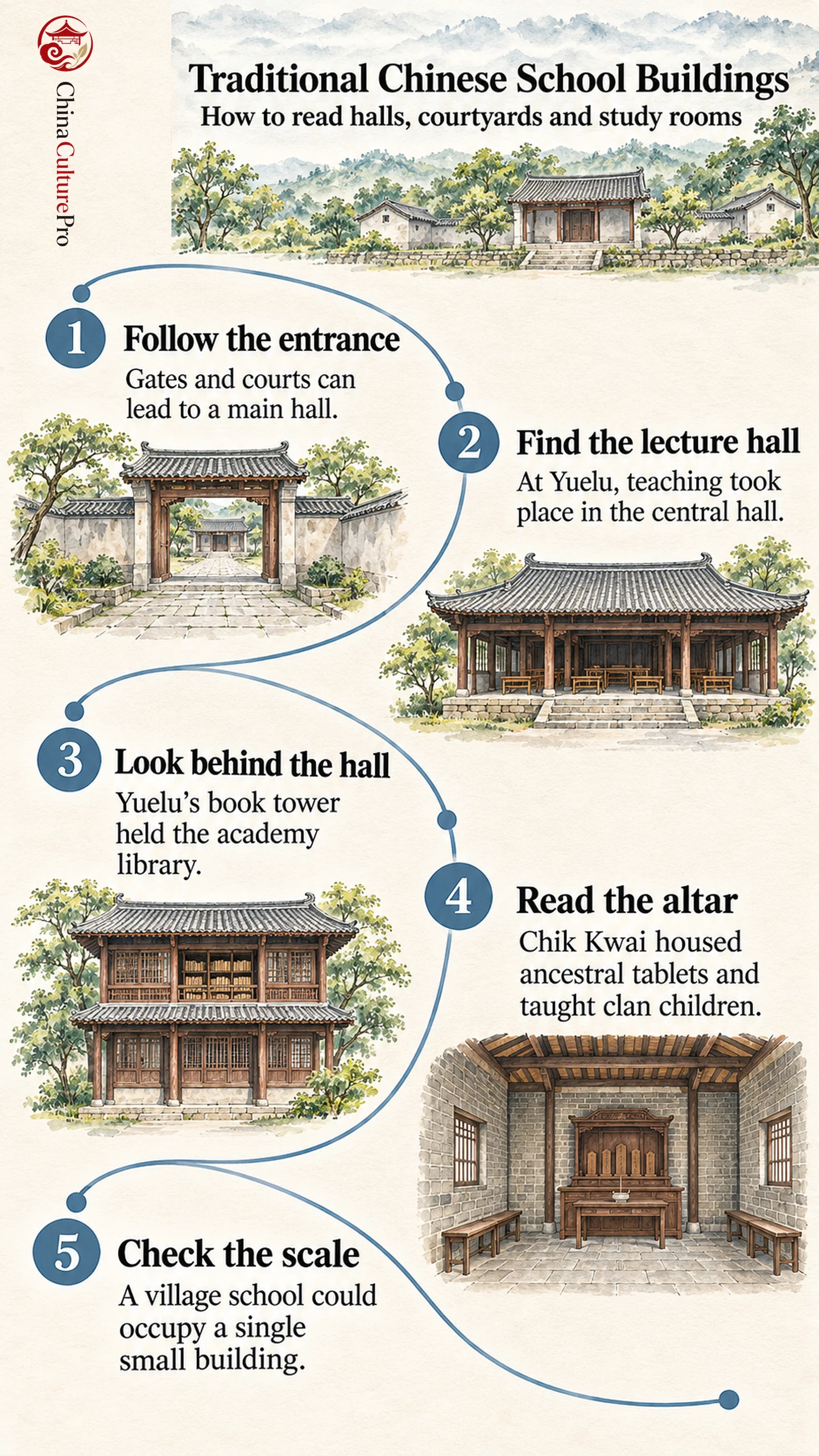
A courtyard can organize movement from the entrance to an important hall. A building’s inscriptions, furnishings and local records can help explain what happened once people stepped inside.
Yuelu Academy and Its Lecture Hall
At Yuelu Academy in Changsha, the main gates, lecture hall and book tower follow a central axis. The lecture hall occupied the centre of the teaching complex. Student quarters and smaller shrines stood off the main route. A separate Confucian temple served ritual within the academy complex.[1][2]
The academy was founded in 976 with official support. The present lecture hall preserves fabric from a Qing rebuilding and later repair. The library stood behind it on the main axis and held donated and purchased books as well as imperial gifts.[1][2]
School Buildings Under the State
Beijing’s Imperial College was the highest state educational institution under the Yuan, Ming and Qing. Its main route runs through three courtyards, with a glazed archway and major halls along the axis. The adjacent Confucian temple has its own sequence of gates and halls.[3]
Local government schools could also be associated with a temple. A Pingyao county gazetteer documents Minglun Hall (明伦堂, Mínglún Táng) and a pavilion behind it in its account of the county temple-school.[4]
A school hall provided a place to study and teach the classics. The Chinese imperial examinations served the separate purpose of selecting candidates for public office.
Clan Study Halls and Village Schools
At Chik Kwai Study Hall (植桂书室, Zhíguì Shūshì) in Hong Kong, a courtyard connects two halls. The Lai clan used the building for educating young clansmen and honouring ancestors. An altar with ancestral tablets remains in the main hall.[5] The ancestral tablets connect the building to the tradition of Chinese ancestral halls.
Fong Yuen Study Hall in Ma Wan served children in a fishing community. It occupies a rectangular two-storey building under a pitched roof.[6]
Chik Kwai later housed temporary classrooms and then a kindergarten, showing how an older hall could accommodate different forms of schooling.[5]
FAQs About Traditional Chinese School Buildings
Did Every School Have a Courtyard?
Plans varied. Yuelu has a sequence of courtyards, while Fong Yuen occupied a smaller rectangular building.[2][6]
Was a Study Hall Also an Ancestral Hall?
Some clan study halls served both functions. Chik Kwai is a documented example.[5]
Is the Library at Yuelu Academy Original?
The book tower has been rebuilt more than once. The academy records the latest rebuilding in 1986.[1]
Fuentes
[1] Yuelu Academy. Historic Buildings of Yuelu Academy
[2] Hunan University Education Foundation. Protected Architecture at Hunan University
[3] Beijing Municipal Government. Beijing Confucian Temple and Imperial College
[4] Revised Pingyao County Gazetteer. Temple-School
[5] Hong Kong Antiquities and Monuments Office. Chik Kwai Study Hall
[6] Hong Kong Tourism Board. Fong Yuen Study Hall