

Quick Answer: Who Was Li Keran?
Li Keran (李可染, Lǐ Kěrǎn; 1907–1989) was a Chinese painter and teacher who helped renew landscape painting in the twentieth century. His work brings together traditional brush-and-ink practice, Western art training and direct observation of nature.[1][2]
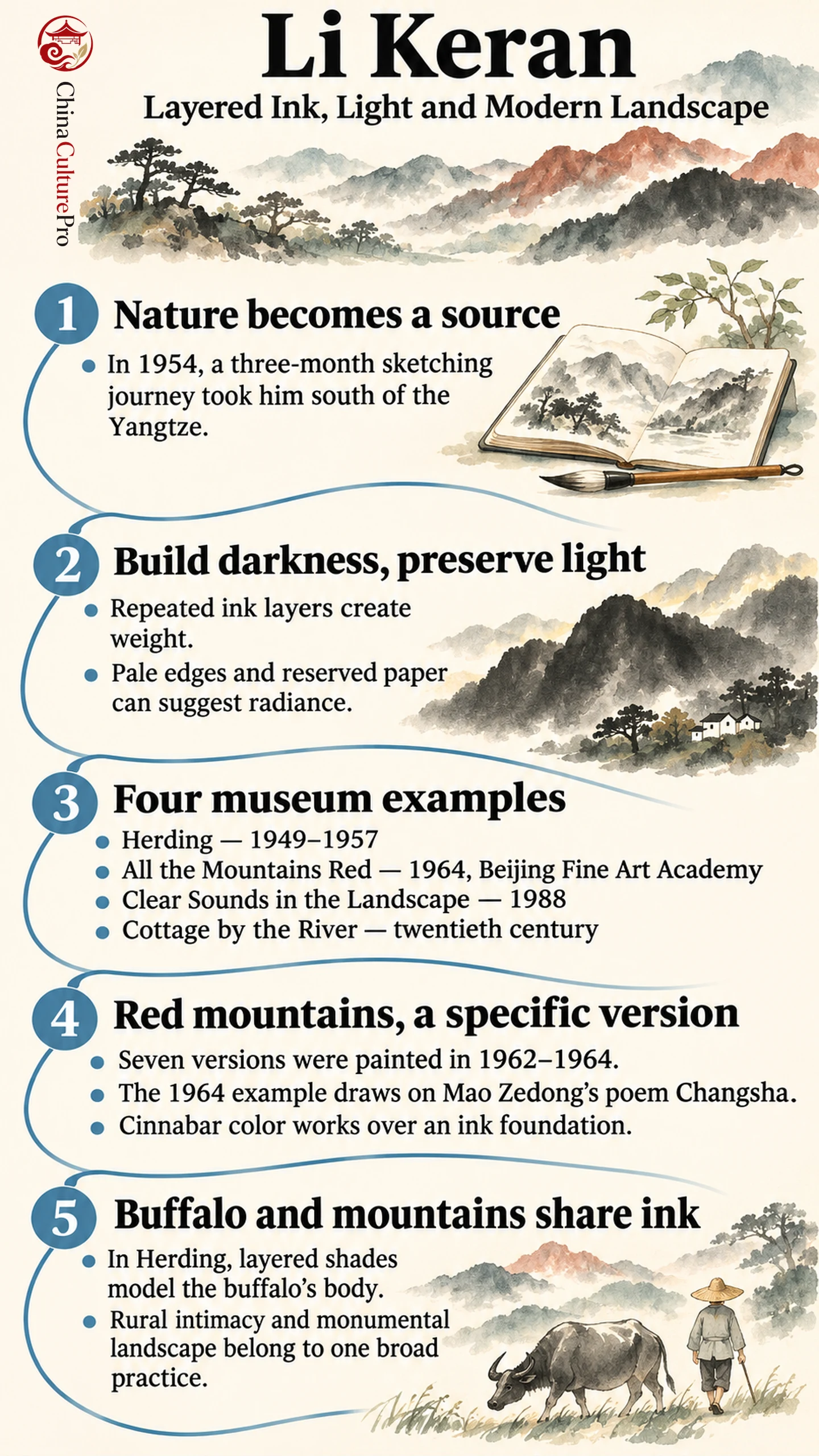
- Painting from life (写生, xiěshēng) became central to his artistic development during the 1950s.[1]
- Accumulated ink (积墨, jīmò) builds layered darkness, making selected lighter areas appear especially luminous.[2]
- His subjects include landscapes, red mountains, buffalo and herdboys.[2][6]
Dense black ink is one part of his range, alongside color, rural subjects and varied ways of suggesting light.
Start by looking for the brightest area inside a dark composition. Then follow the layers surrounding it. That relationship between weight and illumination helps connect Li’s mountain landscapes with his paintings of buffalo.
Training and the Turn toward Painting from Life
Li studied Western painting with Lin Fengmian and learned from the ink traditions of Qi Baishi and Huang Binhong. These experiences offered resources for transforming landscape rather than simply repeating inherited formulas.[1]
In 1954, he traveled south of the Yangtze with Zhang Ding and Luo Ming on a three-month sketching journey. Painting observed places became a way to test what ink could express about contemporary experience.[1]
Sketching and finished composition have different jobs: observation supplies material, while the painter still selects and organizes it.
How Layered Ink Creates Weight and Light
Repeated washes can deepen a mountain or forest without making every part equally dark. Li used lighter ink or reserved areas along selected edges to create an impression of radiance against the surrounding mass.[2]
Cottage by the River offers a specific example. Washes suggest reflections on water, while reserved white in the foreground trees conveys light and air. The painting is cataloged at 38.7 × 26.7 cm.[3] Its compact size rewards close attention to those small areas of brightness.
When comparing Chinese landscape painting, trace where a light shape meets a dark one. The boundary can be as important as the amount of ink filling the mountain.
Four Museum Works to Compare
| Work | Fecha | Material and format | Collection |
|---|---|---|---|
| Herding | 1949–1957 | Hanging scroll; color on paper. | Art Museum, Chinese University of Hong Kong.[4] |
| All the Mountains Red (万山红遍) | 1964 | Color on paper. | Beijing Fine Art Academy.[6] |
| Clear Sounds in the Landscape | 1988 | Ink and slight color on paper. | Ashmolean Museum, Oxford.[5] |
| Cottage by the River | Cataloged broadly as twentieth century | Matted painting; ink and color on paper. | Metropolitan Museum of Art.[3] |
Clear Sounds combines dark ink with a full, carefully balanced composition.[5] Compare that density with the softer light effects of Cottage and the compact animal grouping in Herding.
Red Mountains in a Modern Historical Context
Li painted seven versions of the red-mountain theme between 1962 and 1964. The Beijing Fine Art Academy’s 1964 work draws on Mao Zedong’s poem Changsha, translating its autumn imagery into monumental mountain forms.[6]
Cinnabar color works over an ink foundation, while densely arranged peaks create a full, frontal composition. Red and black reinforce one another across the surface.[6] Identifying the particular version matters: related titles do not make every example the same object or date.
Buffalo Painting and His Wider Legacy
In Herding, the buffalo and boy follow a flowing curve. Repeated applications of differently shaded ink give the animal’s body a layered darkness, linking an apparently modest rural scene to the tonal concerns of Li’s landscapes.[4]
The change in subject changes the mood without abandoning close attention to ink. His buffalo pictures can feel intimate where the mountain compositions feel imposing.
Li also taught at major art institutions, including the Central Academy of Fine Arts.[2] His example connects learning from earlier painters with sustained observation and new pictorial solutions, a useful way to understand modern ink painting as an active practice.
FAQs About Li Keran
Did Li Keran paint only black landscapes?
No. Red mountain compositions and buffalo paintings form important parts of his work alongside the dark landscapes.[2][6]
Is All the Mountains Red a single painting?
The theme exists in several versions. The example discussed here is the Beijing Fine Art Academy work dated 1964.[6]
How did he make light appear in dark ink landscapes?
He combined dark layers with selected areas of lighter ink or reserved paper, letting the contrast create brightness.[2][3]
Fuentes
[1] Beijing Fine Art Academy. Rare View in Rainy Haze: Li Keran’s Sketching
[2] Hong Kong Leisure and Cultural Services Department. Magnificent Vision—The Art of Li Keran
[3] Metropolitan Museum of Art. Cottage by the River
[4] Art Museum, Chinese University of Hong Kong. Herding
[5] Ashmolean Museum. Clear Sounds in the Landscape
[6] National Museum of China. Beijing Fine Art Academy Exhibition: 万山红遍