

Quick Answer: Who Was Fang Zhaolin?
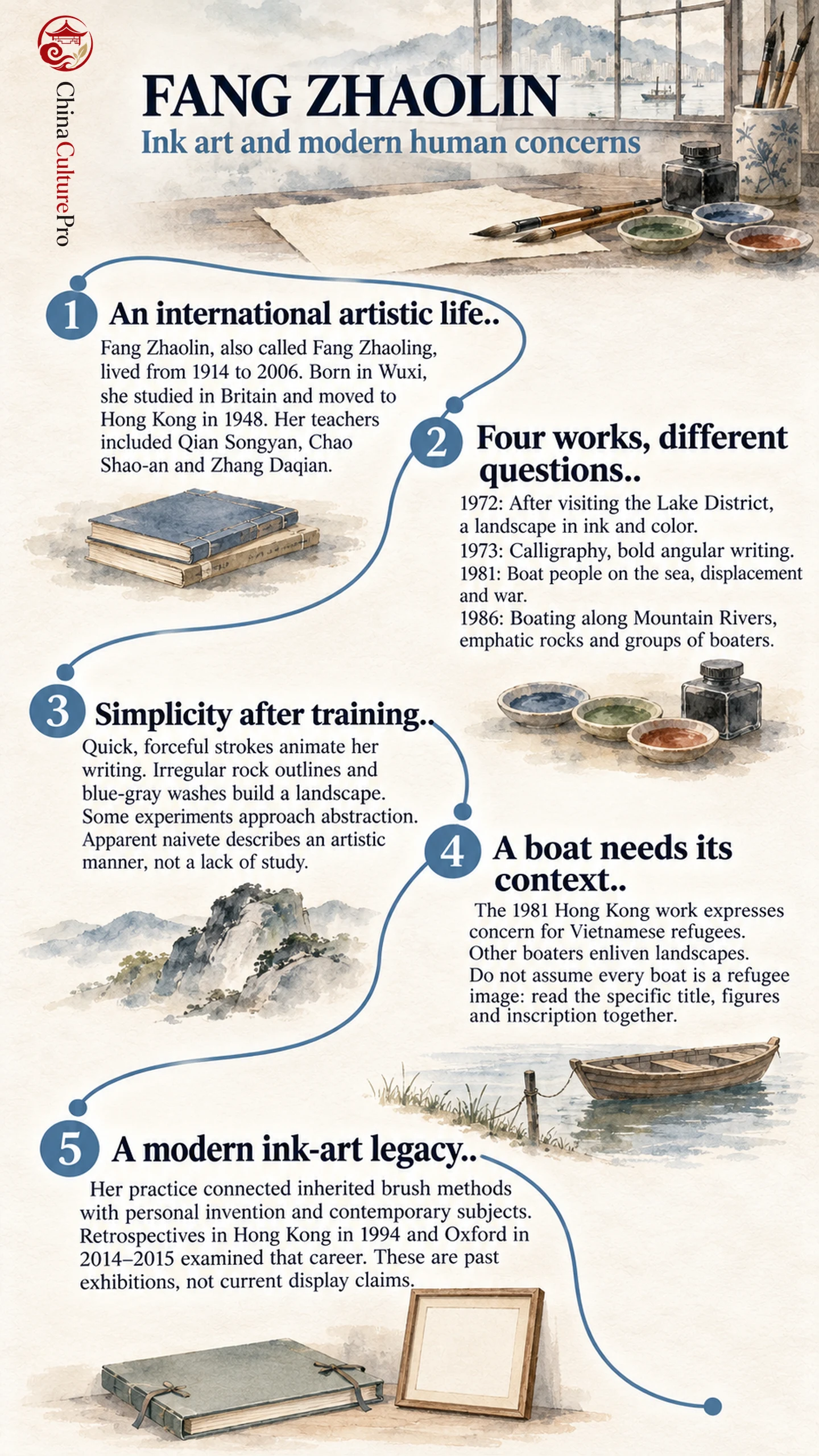
Fang Zhaolin (方召麐, Fāng Zhàolín; 1914–2006), also widely catalogued as Fang Zhaoling, was a Chinese painter and calligrapher. Her ink painting (水墨画, shuǐmòhuà) combines traditional brush practice with highly individual forms and contemporary concerns.[1][2]
- Style: Bold marks and an apparently simple manner grew from sustained artistic training.
- Range: Landscapes, social subjects and calligraphy (书法, shūfǎ) form a varied practice.
- Context: Humanitarian themes helped make inherited ink traditions speak to modern experience.[1][2][3][4]
Her cultivated spontaneity should not be mistaken for a lack of skill or study.
A mountain can become an irregular block of ink; a boat can carry a whole human drama. Fang Zhaolin’s work asks viewers to look beyond a seemingly playful surface and notice how brushwork, writing and contemporary experience reshape the possibilities of Chinese painting.
From Wuxi to an International Artistic Life
Born in Wuxi (无锡, Wúxī), Jiangsu (江苏, Jiāngsū), she studied at Manchester in Britain and moved to Hong Kong (香港, Xiānggǎng) in 1948. Further study took her to Oxford in the 1950s, followed by substantial time in London. Her life included repeated journeys and international exhibitions.[1]
Her teachers included Qian Songyan (钱松喦, Qián Sōngyán), Chao Shao-an (赵少昂, Zhào Shào’áng) and Zhang Daqian (张大千, Zhāng Dàqiān). Chao’s association with the Lingnan School (岭南画派, Lǐngnán Huàpài) connected her with another regional artistic tradition. These varied relationships supplied resources for an individual language, not a requirement to reproduce one teacher’s manner.[2]
Four Works Across Painting and Calligraphy
These examples separate the date of a particular object from a broad theme that she returned to in different works.[1][3][4][5]
| Work | Date and medium | Question it opens |
|---|---|---|
| After visiting the Lake District | 1972; ink and color on paper. | How could a British landscape enter a Chinese ink-painting practice? |
| Calligraphy, Asian Art Museum, object 2005.43 | 1973; ink on paper. | How do large, angular characters and forceful strokes create movement? |
| Boat people on the sea (怒海浮沉, Nùhǎi Fúchén), Hong Kong Museum of Art | 1981; ink and color on paper. | How can ink painting respond to displacement and war? |
| Boating along Mountain Rivers | 1986; ink and color on paper. | How do exaggerated rock forms and groups of boaters animate a landscape? |
Bold Brushwork and Deliberate Simplicity
The connection between calligraphy and painting is visible in the 1973 work: dark, assertive characters move through angular strokes, with quick flicks at some endings. The force and rhythm of the brush remain visible, rather than disappearing into an evenly polished surface.[3]
Boating along Mountain Rivers gives this energy a pictorial form. Irregular outlines enlarge the boulders, while bluish-gray washes suggest their mass. The painting organizes natural forms into emphatic patterns instead of treating every rock as a piece of detailed topographical reporting.[5]
Her experiments could approach abstraction, as in Landscape, about 1962. An apparently naive or spontaneous style was therefore a considered artistic choice within a trained practice. It need not mean an accidental sketch, an unfinished painting or a rejection of earlier ink traditions.[2][6]
People, Displacement and Modern Subjects
The boat-people series addresses displacement and war. The 1981 Hong Kong work responds sympathetically to Vietnamese refugees fleeing upheaval and expresses a wish for peace.[4]
Other boats carry a different meaning. In Boating along Mountain Rivers, groups of people enliven the landscape, expanding beyond the familiar solitary figure. A boat’s presence alone cannot identify a work as part of the refugee series. Read its title, figures and inscription together.[5]
Her Place in Modern Chinese Ink Art
Her work belongs to the modern history of ink painting, including its international circulation and its engagement with social and environmental subjects. Hong Kong was a major setting for that development, while studies and exhibitions abroad offered further artistic encounters.[1][2]
Retrospectives at the Hong Kong Museum of Art in 1994 and the Ashmolean in 2014–2015 show how institutions have presented this career. The combination of brush tradition, personal invention and contemporary subjects defines this legacy.[1][4]
FAQs About Fang Zhaolin
Are Fang Zhaolin and Fang Zhaoling the same artist?
Yes. They are English spelling variants used for the artist 方召麐.[1]
Was Fang Zhaolin a self-taught or untrained painter?
No. She studied with several established painters; apparent naivete describes a developed style.[2]
Did she also make calligraphy?
Yes. Her 1973 ink-on-paper work shows the bold, angular writing associated with her mature practice.[3]
Are all boats in her paintings images of refugees?
No. Identify the specific work and its context; some boating scenes are landscapes rather than refugee subjects.[5]
Fuentes
[1] Ashmolean Museum. Commemorating the life of Fang Zhaoling
[2] Asian Art Museum. Fang Zhaoling: artist biography
[3] Asian Art Museum. Calligraphy, 1973
[4] Hong Kong Museum of Art. Ordinary to Extraordinary: Boat people on the sea
[5] Asian Art Museum. Boating along Mountain Rivers, 1986
[6] Asian Art Museum. Landscape, about 1962