


Quick Answer: What Was the Hundred Days Reform?
The Hundred Days Reform (百日维新, Bǎirì Wéixīn) was a Qing reform campaign from June 11 to September 21, 1898. The Guangxu Emperor (光绪帝, Guāngxù Dì) issued decrees on schooling, government, the economy and the military. Empress Dowager Cixi (慈禧太后, Cíxǐ Tàihòu) reasserted control in September, ending his campaign. [1][3][4][7]
- June: The emperor announced a new direction for government and made higher education a priority.
- Summer: Edicts called for changes to schooling, examinations and public administration.
- September: A palace coup ended the campaign. The Imperial University of Peking (京师大学堂, Jīngshī Dàxuétáng) survived. [1][2][3][5][7]
The term covers the burst of imperial orders. How much those orders changed depended on what officials could put into practice. [2][3]
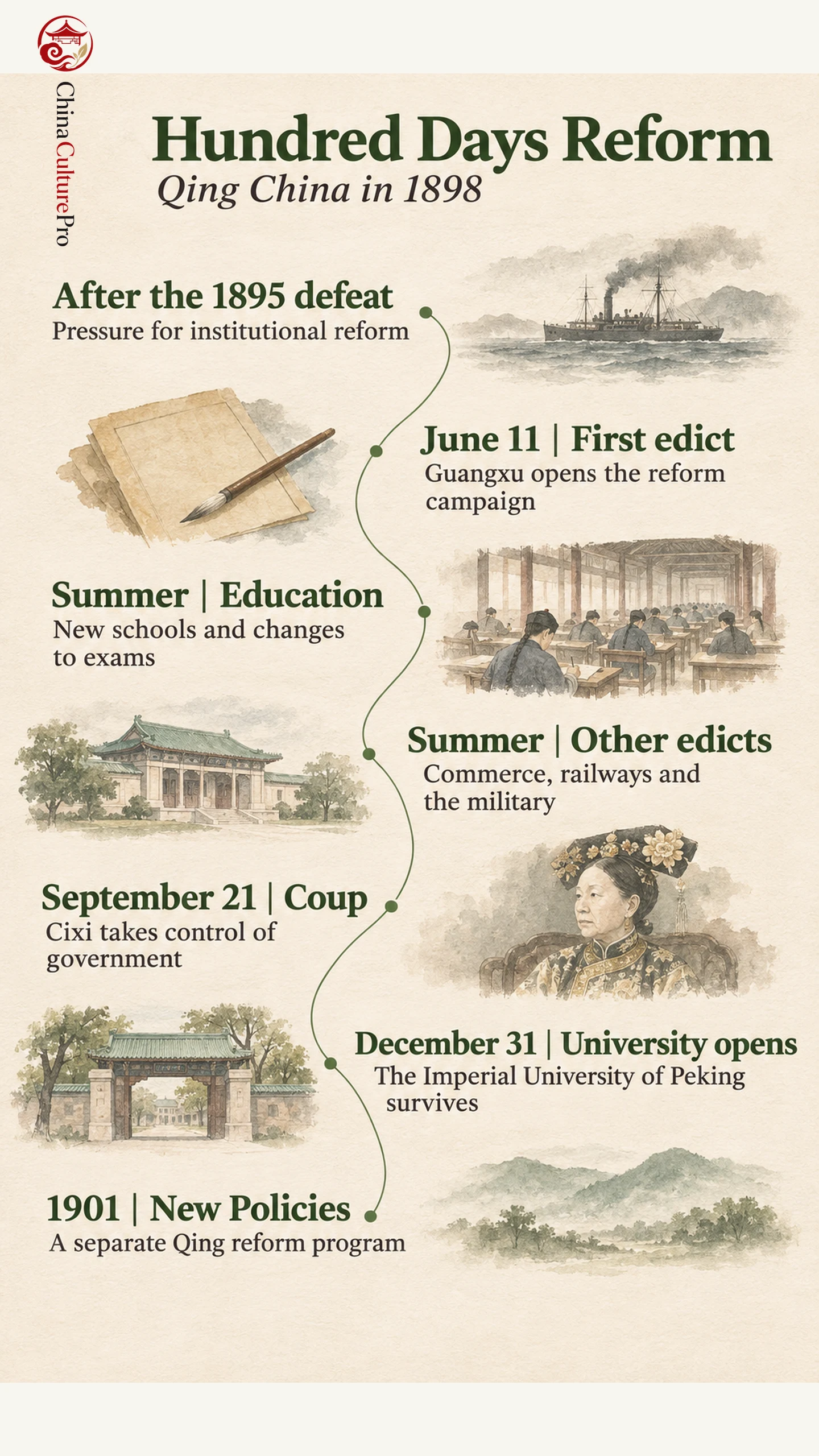
The September coup made it possible to reverse an examination rule with a new order. The court chose to keep the university, which still had to recruit students and begin teaching.
Why Reform Reached the Throne in 1898
The Qing dynasty had lost the First Sino-Japanese War of 1894–1895. The defeat and the Treaty of Shimonoseki sharpened an existing debate over whether changes in military equipment were enough to strengthen the Qing state. In 1896 the official Li Duanfen had already proposed establishing a higher school in the capital. [2][3][4]
Kang Youwei (康有为, Kāng Yǒuwéi) pressed the throne to reorganize institutions. Liang Qichao (梁启超, Liáng Qǐchāo) helped promote reforms and later drafted the university’s founding regulations. The Guangxu Emperor issued the opening edict on June 11, then received Kang later that month. His meeting with Kang came after the edict and after years of debate about schooling. [1][2][3][4]
The opening edict treated existing learning and useful new studies as compatible. It made the university in Beijing an example for the provinces. The order is evidence of what the emperor wanted officials to do, while later charters and administrative records show how much moved forward. [1][2]
What the Reform Edicts Ordered
Education linked schools to the recruitment of officials. The court ordered an end to the eight-legged essay, a prescribed literary format in the civil service examinations and called for schools to teach subjects useful to government and the economy. Changing how candidates wrote an exam still left the examination system in place. [3][5]
On July 10, an edict directed that academies and temples be converted into schools, with an exception for sites on the register of state sacrifices. A school policy could therefore change who used a local building and what it was used for. The Shanghai newspaper Shenbao discussed it as a change in religious policy as well. [6]
Other edicts encouraged commerce, called for faster railway development and proposed changes in military drill and training. The scope of the decrees helps explain why implementation depended on many offices. Headland’s published digest of the edicts shows their reach. It gives no count of schools that opened or offices that changed in response. [3][5]
How the September Coup Ended the Reform
The emperor challenged senior officials over which proposals could reach him and promoted junior officials who supported his program. The dispute over an attempt to block a submission by the official Wang Zhao shows how changing access to the throne threatened established authority. The emperor could publish orders. His authority over the officials and forces needed to sustain them was more limited. [3][4][7][8]
On September 21, Cixi resumed direct control of the government and confined the emperor, who remained on the throne. Six reformers, including Tan Sitong (谭嗣同, Tán Sìtóng), were executed on September 28. Kang and Liang fled abroad. Accounts of the coup differ over motives and who drove the decisions. Fang Delin’s reconstruction from Qing records distinguishes the public transfer of authority from the arrests and executions that followed. [4][7][8]
What Survived the Reversal
The emperor approved the Imperial University of Peking’s charter and appointed Sun Jianai to oversee it on July 3. It opened on December 31, after the coup, with a smaller intake and a narrower initial curriculum than planned. It was forced to close amid the 1900 crisis and opened again in 1902. In 1912 it took the name Peking University. [2]
Many measures of 1898 were reversed or left unrealized. The Qing New Policies began in 1901, after the Boxer crisis and foreign intervention. They revived questions about education, military organization and government under different political circumstances. The court revisited some of the same questions while the emperor remained confined. [2][3][9]
FAQs About the Hundred Days Reform
Why is it also called the Wuxu Reform?
Wuxu identifies 1898 in the traditional Chinese sixty-year calendar cycle. The name Wuxu Reform dates the movement by that cycle. The Hundred Days Reform refers to the duration of the imperial campaign. [1][6]
Did the Hundred Days Reform abolish the imperial examinations?
The 1898 orders changed parts of the examination format. The examination system itself continued until the Qing abolished it in 1905. [3][5][10]
Was the Hundred Days Reform the same as the Qing New Policies?
The Hundred Days Reform took place in 1898. The New Policies began with a separate Qing edict in January 1901, after the Boxer crisis. The two programs addressed some of the same institutions. [3][9]
Fuentes
[1] Guangxu Emperor. Imperial Edict on National Policy, June 11, 1898
[2] Peking University. The Imperial University of Peking and Early Peking University, 1898–1916
[3] Lane J. Harris, editor and translator. The Hundred Days’ Reforms, 1898, in The Peking Gazette
[4] Young-tsu Wong. Revisionism Reconsidered: Kang Youwei and the Reform Movement of 1898
[5] Isaac Taylor Headland, reproduced by Fordham University. Emperor Kuang Hsu: Attempted Reforms, 1898
[6] Vincent Goossaert. 1898: The Beginning of the End for Chinese Religion?
[7] Fang Delin. The Truth About the Coup of 1898, in Studies in Qing History
[8] Luke S. K. Kwong. A Mosaic of the Hundred Days: Personalities, Politics, and Ideas of 1898
[9] Richard S. Horowitz. Breaking the Bonds of Precedent: The 1905–6 Government Reform Commission and the Remaking of the Qing Central State
[10] U.S. Department of State, Office of the Historian. William W. Rockhill to the Secretary of State, September 19, 1905