

Quick Answer: What Was the Huang Chao Rebellion?
The Huang Chao Rebellion (黄巢之乱, Huáng Cháo zhī Luàn) was a major uprising against the Tang dynasty from 875 to 884. Its best-known leader, Huang Chao (黄巢, Huáng Cháo), occupied Chang’an and declared himself emperor of Qi. Tang forces retook the capital in 883, but the court depended heavily on regional armies for that victory. [1][4][6][7]
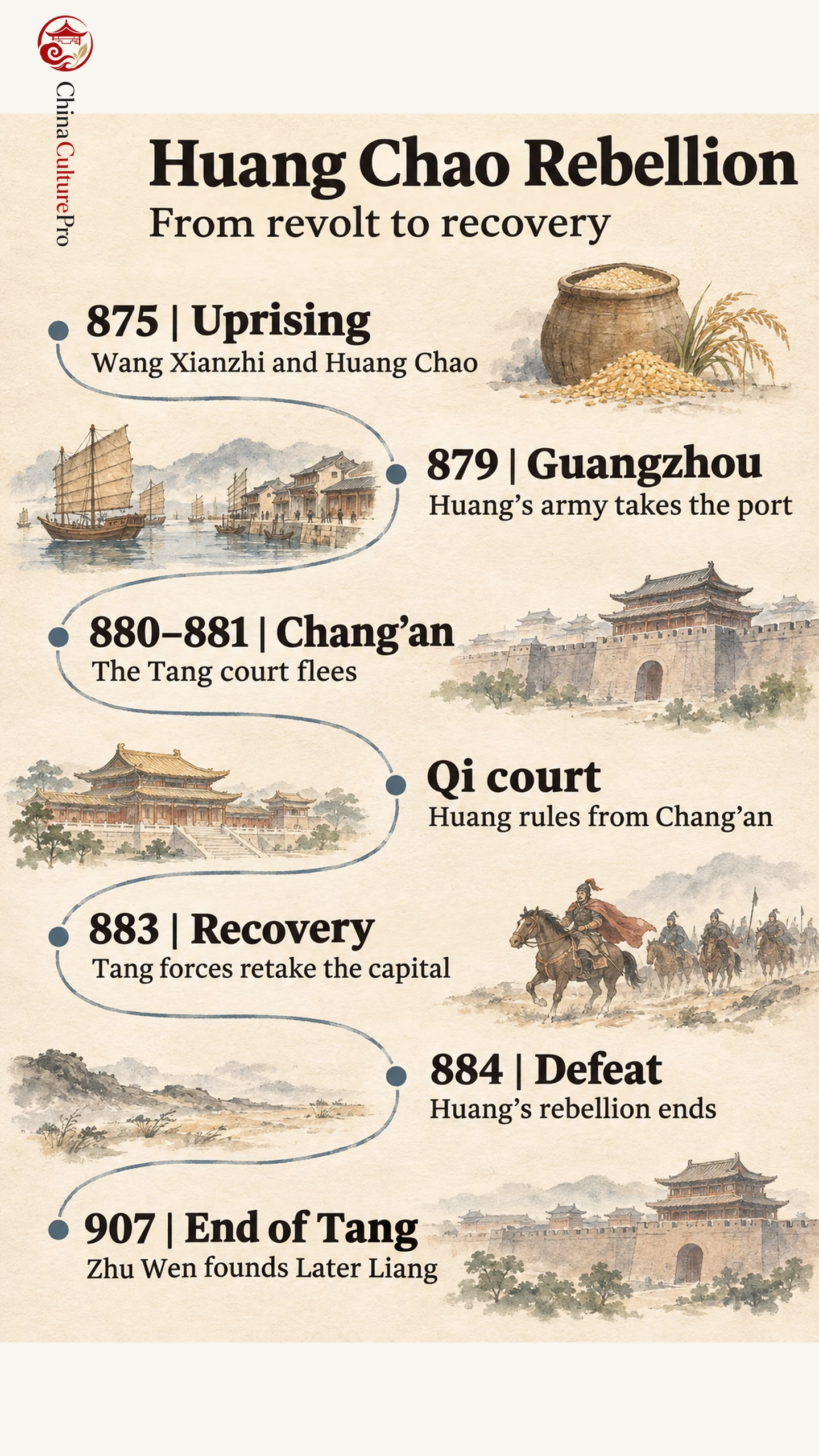
- 875: Uprisings broke out in the eastern part of the empire.
- 880–881: Huang’s army entered Chang’an as the Tang court fled.
- 883–884: Tang forces recovered Chang’an and defeated Huang’s remaining army. [1][3][4][6][7]
Tang rule continued from outside Chang’an during the occupation. The dynasty ended in 907. [1][8]
Rebel armies threatened the supplies that helped keep the Tang government running. When the capital fell, the emperor escaped and called on armies that could still fight under his name.
How the Uprising Grew and Reached Guangzhou
The Old Book of Tang places the revolt against a background of drought and hunger. Historian Robert Somers traces longer pressures, including heavier taxation, unrest among soldiers and disorder in the provinces. These strains weakened the government’s ability to contain armed movements before they reached major cities. [1][4]
Wang Xianzhi (王仙芝, Wáng Xiānzhī) was a major leader in the early uprising. His forces threatened the routes that carried grain and tax revenues through the middle Yangzi region. After Wang was killed in 878, Huang Chao took command of much of the movement and led his forces farther south. They captured Guangzhou in 879. Huang’s forces killed civilians after taking the port. [2][4]
The move to Guangzhou took the rebellion far from its early centers. Huang turned north again and crossed the Yangzi in 880. To reach the capital, his army passed through territories guarded by different regional commands. [2][3][4]
Why Chang’an Fell and the Tang Survived
Gao Pian (高骈, Gāo Pián), the commander based at Yangzhou, did not stop the crossing. Yangzhou stood at the junction of the Grand Canal and the Yangzi, a vital point on the network carrying supplies north. Gao later prepared an expedition to recover the capital. An ultimatum to Huang survives in the writings of his secretary, Ch’oe Ch’iwŏn, a scholar from Silla. The ultimatum preserves the voice of a commander’s headquarters while the war was still under way. [3]
After taking Luoyang, Huang’s forces pressed through the approaches to Tong Pass. According to the Old Book of Tang, an advance force used a nearby valley to get around the defenders. Emperor Xizong escaped west and made Chengdu his refuge. Huang entered Chang’an and established a rival court called Qi, with his own reign title and senior officials. [3][4][5]
Declaring a new dynasty gave Huang a claim to govern. Keeping the city fed and raising revenue were harder. The Old Book of Tang describes abandoned fields, interrupted revenues and sharply rising grain prices. Xizong could still appoint officials and receive support beyond the occupied region. [4][5][6]
How the Tang Retook Its Capital
One of Huang’s officers, Zhu Wen (朱温, Zhū Wēn), surrendered to the Tang in 882. The Tang rewarded him with a military post and the name Zhu Quanzhong. Another important contribution came from Li Keyong (李克用, Lǐ Kèyòng), whose Shatuo troops fought alongside other Tang forces east of Chang’an and helped recapture the city in 883. Huang fled and continued fighting until his defeat and death in 884. [5][6][7]
For residents, the capture did not immediately end the violence. The Comprehensive Mirror records that government troops looted after entering Chang’an. The chronicle praises the generals who recovered the city and also records abuses committed by the victors. [6]
What the Rebellion Changed
Zhu Wen and Li Keyong built separate power bases. Both gained standing by serving the Tang, then competed for influence over the court from their regional commands. Zhu eventually forced the last Tang emperor to abdicate in 907 and founded Later Liang, the first of the northern dynasties conventionally grouped in the Five Dynasties and Ten Kingdoms period. [1][7][8]
The surviving Chinese narratives were compiled after the war. The Old Book of Tang places Huang’s life in a chapter on rebels, while the later Comprehensive Mirror organizes the same crisis year by year. The texts preserve valuable detail about grain shortages, defections and military action. For a sense of their perspective, compare the praise of Tang commanders with the account of what their troops did in the streets of Chang’an. [4][5][6]
FAQs About the Huang Chao Rebellion
Was Huang Chao a salt trader?
Yes, according to his biography in the Old Book of Tang. It says that he sold salt before the uprising. [4]
When did Huang Chao capture Chang’an?
Chang’an fell around the turn of 880–881. The Old Book of Tang dates its capture to the twelfth lunar month of the first Guangming year. Some modern histories put the capture under 880, while others place the imperial flight and fall of the city in early 881. [3][4][8]
Did the Huang Chao Rebellion end the Tang dynasty?
The rebellion ended in 884. The Tang court continued until 907, when Zhu Wen displaced it. The victory over Huang had increased the influence of provincial commanders, including Zhu. [1][6][8]
Fuentes
[1] Robert M. Somers. The End of the T’ang, in The Cambridge History of China
[2] Franciscus Verellen. The Gathering Storm, in The Fall of the Tang
[3] Franciscus Verellen. Stone Quarry, in The Fall of the Tang
[4] Liu Xu and other compilers. Old Book of Tang, Volume 200B: Biography of Huang Chao
[5] Sima Guang and collaborators. Comprehensive Mirror for Aid in Government, Volume 254
[6] Sima Guang and collaborators. Comprehensive Mirror for Aid in Government, Volume 255
[7] Richard L. Davis. From Warhorses to Ploughshares: The Later Tang Reign of Emperor Mingzong
[8] Linda Walton. The Turbulent Tenth Century, in Middle Imperial China, 900–1350