

Quick Answer: What Were Chinese Sumptuary Laws?
Chinese sumptuary laws regulated visible markers of social and official status. Ming and Qing examples governed clothing, the design of some residences and decoration on travel equipment. The rules made rank legible through materials, dimensions and motifs.[1][2][3][6]
- Dress: Court clothing could identify an official’s rank through a regulated badge or design.[4][5]
- Buildings: Ming rules assigned different gate sizes and finishes to different ranks.[2]
- Travel: Qing rules could restrict luxury decoration on saddles and harnesses.[6]
A written rule describes what the state wanted people to display. The surviving objects and accounts of dress show how people used those markers in particular places and periods.[4][5][7]
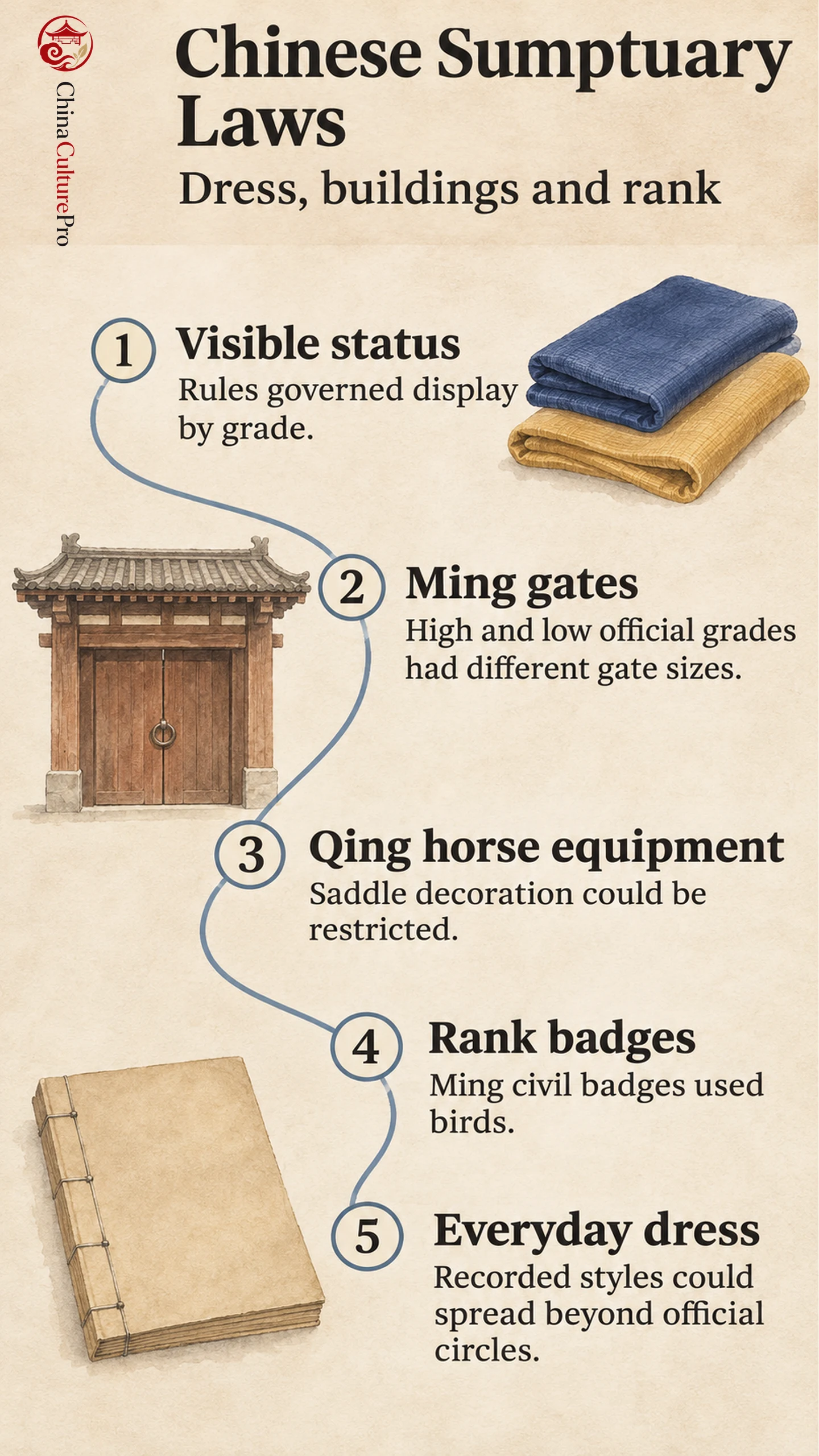
A Ming residence could advertise rank before anyone stepped out of its gate. Qing court orders also assigned different saddle decorations to different grades. Clothing was one part of a wider effort to regulate how status appeared in public.[1][2][6]
How Ming and Qing Rules Made Rank Visible
The early Ming court used regulated dress to make its hierarchy visible. The *Collected Statutes of the Ming Dynasty* (大明會典, Dà Míng Huìdiǎn) also records rules for residences. It specifies three-bay gate buildings for first- and second-rank officials, with a green finish on their doors. The main gates of officials in grades six through nine were to have one bay, black doors and iron rings. A bay is a division of the building’s width. Someone approaching the gate could see the distinction before meeting the owner.[1][2]
The *Great Ming Code and Substatutes* (大明律例, Dà Míng Lǜlì) treated residences, vehicles, clothes and utensils as items with grades. Its penalties for overstepping prescribed forms differed for officials and commoners. Liability could also reach the head of the household and the artisan who made the object.[3]
The Qing court also regulated equipment used on the road. In 1700, the Kangxi emperor complained of gilded saddle and harness ornaments appearing even among household servants. A response to the order specified which grades could use certain animal skins on saddles and restricted other embellishments. The complaint shows that the court saw unauthorized decoration as an issue. The order alone gives no measure of compliance across the empire.[6]
What Rank Badges Can Tell Us
In 1391, Ming rules called for court officials to wear rank badges (補子, bǔzi). Birds generally marked civil office, while animals marked military office. A surviving Ming badge dated to about 1500–1550 shows a pair of mandarin ducks. Its design corresponds to the seventh civil rank in that setting.[4]
Qing badges also encoded rank, with designs that changed over time. One silk badge from the Qianlong reign shows a gold lion looking toward a small red sun amid clouds. Badge pairs could be attached to the front and back of a robe. For a robe opening in the center, the front badge could be divided down the middle. Shape, assembly and period help interpret the image along with the creature itself.[5] Related Chinese imperial regalia put dress in the wider system of court ceremony.
Written Rules and Everyday Dress
The adoption of an elite style was a separate matter from holding an official rank. In seventeenth-century accounts of Shanghai, the writer Ye Mengzhu described members of officials’ families and educated men without degrees adopting elements of literati dress. The example concerns the spread of a social style beyond the group once identified with it. Textile markets gave people more options for doing so.[7]
The evidence looks different depending on which source survives. A rule can show the distinction an authority wanted to maintain. A surviving badge can show how a rank was represented on cloth. An account of imitation can show what a contemporary observer noticed changing. Read these kinds of evidence together before treating a dress rule as a complete description of life in a city.[2][4][5][7]
FAQs About Chinese Sumptuary Laws
Was Silk Reserved for the Imperial Family?
Silk was used outside the imperial household, including in literati dress. To interpret a restriction, check the fabric, the pattern and the context in which it was worn.[2][7]
Can a Rank Badge Identify Its Owner?
A badge can indicate a rank category if its date and design are known. Establishing the name of the wearer usually requires provenance or an independent record. The same rank design could appear on more than one person’s clothing.[4][5]
Could an Imperial Gift Change What Someone Wore?
Yes. The Ming statute compilation exempts items bestowed by the emperor from certain restrictions. The exception concerns a specific grant, so it does not turn the granted design into a general entitlement.[2]
Fuentes
[1] Yuan Zujie. Dressing for Power: Rite, Costume, and State Authority in Ming Dynasty China
[2] Collected Statutes of the Ming Dynasty. 大明會典卷之六十二
[3] Great Ming Code and Substatutes. 大明律例, passage on residences, vehicles, dress and utensils
[4] Cleveland Museum of Art. Rank Badge (Buzi), Ming Dynasty
[5] Cleveland Museum of Art. Rank Badge (Buzi), Qianlong Reign
[6] National Museum of China. 清代宫廷马装具考述
[7] Nadine Amsler. Clothes Make the Man: The Jesuits’ Adoption of Literati Masculinity