
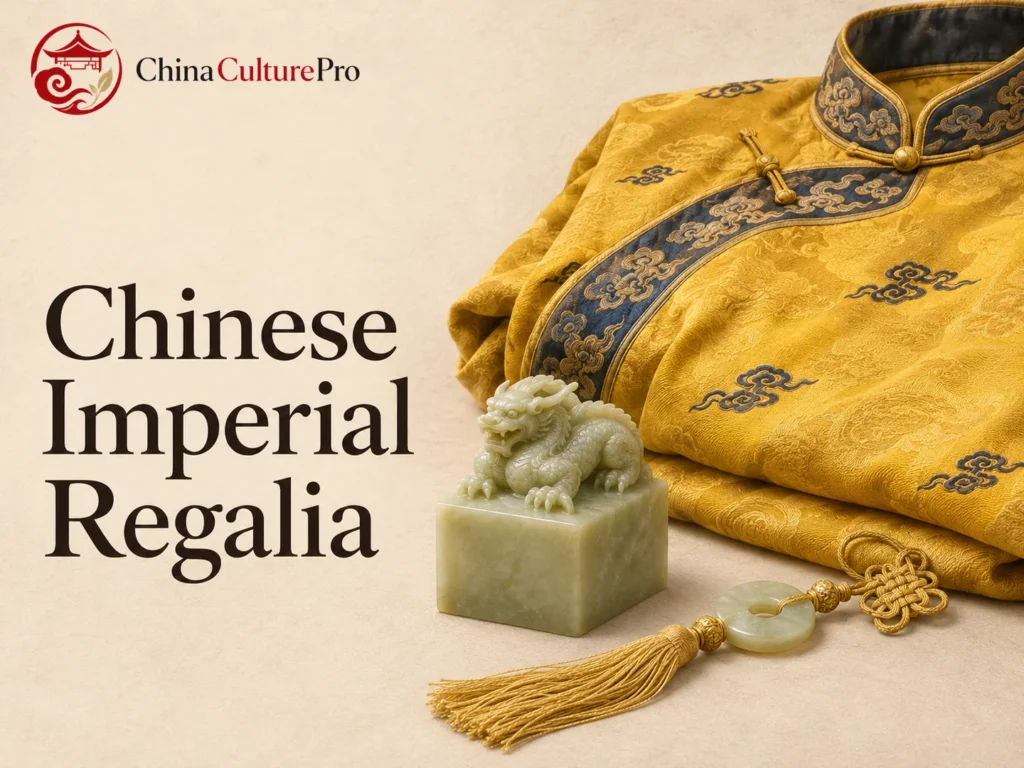

Quick Answer: What Was Chinese Imperial Regalia?
Chinese imperial regalia comprised garments and ceremonial objects that made imperial rank and authority visible or gave them formal effect. A Ming sacrificial crown, a Qing state seal and an empress’s formal book and seal belonged to different settings and did different work. [1][4][6]
- Dress: Robes, crowns and accessories identified rank and could change with the occasion.
- Authority: An official seal could mark a document or represent a particular imperial function.
- Conferral: A book and seal presented in a ceremony could mark a newly conferred status. [1][2][4][6]
Interpret an object through its dynasty, intended user and documented use.

A Qing emperor in a bright yellow portrait and a Ming ruler in a crown with hanging strands both look formal. They belong to different systems of dress. The purpose of a seal or ceremonial object can be equally hard to identify from appearance alone. [1][2][4]
How Ming and Qing Court Dress Marked Rank and Occasion
The Ming court prescribed particular garments for major sacrifices and other formal occasions. An emperor’s mian (冕, miǎn) crown had an upper board with strands hanging at the front and rear. One Ming regulation specified twelve strands at the front and twelve at the back for the emperor. The same statutes distinguish different garments for different occasions, so the pendant count identifies a prescribed form rather than an emperor’s headgear in general. [1]
Qing formal court dress (朝服, cháofú) followed a different system. Color could distinguish the ceremony as well as the wearer. A Qing emperor could wear bright yellow for occasions such as New Year and blue for a sacrifice to Heaven. Among other ranks, some princes and high officials could also wear dark blue garments under their own regulations. To interpret the shade, identify the garment and the occasion together. [2][7]
The Twelve Imperial Symbols (十二章, shí’èr zhāng) are a group of motifs, including the sun, moon, mountains and a pair of dragons. A surviving Qianlong-period festival robe (吉服袍, jífúpáo) carries the set. Its catalogue identifies it as festival wear, a garment used on occasions such as banquets and military inspections. That distinction helps explain why “dragon robe” can be too broad a label for a specific object. See Chinese sumptuary laws for the wider rules linking rank to what people could wear. [2][3][7]
Why the Qing Court Used More Than One Imperial Seal
In 1746 the Qianlong emperor reorganized the official state seals and designated a set of Twenty-Five Imperial Seals (二十五寶璽, èrshíwǔ bǎoxǐ). The court assigned seals to different uses. The collection included seals whose names referred to imperial commands, military authority and the relationship of the ruler to his relatives. A court could therefore have several objects bearing marks of imperial authority at the same time. [4]
In 1748 Qianlong placed the set in the Hall of Union. In the same year, the court ordered the Manchu wording on twenty-one seals recut in seal script to harmonize with the Chinese text. Four seals already in use before the Qing entered through the Great Wall were left as they were. The dates distinguish the choice of the set from later decisions about its appearance and custody. [4][5][9] The list defines a particular official set. A seal owned by an emperor still needs its own identification. An individual catalogue record may identify a named seal and its place within the group. [4][5]
How Regalia Worked in an Empress’s Investiture
A Qing empress’s investiture (冊封, cèfēng) used a golden book and seal. At the ceremony, the emperor inspected the objects in the Hall of Supreme Harmony. Attendants then took them in a decorated pavilion along a prescribed route toward the empress’s palace. The delivery was part of the process by which her position was formally conferred. The stages show why these objects can appear in descriptions of multiple halls during a single ceremony. [6]
The two objects worked as a pair. The book conveyed the formal appointment, while the seal belonged to the status it conferred. Reading their role requires knowing who presented them, who received them and where they went. The article on imperial court audiences explains another way palace space and procedure organized relationships to the throne. [6]
What to Look for in a Museum Catalogue
Start with the object name and dynasty. Then distinguish features visible on the object from the catalogue’s identification of its use. A robe’s ornaments are visible. Identifying it as festival dress also draws on its construction and comparison with other garments. The same difference matters when deciding whether a seal belongs to a named set. [3][4][7]
| Object type | Pruebas que conviene buscar | What it can help identify |
|---|---|---|
| Regulated dress | Cut, color, motifs and complete outfit. [1][2][3][7] | Garment class, possible wearer and likely occasion. |
| State seal | Inscription, catalogue identification and official list. [4][5] | Which named authority or function the seal represented. |
| Investiture object | Paired objects and a description of the ceremony. [6] | Whose status was conferred and how the objects were presented. |
FAQs About Chinese Imperial Regalia
Did Chinese Emperors Always Wear Yellow?
In the Qing, the emperor’s formal dress could be yellow, blue, red or pale moon-white, depending on the rite. A portrait’s color is one clue. The type of garment and the occasion help explain what it means. [2]
Does a Dragon Motif Identify an Emperor’s Robe?
Look for the combination of motifs, garment form and the rank specified in the catalogue. A surviving court robe for a top-rank prince carries five-clawed dragons. The motif alone cannot identify the wearer. [3][7]
Were All Qing Court Necklaces Imperial Regalia?
A court necklace (朝珠, cháozhū) was part of regulated Qing dress. Officials above specified ranks also wore such necklaces. Materials and ribbon colors can provide clues to status, so a necklace should be read with its catalogue record and the rest of the outfit. [8]
Fuentes
[1] Collected Statutes of the Ming Dynasty. Volume 60: Caps and Clothing
[2] The Palace Museum. Portrait of the Qianlong Emperor in Court Dress
[3] The Metropolitan Museum of Art. Emperor’s Twelve-Symbol Festival Robe
[4] The Palace Museum. Twenty-Five Imperial Seals
[5] The Palace Museum. Hall of Union
[6] The Palace Museum. Investiture Ceremony
[7] Smithsonian National Museum of Asian Art. Summer Chaofu for a Top-Rank Prince
[8] The Metropolitan Museum of Art. Official Necklace
[9] The Palace Museum. Green Jade Seal With Crouching Dragon Knob, One of the Twenty-Five Seals