
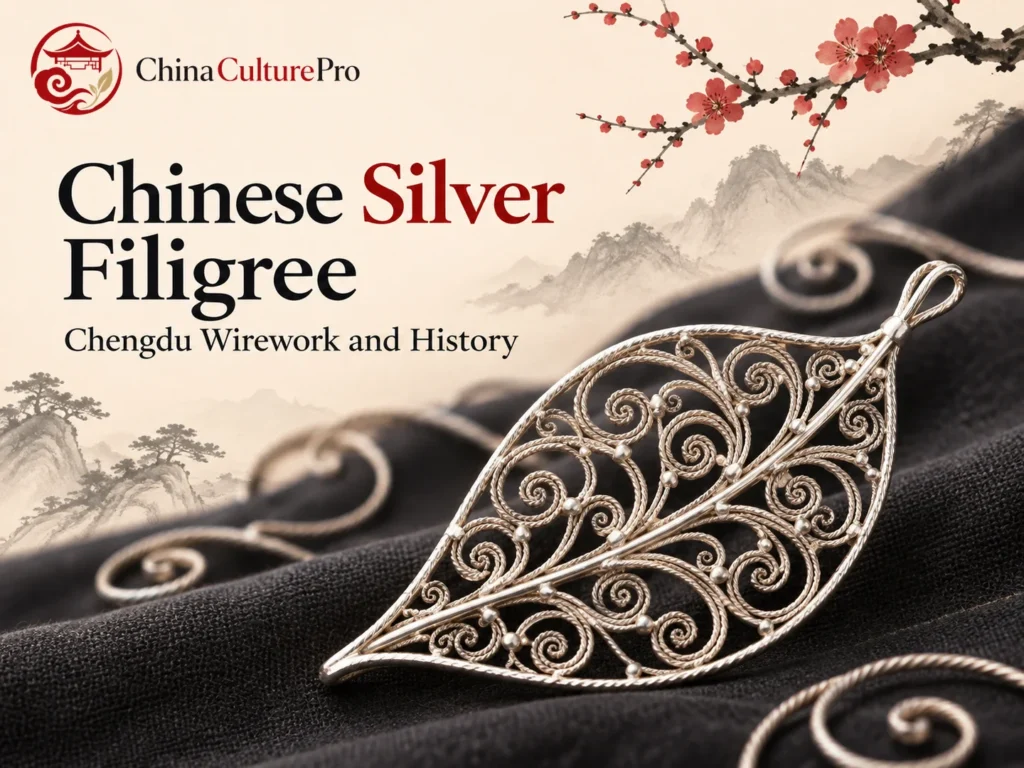

Quick Answer: What Is Chinese Silver Filigree?
Chinese silver filigree (银花丝, yínhuāsī) is metalwork made by shaping and joining fine silver wire. A wire pattern can make an open surface or decorate a larger object. Chengdu’s craft uses high-purity silver and includes jewelry as well as display pieces.[1][2]
- Material: Fine silver wire may be combined with thicker wire or worked silver sheet.[1]
- Technique: Makers twist and shape wire, place it in the design and solder the contacts.[1]
- Historical use: Silver filigree appears on historical hairpins. The Chengdu repertory includes vases, trays, incense burners and bracelets.[2][3][4]
Look for separate lengths of wire tracing the design.[1]

Look inside one curl of a silver ornament and you may see two wires twisted together. Follow that curl and you can often see where it touches the next one. A filigree design depends on the arrangement of those contacts as much as the shape of each wire.
How Silver Wire Becomes Filigree
In the Chengdu practice documented by the national heritage museum, artisans draw silver into wire in several thicknesses. They twist or flatten selected strands to change the texture. When an outline is used, thicker wire can define its edge. Finer curls touch the outline or their neighbors at selected points, where the maker solders them together. Some of the same objects also have solid sheet sections worked with small punches.[1]
In flat filling (平填花丝, píngtián huāsī), the small wire units fill a bounded area and form a surface. Think of a leaf outlined in wire, with coils within the outline. The small openings between the coils let light through the pattern. A three-dimensional object can be built by joining sections. In other pieces, wire decoration can sit against solid silver sheet, sometimes with designs worked into the sheet by chasing.[1][2]
On an open piece, a side view can show how the shaped strands meet. On a backed piece, the wire may stand slightly proud of the sheet, with its own outlines and joints. The distinction matters when a museum label names more than one technique. A single area can contain both separate filigree strands and a continuous piece of chased sheet.
Silver Filigree in Song and Qing Hairpins
A Song dynasty hairpin in the Royal Ontario Museum collection is 12.5 centimeters long and has sections of silver filigree. The catalogued example shows wire decoration on a surviving Song hair ornament. Its Song attribution leaves the workshop and locality open.[3]
A Qing example at the National Palace Museum shows the two-prong form discussed in the guide to Chinese hairpins. The 16-centimeter pin has two prongs and two overlapping lozenges at its head. The museum identifies its material as gilt silver and records small pearls at the points of the lozenges. A coin, an ingot and a yin-yang motif decorate three small discs between the prongs. Here, the catalogue distinguishes a silver base, gilding on the surface, wire decoration and pearl settings.[4]
Chengdu, Beijing and Jianhe Silverwork
The Chengdu silver filigree craft entered China’s national intangible cultural heritage list in 2008. Its repertory includes hairpins and bracelets as well as vessels and boxes. The heritage museum profiles the maker Dao An and illustrates a six-sided dragon-and-phoenix vase. On a vessel, the wirework contributes to the whole silhouette, beyond the small areas of ornament on a hairpin. The national listing also records modern silver-wire pictures, where wire traces designs in a flat composition instead of enclosing a vessel.[1][2]
The Beijing listing for Chinese filigree inlay (花丝镶嵌, huāsī xiāngqiàn) describes gold or silver wirework alongside metal settings for stones and pearls. Both traditions use fine wire, but the Chengdu listing is particularly associated with flat filling and the Beijing listing encompasses both wirework and settings.[5]
Jianhe County’s Miao silver jewelry includes drawn wire, twisted chains and decoration on sheet. Local forms include twisted-chain collars in Gedong and sheet collars in Nanzhai. Its heritage entry also describes local makers taking design ideas from women’s needlework. That connection is one reason to read about Miao embroidery alongside the silver objects.[6]
FAQs About Chinese Silver Filigree
Can silver filigree look gold?
Yes. Gilt silver has a layer of gold over silver. The Qing hairpin with the overlapping lozenges is a documented example.[4]
Does filigree have to include gemstones?
No. Shaped wire can form the whole decoration. A stone or pearl, where used, is a separate part of the design.[5]
Is pierced silver sheet the same as filigree?
Pierced sheet has openings cut or punched out of a solid piece. In filigree, the openings form between separate strands as the maker assembles them.[1]
Fuentes
[1] China Intangible Cultural Heritage Digital Museum. Master Crafts Exhibition: Metalwork
[2] China Intangible Cultural Heritage Digital Museum. Chengdu Silver Filigree Craft
[3] Silver Society of Canada. Chinese Silver at the Royal Ontario Museum
[4] National Palace Museum. Gilt Silver Hairpin with Filigree Decoration of Intersecting Lozenges
[5] China Intangible Cultural Heritage Digital Museum. Filigree Inlay Craft
[6] China Intangible Cultural Heritage Digital Museum. Miao Silver Ornament Craft in Jianhe