


Quick Answer: What Are Xunpu Flower Headdresses?
The Xunpu flower headdress (簪花围, zānhuāwéi) is an arrangement of flower strands around a round bun. It is associated with Xunpu and neighboring communities in Quanzhou’s Fengze District, Fujian. The hair forms the center of the design, and flowers and other ornaments can be added around it.[1][2]
- Support: A horizontal pin goes through the bun to help hold its shape.[2]
- Flowers: Strung flowers make the rings. Individual blooms can add larger accents.[2]
- Setting: The arrangement appears in local daily and festive dress and in contemporary visitor photography.[1][3][4]
A view from the back often shows the construction more clearly than a front portrait.
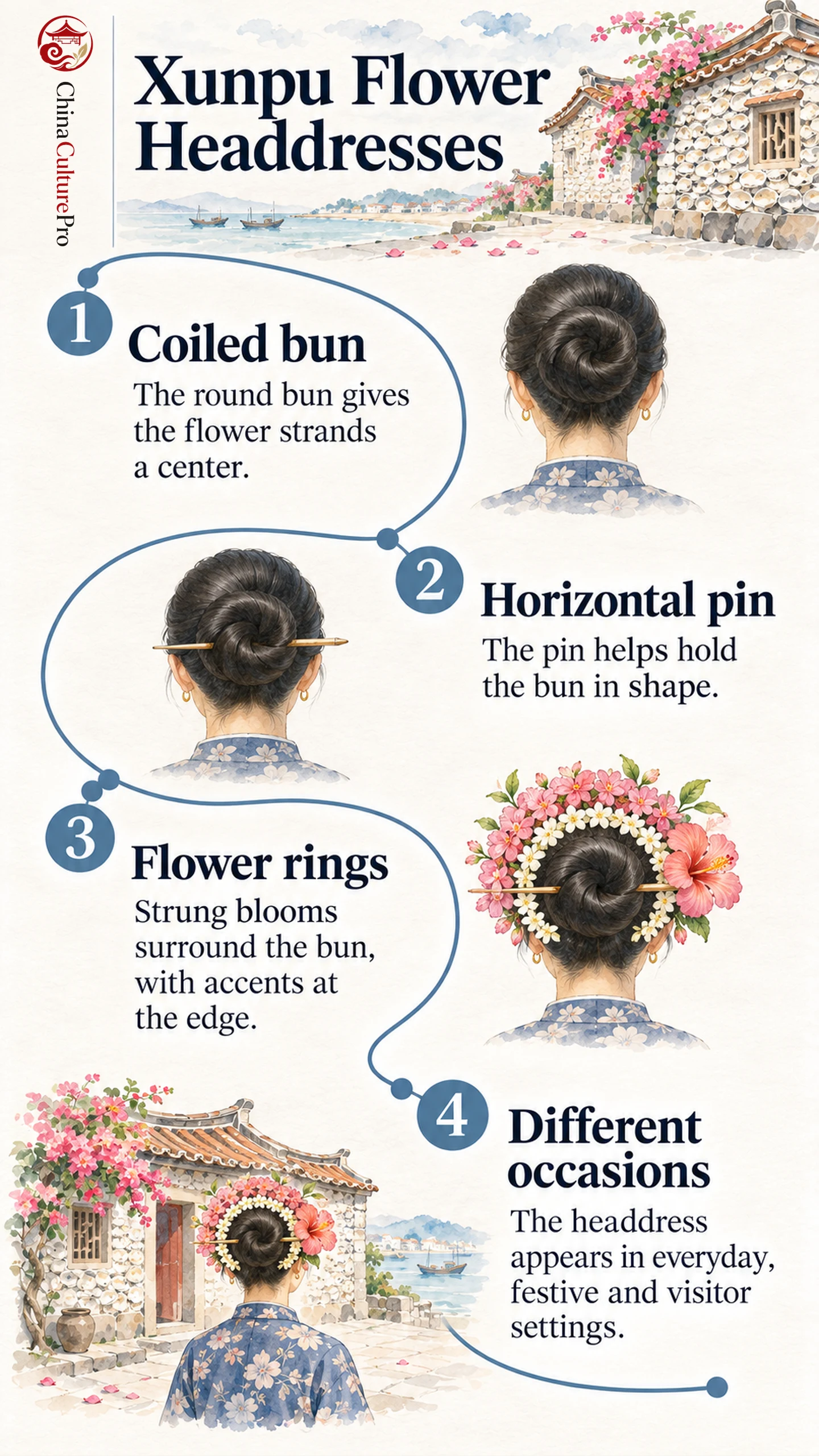
The flower strands follow the shape of a bun. A close view reveals a center of coiled hair, several lines of smaller blooms and sometimes a larger blossom at one edge. That arrangement gives the headdress its recognizable shape.
How the Bun Supports the Flower Rings
Quanzhou’s local standard DB 3505/T 16–2024 describes a round bun held by a pin shaped like a chopstick passed through the center. The strands are laid around the bun in nested rings. Look for the coil and the horizontal pin beneath the flowers, and then for the different sizes of bloom at the edge.[2]
| Parte | What it does |
|---|---|
| Coiled bun | Gives the flower strands a center. |
| Horizontal pin | Helps secure the hair at the center of the bun. |
| Flower strands | Encircle the bun in one or more rings. |
| Accent blooms | Sit around the strands as individual flowers. |
A small comb can help hold loose hair and keep the bun tidy. The standard describes red cord among the materials for gathering the hair. It has a supporting role before the flowers are placed. Added hair can provide enough length for a fuller coil. The guide to Chinese traditional hairstyles explains other ways hair and supports can work together.[2]
Fresh Flowers, Accent Blooms and Metal Ornaments
The local standard distinguishes fresh and artificial blooms. It names jasmine and banana shrub flowers among the fresh flowers used for the arrangement. Small blooms can be strung close enough to read as a band of color. A larger bloom at the edge can change the outline without making another full ring.[2]
The same document describes using small combs and other ornaments, including metal pins. The comb and the main horizontal pin have different jobs. Decorative pins and larger flowers can appear alongside either. This layering explains why a side view can show ornaments that are hidden in a photograph taken directly behind the wearer. The wider guide to Chinese zanhua explains how flower wearing also takes forms other than rings around a bun.[2]
Daily Dress, Celebrations and Visitor Portraits
The national listing identifies Xunpu, Jinqi, Houbu and Dongmei among the communities connected to the customs. It describes fishing-community customs that encompass dress, work, celebrations and beliefs. Local reporting describes women wearing flowers for everyday occasions and fuller arrangements at celebrations. Quanzhou bridal headdresses describes the separate ornaments connected to wedding dress.[1][3]
China Daily reports that local practitioner Bai Lan opened a studio in 2015 offering flower arrangements, makeup and photographs. A styled visitor portrait is one way the headdress is seen today. In a family or historical photograph, the date, people and occasion can help explain why the particular flowers and ornaments were chosen.[4]
FAQs About Xunpu Flower Headdresses
Do the rings always use fresh flowers?
Both fresh and artificial flowers are documented. The local standard describes fresh strands as a longstanding practice and records the increasing use of artificial flowers since the early twenty-first century.[2]
Is there a fixed number of flower rings?
No. The local standard suggests one to five strands in its preparation guidance. Fujian Daily describes local use varying between ordinary and festive occasions. Ring count alone gives little information about the wearer.[2][3]
What entered the national heritage list in 2008?
The entry is for Xunpu women’s customs, which include the headdress as one part of a wider set of local practices.[1]
Fuentes
[1] China Intangible Cultural Heritage Digital Museum. Customs of Xunpu Women
[2] Quanzhou Municipal Government. Skills of Zanhuawei, DB 3505/T 16–2024
[3] Fujian Daily. The Xunpu Headdress: A Walking Garden
[4] China Daily. Popularity of Zanhua Lifts Incomes of Local Residents in Quanzhou