
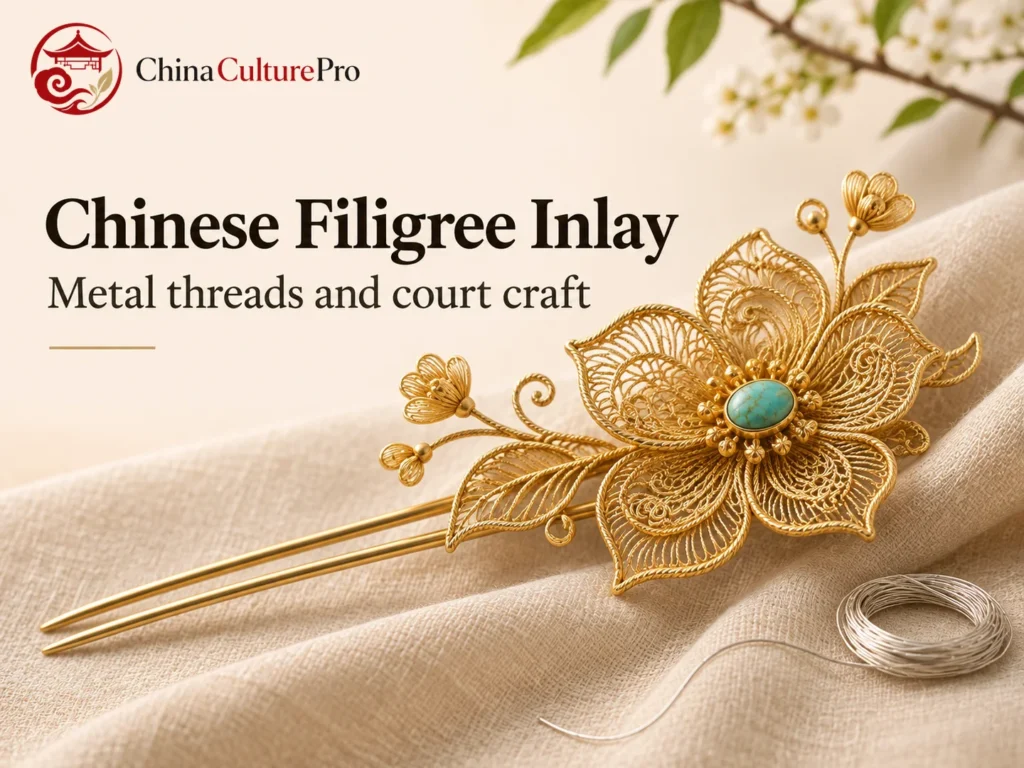

Quick Answer: What Is Chinese Filigree Inlay?
Chinese filigree inlay(花丝镶嵌,huāsī xiāngqiàn)combines fine metal-wire construction with the setting of stones or pearls. [1]
- Wire: Fine gold or silver threads form curls, meshes and raised patterns.
- Setting: Separate metal supports hold gems or pearls.
- Materials: A gold-coloured object may be gilded silver, as documented in contemporary museum exhibits.
- Uses: Surviving examples include historical hair ornaments and modern decorative vessels. [2][4]
Read the metal structure and coloured additions separately; they need not occupy every opening.

Look closely at a delicate metal ornament: its apparent lace may consist of twisted wires, while its coloured centre sits in a separate setting. Within Chinese traditional crafts, filigree rewards this distinction between the structure, its surface and the materials it carries.
Fine Metal Wires and the Two Parts of the Craft
Huasi(花丝,huāsī)names the fine-wire work; xiangqian(镶嵌,xiāngqiàn)names setting or inlay. Drawing wire and securing stones perform separate jobs within the combined craft. [1]
An openwork flower raises separate questions about assembly and the setting. The contemporary museum catalogue lists golden-looking works made of gilded silver. [4]
Shaping, Joining and Setting
Bending, filling, assembling, soldering, stacking, building up, weaving and braiding organise wires and connect components. These methods need not form one compulsory sequence. [1]
A Qing hairpin discussed by the Chinese University of Hong Kong makes the assembly visible: lotus elements carry pearls and gems, with decorated edges and veins; the individual components attach to wires and gather into the ornament. Its complexity comes from several connected elements rather than a single cast flower. [5]
The useful distinction is between constructing the metal form and securing the additions. Reading a label that mentions both wirework and gem inlay helps explain why an ornament can appear simultaneously airy and richly coloured.
Filigree, Chasing, Enamel and Feather Decoration
Several decorative methods can coexist on metal. Their visual effects do not make them interchangeable:
| Technique | Función principal |
|---|---|
| Filigree | Builds a design from fine metal wires, including open or raised arrangements. [1] |
| Chasing(錾刻,zànkè) | Works details into a metal surface with tools such as punches or chisels. [7] |
| Cloisonné(掐丝珐琅,qiāsī fàláng) | Uses metal partitions to contain coloured glass enamel on a supporting body. [6] |
| Kingfisher-feather decoration(点翠,diǎncuì) | Applies blue-green feathers to metal elements to supply colour and texture. [1] |
In Chinese cloisonné, wire commonly outlines enamel-filled compartments. Filigree instead makes the wire itself a principal part of the pattern. Likewise, kingfisher-feather work names an applied material, not a blue enamel recipe.
The broader English word “inlay” also appears in mother-of-pearl decoration. That shared vocabulary should not obscure the different materials and methods involved.
Historical Ornaments and Court Use
An eighth-century Tang hair ornament in a New York museum collection provides a specific historical example. Its prongs are missing, but the surviving gold top combines fine filigree with carved turquoise. The object establishes an example of this workmanship at that date; it does not identify an inventor or date the entire later craft system. [2]
Court dress gives a different kind of evidence. The Palace Museum preserves a Qing jinyue(金约,jīnyuē), a headdress band worn beneath a court crown. Its lapis-lazuli settings have filigree cloud borders. The museum relates variations in the gold components and pearl strands to rank; this example belonged to the dress category of an imperial concubine. Some pearl elements are now missing. [3]
Such records distinguish original court function from present appearance. A missing strand is part of an object’s surviving condition, not proof that the design was always incomplete.
Gold Colour, Gilding and Technical Examination
Yuan Changjun’s catalogue includes a dragon-spouted ewer made of silver with gilding. Calling it solid gold would misreport the material: its golden appearance comes from the finish. [4]
Scientific examination can also revise a reading of historical decoration. A belt hook discussed in the CUHK research project had been thought to carry gold inlay. Testing instead identified gilding. This example concerns that particular object, but it demonstrates why an apparent line of gold need not establish how the gold was applied. [5]
For museum reading, separate the catalogue’s statements about metal, technique, date and function. “Gold,” “gilt,” “wirework” and “set with turquoise” answer different questions.
Beijing, Dachang and Contemporary Practice
The national heritage record lists Tongzhou filigree inlay craftsmanship in the second batch announced in 2008 and describes traditions in Beijing and Dachang, Hebei. This protects a transmitted craft, not every marketed object. [1]
The National Art Museum of China’s Yuan Changjun exhibition ran from January 6 to February 2, 2026. Its vessels and decorative objects demonstrate continued design activity, without implying that every historical workshop or specialist method has survived unchanged. [4]
FAQs About Chinese Filigree Inlay
Does Every Filigree Piece Contain Gemstones?
No. Fine-wire construction and stone setting are distinguishable skills. A design can emphasise its metal pattern without filling every space with a jewel. [1]
Are All Gold-Coloured Parts Solid Gold?
No. Gilded silver can have a golden surface. Check the stated material rather than using colour as a substitute for the catalogue description. [4]
Is Filigree the Same as Cloisonne?
No. Cloisonné uses partitions containing enamel; filigree constructs patterns from fine wires. Both can contribute to an elaborately decorated object. [1][6]
Was Filigree Used Only for Royal Jewellery?
No. Court ornaments are important historical examples, but modern museum catalogues also document decorative vessels. A court association does not establish the function of every object made with the technique. [3][4]
Fuentes
[1] China ICH Network. Filigree inlay craftsmanship
[2] Metropolitan Museum of Art. Tang hair ornament, 31.54.1
[3] Palace Museum. Gold and lapis lazuli jinyue, Gu00012015
[4] National Art Museum of China. Yuan Changjun filigree inlay exhibition, 2026
[5] Chinese University of Hong Kong. Ancient Chinese gold-working research exhibition, 2017
[6] Metropolitan Museum of Art. Chinese Cloisonne
[7] Getty Conservation Institute. Exquisite Objects, Prodigious Technique: Chasing