


Quick Answer: What Is a Jade Bi Disc?
Bi(璧,bì)is the name used for a flat jade disc with a central hole. Examples span different periods, from plain Neolithic forms to elaborately decorated later objects. A Liangzhu disc at the Metropolitan Museum is made of nephrite and dated to the middle of the third millennium BCE.[1]
- The form: A broad stone surface surrounds a circular opening.
- The context: Excavated examples help reveal burial practice and social distinction.
- The meanings: Later ritual texts and collectors added further interpretations.
The familiar association with heaven should not be treated as a complete explanation of every prehistoric disc.
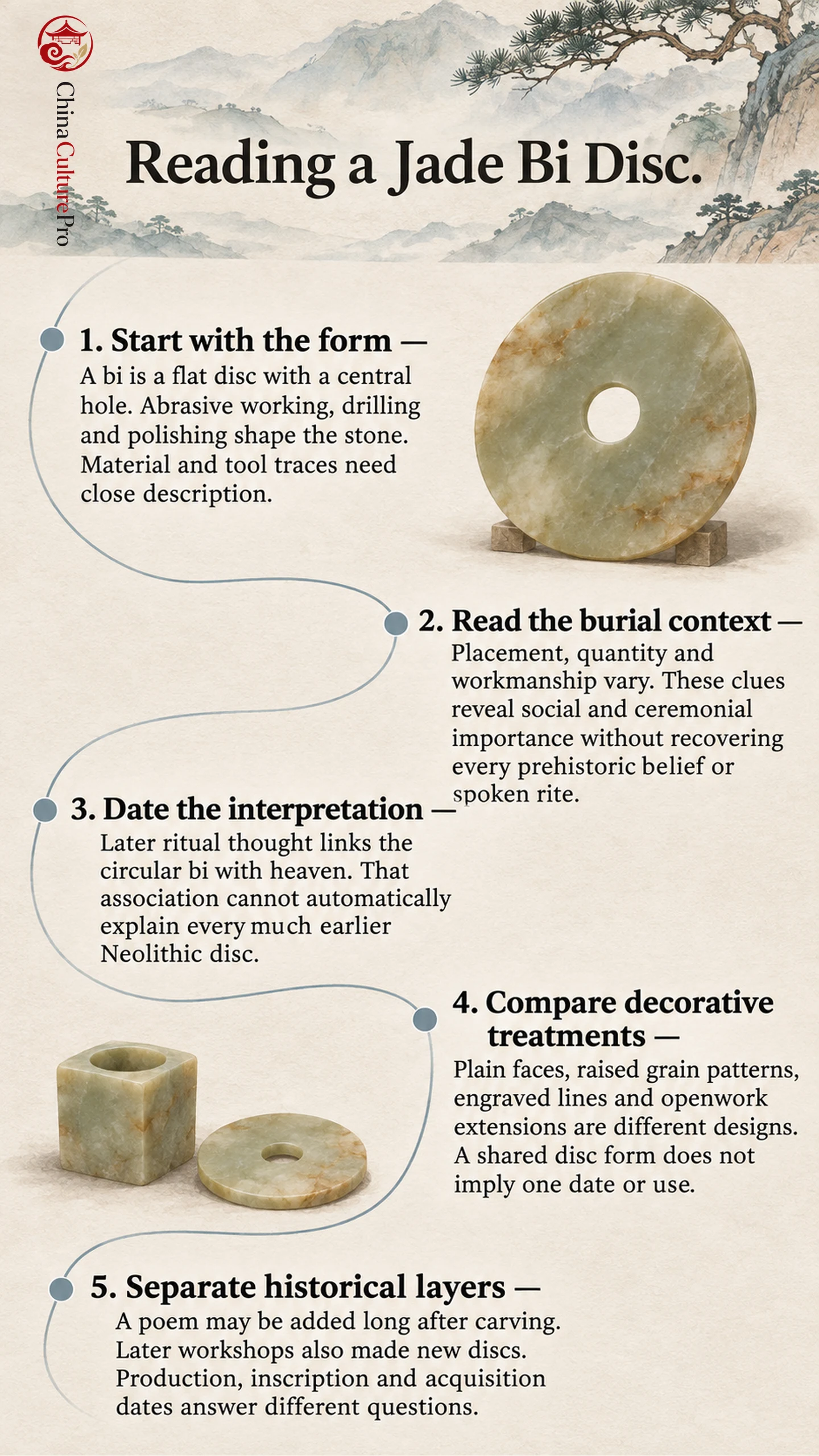
A broad circle of polished stone frames a small central opening. One disc is nearly plain, another carries rows of tiny raised spirals, and a third has writing along its edge. Within Chinese jade carving, bi discs combine a recognizable form with changing workmanship, decoration and cultural use.
A Flat Disc, Central Hole and Worked Stone
A bi is a disc, not a container. It differs from a cong(琮,cóng), a tube with a generally squared outer form and a circular opening. The guide to Chinese jade cong explores that contrasting shape and its own ritual questions.
Early bi were often worked in nephrite. The Smithsonian’s jade study describes cutting, grinding and polishing with abrasive minerals, with tubular drilling among the techniques proposed for making the central opening.[2] The smooth circle is the result of substantial stoneworking.
Marks can preserve evidence of that process. Drilling from opposite sides may leave an internal ridge if the holes do not meet evenly, while some surfaces retain traces of cutting or grinding.[2] These are useful observations about manufacture, not a visual shortcut for assigning every disc a date.
The museum record’s material description matters too. Nephrite and jadeite are distinct materials grouped under the English word jade. An object’s color alone does not provide its mineral identification.
Liangzhu Burials and the Limits of Interpretation
Many early bi are associated with Liangzhu culture. Their presence in substantial burials places them within social and ceremonial settings, but burial evidence does not reveal every spoken belief or action that accompanied them.
The National Museum of China describes differences in workmanship and placement: carefully finished pieces occur near the body, while other discs can be less regular and stacked toward the feet.[3] Those variations matter as much as the shared circular outline.
A group of discs in a tomb can suggest the resources invested in the burial and the importance attached to jade. It cannot tell us, by itself, the words of a ceremony or one fixed meaning for the central hole.
The same museum account explicitly notes that the function of Liangzhu bi remains debated.[3] Calling them ritual objects summarizes a context of use; it does not reconstruct a complete prehistoric religion from a polished stone.
Heaven Symbolism in Later Ritual Thought
The connection between bi and heaven belongs to an important later interpretive tradition. University of Michigan Museum of Art discusses the association of the circular bi with heaven and the squared cong with earth in the ritual text commonly known as the Rites of Zhou.[4]
A later text can explain how later writers classified ritual objects. It is not a transcript left by the Neolithic people who made much earlier discs. The difference is chronological: an ancient object may have acquired meanings over many centuries.
The Michigan account also discusses Han burial imagery in which dragons pass through a jade disc, suggesting an association with a journey toward the celestial realm.[4] The suggestion concerns that funerary imagery; it does not establish what every Liangzhu disc originally meant.
For readers, two questions are therefore useful: where was the object found, and which period supplies its interpretation? A shape may persist while its religious, social or commemorative role changes.
Grain Patterns, Dragons and Changing Designs
Bi discs are not all undecorated. Cleveland Museum of Art’s Warring States example has dense rows of raised dots with fine incised spirals, described as a grain pattern.[5] Its surface turns the broad annular area into a carefully ordered field of small forms.
The National Museum’s dragon-decorated disc shows another approach: the design is divided into zones, with geometric decoration toward the hole and dragon forms farther out. The museum also discusses later openwork designs extending beyond a disc’s circular perimeter.[6]
Decoration can thus alter both the surface and the outline while leaving the central disc recognizable. Compare the raised ornament, engraved line and openwork separately; they are different treatments of the stone.
Motifs describe the design; materials, construction and documented context help place it in time. The museum record brings these kinds of evidence together.
Qianlong Inscriptions and the Life of an Older Object
The Cleveland grain-pattern disc carries another historical layer: a poem at its outer rim dated to 1770 in the Qianlong reign.[5] The museum dates the disc itself to the Warring States period. Its manufacture and inscription therefore belong to very different moments.
A Fitzwilliam Museum bi likewise has an edge poem dated to 1769. That record also describes its worked surface and a hole drilled from one side.[7] The detail is a reminder that no single drilling arrangement applies to every object called bi.
Later workshops also made discs in an established form. The Met catalogues a nephrite disc as a Qing work of the Qianlong period.[8] An ancient-looking shape alone cannot distinguish an older object from a later creation.
Read the dates in an object record carefully: a carving date, an inscription date and a modern acquisition date answer different questions. A poem adds evidence about a disc’s reception without automatically resolving when the stone was first shaped.
FAQs About Jade Bi Discs
Does every bi disc represent heaven?
No. That is a later ritual association, not a proven original meaning for every prehistoric disc.
Are all bi discs plain?
No. Surviving examples include patterned surfaces, dragon decoration and openwork extensions.
Were all bi discs made in the Neolithic period?
No. The form continued through later periods, including the Qing dynasty.
Does an imperial poem date the whole disc?
No. The inscription may be much later than the disc it was added to.
Fuentes
[1] Metropolitan Museum of Art. Liangzhu Annular Disc, Nephrite, Mid-Third Millennium BCE
[2] Smithsonian National Museum of Asian Art. Liangzhu Jade Bi: Materials and Manufacture
[3] National Museum of China. Jade Bi: Form, Burial Evidence and Debated Functions
[4] University of Michigan Museum of Art. Bi: Later Ritual Interpretation and Burial Imagery
[5] Cleveland Museum of Art. Warring States Grain-Pattern Disc with a Later Imperial Poem
[6] National Museum of China. Dragon-Decorated Bi and Later Ornamental Forms
[7] Fitzwilliam Museum. Bi O.38-1946 with a Qianlong Poem Dated 1769
[8] Metropolitan Museum of Art. Nephrite Disc, Qing Dynasty, Qianlong Period