
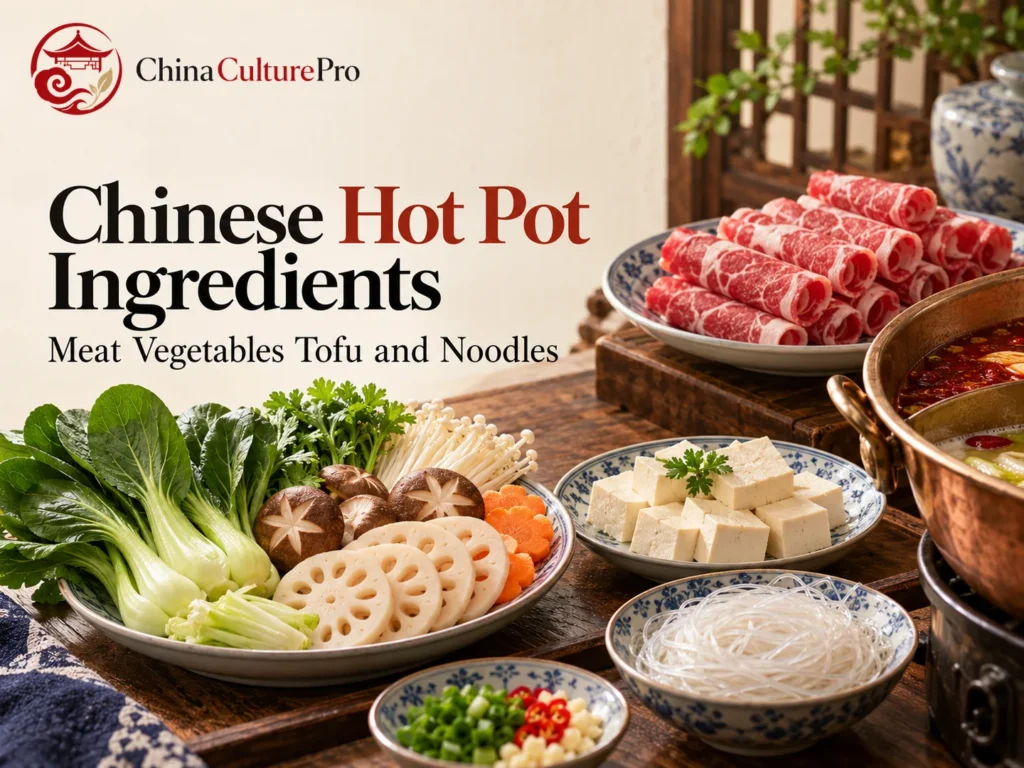

Quick Answer: What Ingredients Go in Chinese Hot Pot?
Chinese hot pot(火锅,huǒguō)can include sliced meat, seafood, vegetables, mushrooms, tofu(豆腐,dòufu)and noodles. The selection changes with the restaurant and regional style.
- Animal ingredients: Thin meat slices, fish, shellfish, offal and processed balls offer different textures.
- Plant ingredients: Greens, roots, mushrooms and soy foods bring variety beyond meat.
- Starches: Wheat noodles, rice products and glass noodles(粉丝,fěnsī)are distinct options, not interchangeable ingredient names.
There is no compulsory set or universal cooking time. Confirm what each plate contains, whether it is raw or precooked, and how the actual product should be prepared.
Rolled meat slices are easy to recognize, but a tray of pale cubes, folded sheets and springy balls can be less obvious. Names may identify a food, a compound product or simply a shape. The Chinese hot pot overview explains the meal; this guide helps identify what goes into it.
Hot Pot Ingredient Families at a Glance
Use these families to read a menu, rather than as a shopping quota. Restaurants may specialize in one group while offering only a small selection of others.[1]
| Ingredient family | Ejemplos habituales | Texture or identification clue |
|---|---|---|
| Sliced meat and offal | Beef, lamb, pork, poultry, tripe | Thin slices differ from thicker pieces and textured offal; marbling varies |
| Seafood | Fish slices, shrimp, squid, shellfish | Whole seafood differs from molded seafood products |
| Meat and seafood products | Beef balls, fish balls, shrimp paste | Springy or smooth minced mixtures; fillings and binders vary |
| Vegetables and mushrooms | Cabbage, leafy greens, lotus root, potato, shiitake, enoki | Leaves, firm roots and fungi retain different textures |
| Soy foods | Tofu blocks, frozen tofu, tofu puffs, bean curd sheets | Smooth, porous, spongy or layered forms |
| Noodles and other starches | Wheat noodles, rice noodles, starch noodles, rice cakes | Composition and product state matter more than shape alone |
The table separates fresh ingredients from compound products. A fish slice is identifiable fish; a fish ball is a mixture whose other ingredients need checking. Likewise, a plain tofu cube and a cube sold as “fish tofu” should not be assumed to have the same composition.
Recognizing Tofu, Noodles and Processed Seafood
Firm tofu is comparatively easy to lift intact. Softer tofu needs gentler handling. Frozen-and-thawed tofu develops a more porous, sponge-like texture, offering a different bite from a smooth fresh block.[2] Fried puffs and bean curd sheets add further contrasts; the Chinese tofu types guide explains the wider family.
Fuzhu(腐竹,fǔzhú)is a dried bean curd skin product, often sold as sticks. It is not a wheat noodle. Fresh sheets, dried sticks and fried rolls are different products even when menus loosely group them as tofu skin. Their preparation requirements should follow the actual product, not a shared English label.
Fish tofu is a seafood product name, not a guarantee of a meat-free tofu dish. Commercial hot pot ranges distinguish fish tofu, seafood bean curd rolls, fish balls and prawn paste products. Even closely related products can have different fillings and binders.[3]
For noodles, separate material from width. Chinese noodles include wheat and rice varieties as well as starch-based products. Glass noodles are starch noodles; thin strands do not prove that they are pure mung bean. One manufacturer, for example, lists potato, tapioca, corn and pea starch in a vermicelli product.[4]
Fresh, dried, chilled and instant noodles can require different treatment. A wide translucent strip does not tell you which starch it contains or whether it is ready for the pot. Use the package or the restaurant’s information.
Choosing a Varied Table Without a Fixed Shopping List
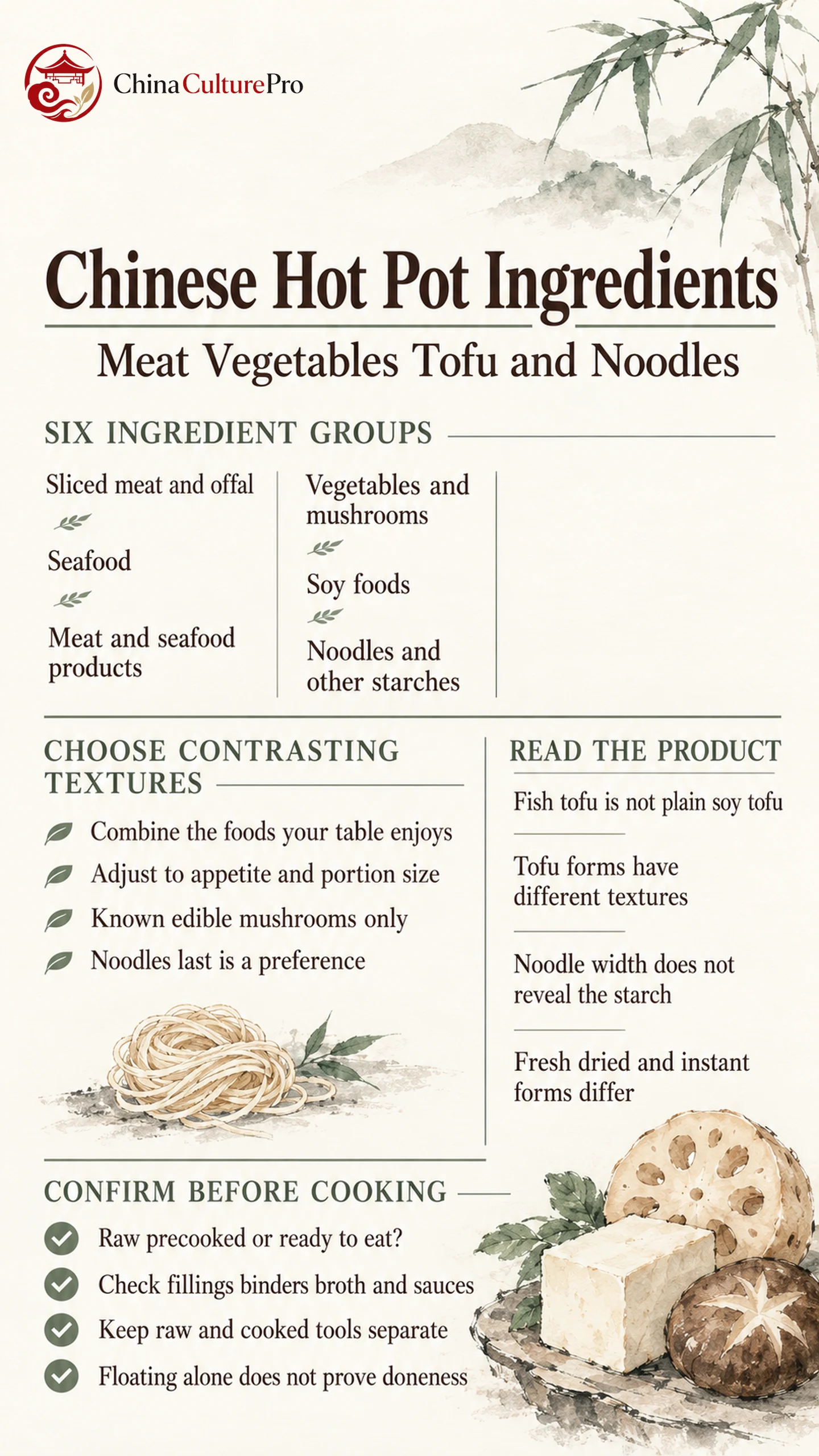
Think about contrasting textures: a tender slice, a leafy vegetable, a firm root, a soy food and a starch can make a varied selection. Adapt that selection to the table. Group size, appetite, portion size and dietary needs determine the actual order.
Vegetables include more than leaves. Lotus root, potato, corn and winter melon behave differently from cabbage or spinach. Mushrooms also vary: enoki brings slender clusters, shiitake a firmer cap, and king oyster mushrooms a denser bite. Use the Chinese mushrooms guide for identification; choose known, properly sourced edible varieties.
Broth and dipping sauces provide additional flavor, so there is no need for every plate to be strongly seasoned beforehand. Check the cooking liquid as well: plain ingredients share whatever the broth contains.
Some tables save noodles for later, when the broth has developed more flavor. That is a dining preference, not a rule applying to every noodle or every meal.[6] Manage portions so the pot remains workable instead of adding all the starches and vegetables at once.
Raw, Cooked and Dietary Checks
Before adding an unfamiliar item, establish its status and composition:
- Raw or precooked: Precooked and fried products may still need further heating. Confirm the specific product’s instructions; surface appearance does not establish readiness.
- Compound ingredients: Balls, dumplings, seafood pastes and stuffed tofu products can include more than the ingredient named on the menu. Confirm fillings, binders and seasoning.
- Whole-meal restrictions: Soy foods contain soy; wheat noodles contain wheat; sauces and broth may add further ingredients. A vegetable selection cooked in meat stock is not a vegetarian meal.
The vegetarian food guide helps frame those whole-dish questions. Explain any allergy to staff before selecting a broth and shared cooking arrangement.
Keep raw meat and seafood separate from ready-to-eat food, plates and utensils. Cook ingredients thoroughly, avoid overcrowding, and wait for the broth to return to a full boil after a refill before continuing. Floating, curling or changing color is not a universal safety test.[5] The hot pot eating guide covers the table sequence without assigning one timer to every ingredient.
FAQs About Chinese Hot Pot Ingredients
Are fish balls and fish tofu vegetarian?
Ordinary versions contain fish or other seafood. The word tofu in a product name does not establish that it is a plain soy food. Check the specific label.
Are glass noodles made from rice?
No. They are starch noodles, made from ingredients such as beans or tubers, sometimes in blends. Rice noodles belong to a different ingredient group.
Must noodles always go in last?
No. Many tables finish with noodles, but the order depends on the product and the diners. Follow the preparation needs of the actual noodles.
Does floating mean a meatball is safely cooked?
No. Floating alone cannot establish that its center is thoroughly cooked. Product instructions and proper cooking matter more than that visual cue.
Fuentes
[1] Sarah Leung. Chinese Hot Pot at Home
[2] House Foods. Premium Firm Tofu
[3] EB Food. Hot Pot Series
[4] Sunright Foods. Vermicelli Product Ingredients
[5] Centre for Food Safety. Hot Pot Food Safety Advice
[6] Hunter Lu. Chinese Hot Pot Guide