
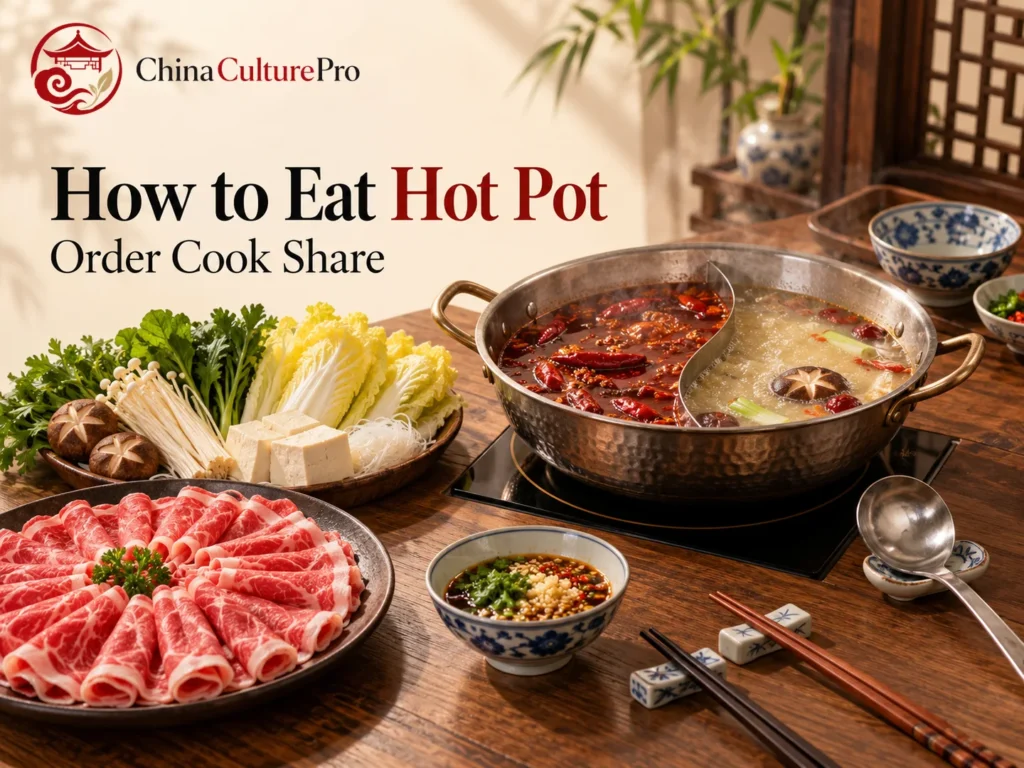

Quick Answer: How Do You Eat Hot Pot?
To eat Chinese hot pot(火锅,huǒguō), choose the broth, order a manageable selection of ingredients, prepare a personal dip, then cook and eat in batches around the heated pot.
- Before cooking: Agree on dietary needs, broth preferences and the restaurant’s ordering system.
- At the pot: Keep raw-food tools separate from utensils for retrieving cooked food and eating.
- Before eating: Ensure the actual ingredient is thoroughly cooked; a boiling pot is not a universal timer.
The sequence is flexible. Safety requirements matter more than a supposed rule that every table must cook the same ingredient first.

At a hot pot restaurant, the food arrives in stages and the table helps finish the cooking. Begin by identifying raw-food tools, agreeing what is shared and asking staff about unfamiliar ingredients. The Chinese hot pot overview explains the regional range behind this format.
Before Ordering: Agree on the Pot and the Menu
Tell staff about allergies and dietary restrictions before choosing the broth. Check stock, cooking fat and seasonings as well as the visible ingredients. The Chinese vegetarian food guide explains why a mushroom or tomato name alone does not confirm a plant-based base.
Discuss heat with the whole table. Mala(麻辣,málà)combines chili heat and peppercorn tingling. A yuanyang(鸳鸯锅,yuānyāng guō)divided pot can offer contrasting broths, but shared ladles and splashes mean it is not a dependable allergy barrier. Weila(微辣,wēilà)means mildly spicy on a menu; its intensity is not standardized between kitchens.
Choose by the meal you want: Beijing hot pot offers a different broth-and-lamb emphasis from the red-broth traditions discussed in Sichuan versus Chongqing hot pot.
Finally, confirm the ordering model. Is it à la carte, a set, or all-you-can-eat? Does the quantity mean a whole plate or a smaller portion? Ask about broth, sauce-station and other charges on the actual menu. Start small enough to judge portion sizes before reordering.
From First Order to First Bite
Use this sequence for a first visit, adapting it to staff instructions and the chosen ingredients.
- Choose an initial selection: Order contrasting ingredients such as a meat or seafood option, tofu, vegetables and a starch, adjusted for the table’s diet. Use the hot pot ingredients guide to identify unfamiliar items. Menus commonly separate these families.[1]
- Prepare your dip and tools: Make a small personal dipping bowl or choose a supplied sauce. The dipping sauces guide explains the options. Identify raw-food tongs or cooking chopsticks, a clean retrieval utensil and your own eating utensils before handling food.
- Wait for the pot to be ready: Let staff set up the heat source and confirm when to begin. Keep raw plates separate from ready-to-eat dishes. Add a manageable batch so ingredients can move in the liquid and you can track them.
- Cook and retrieve deliberately: Separate clumped slices, keep track of dense or filled items, and follow ingredient-specific guidance. Retrieve food only after it is thoroughly cooked, using a clean utensil that has not just handled raw meat.
- Dip, eat and repeat: Transfer the cooked food to your bowl, add your personal seasoning and let a very hot bite cool before eating. Finish the current batch before crowding the pot with another round. Add more food when the table actually wants it.
There is no official national sequence requiring all proteins before all vegetables. Different ingredients need different handling, and diners may coordinate individual portions or cook batches for everyone.[2]
Cooking Safely Without a Universal Timer
Thickness, starting temperature, whether food is raw or precooked, the amount added and the heat of the pot all affect cooking. Dense balls, filled dumplings, poultry, seafood and offal cannot be assigned the same quick dip as a thin slice. Ask staff about the actual product instead of borrowing a timing rhyme from another ingredient.
Avoid overfilling the pot. After a refill or a large cold addition, wait for the liquid to recover its heat; do not assume food is ready merely because it has been in the pot while the broth cooled. Separate raw and cooked food and do not dip a cooked bite into unpasteurized raw egg.[3]
Color change alone cannot establish safe cooking. A food thermometer is the dependable way to verify an appropriate internal temperature, rather than judging meat only by whether it looks brown or white. At a restaurant, ask staff to help confirm cooking when the ingredient or method is unfamiliar.[4]
For Yunnan mushroom hot pot, follow guidance for the identified ingredients and avoid unfamiliar wild species. Neither an attractive appearance nor an online cooking time makes an unknown mushroom safe.[5]
Shared-Table Etiquette and the End of the Meal
The practical rule is to communicate before changing a shared pot. Ask before adding a large batch, seafood or a strongly flavored ingredient. If another diner is tending a particular piece, ask before taking it; some batches are communal and others are being cooked for one person.[2]
Keep personal sauce bowls personal. Use a clean spoon at a shared sauce station, and return shared tools to stable rests rather than leaving them in raw-food juices or a used eating bowl. Keep the raw-food tool on its designated rest rather than setting it in a cooked-food bowl.
Ask staff for broth refills and help with unfamiliar burner controls. Keep sleeves, phones and napkins away from the hot surface. Near the end, check whether anyone wants more before placing another order. In an all-you-can-eat setting, confirm last-order and unfinished-food rules instead of assuming all restaurants apply the same policy.
FAQs About Eating Hot Pot
Should meat or vegetables go in first?
There is no universal cultural requirement. Coordinate batches around the actual ingredients and their cooking needs; avoid adding everything at once.
Can I use one pair of chopsticks for everything?
Keep raw-food handling separate from retrieving cooked food and eating. Use the designated tools or ask staff for additional utensils rather than moving the same contaminated pair between roles.
Can I drink the broth?
Some bases are served for sipping, while rich red cooking broths may be unsuitable for that purpose. Ask staff, and use a clean ladle only when the broth is fully heated after raw additions.
What if the broth is too spicy?
Ask about a milder base or use the mild compartment agreed on by the table. Adding extra oil or dip does not remove the chili already in the cooking liquid.
Fuentes
[1] Super Hi International. Menu and Ingredients: Company Filing
[2] Deanna Ting / Resy. A Chef’s Guide to Asian-Style Hot Pot
[3] Centre for Food Safety. Hotpot Safety at Restaurants
[4] USDA FSIS. Can You Tell If Meat Is Safely Done by Its Color?
[5] Yunnan Health Commission. Safe Mushroom Consumption